

Daily Devotional
Saturday, April 21, 2029 (NS), April 8, 2029 (OS)
No Fasting.
Saturday of the Second Week
The commemoration of the holy Apostles Herodion, Agavos, Rufus, Phlegon, Asyncritos, and Hermes of the Seventy, and those with them.
Scripture Readings
Paschalion — Movable Calendar
Saturday of the Second Week
Epistle
The Reading is from the Acts of the Apostles [§ 15]. In those days:
5 21The apostles, having heard that, entered into the temple during the early morning and began teaching. But the high priest came and those with him, and they called together the sanhedrin and all the council of elders of the sons of Israel, and sent off to the prison to have them brought. 22But after the officers came and found them not in the prison, they returned and reported, 23saying, “Indeed we found the prison shut with all security, and the guards standing outside before the doors; but after we opened them, we found no one inside.” 24Now when the priest and the captain of the temple-guard and the chief priests heard these words, they were quite at a loss concerning them and what this would become. 25But a certain one came and reported to them, saying, “Behold, the men whom ye yourselves put in the prison are standing in the temple and teaching the people.” 26Then the captain went with the officers and brought them without violence, for they were fearing the people, lest they should be stoned. 27And after they brought them, they stood them in the sanhedrin. And the high priest questioned them, 28saying, “We did charge you by a command not to teach on this name, did we not? And behold, ye have made Jerusalem full of your teaching, and intend to bring the blood of this Man upon us.” 29But Peter and the apostles answered and said, “It is needful to obey God rather than men. 30“The God of our fathers raised up Jesus, Whom ye yourselves laid hands upon and hanged on a tree. 31“This One did God exalt with His right hand to be a Prince and Savior, to give repentance to Israel and forgiveness of sins. 32“And we are His witnesses of these words, and also the Holy Spirit Whom God gave to those who obey Him.” 33Now after they heard that, their hearts were sawn asunder, and they were taking counsel to kill him.
Gospel
The Reading is from the Holy Gospel according to Saint John [§ 19]. At that time:
6 14The people, having seen what sign Jesus did, began to say, “This is truly the Prophet Who cometh into the world.” 15Then Jesus, having known that they were about to come and seize Him in order that they might make Him king, withdrew again to the mountain Himself alone.
16And when it became evening, His disciples went down to the sea; 17and having embarked into the ship, they were going across the sea to Capernaum. And already it had become dark, and Jesus had not come to them. 18And the sea was stirred up by a great wind blowing. 19Then after they had rowed about twenty-five or thirty stadia, they see Jesus walking on the sea and drawing near to the ship; and they became afraid. 20But He saith to them, “I am; cease being afraid.” 21Then they were willing to receive Him into the ship; and straightway the ship came to be at the land to which they were going.
22On the morrow, the crowd which stood on the other side of the sea saw that there was no other boat there, except that one into which His disciples entered, and that Jesus did not enter together with His disciples into the little boat, but that His disciples went away alone— 23but there came little boats from Tiberias, near the place where they ate the bread after the Lord gave thanks. 24When the crowd therefore saw that Jesus was not there, nor His disciples, they themselves also embarked into the ships and came to Capernaum, seeking Jesus. 25And after they found Him on the other side of the sea, they said to Him, “Rabbi, when didst Thou arrive here?” 26Jesus answered them and said, “Verily, verily, I say to you, ye seek Me, not because ye saw signs, but because ye ate of the loaves and were filled. 27“Cease working for the meat which perisheth, but for the food which abideth to everlasting life, which the Son of Man shall give to you; for this One did God the Father seal.”
Menaion — Fixed Calendar
The commemoration of the holy Apostles Herodion, Agavos, Rufus, Phlegon, Asyncritos, and Hermes of the Seventy, and those with them.
No readings given.
Lives of the Saints (Prologue)
April 21st – Civil Calendar
April 8th – Church Calendar
1. The Holy Apostles Herodion, Agabus, Rufus, Asyncritus, Phlegon and Hermas.
They were all among the Seventy, and are all mentioned by St. Paul in his Epistles. Herodion was a kinsman of Paul’s: ‘Salute Herodion my kinsman,’ he writes to the Romans (16:11). Herodion suffered greatly at the hands of the Jews as Bishop of Neoparthia; he was beaten about the head, stoned on the mouth and stabbed in the legs. When they had left him for dead, St. Herodion arose and continued to serve the apostles. He helped the Apostle Peter in Rome, and was beheaded along with many other Christians on the same day that St. Peter was crucified.
St. Agabus had a spirit of prophecy. Two of his prophecies are recorded in the Acts of the Apostles. First, he prophesied a great famine throughout the world, which came to pass in the time of Claudius Caesar (Acts 11:28). The second was when he met the Apostle Paul in Caesarea. Paul was on his way to Jerusalem, and Agabus took St. Paul’s girdle and bound himself hand and foot, saying: ‘Thus saith the Holy Spirit: so shall the Jews at Jerusalem bind the man that owneth this girdle’ (21:11).
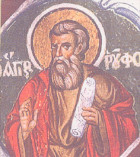 St. Rufus was Bishop of Thebes in Greece. The Apostle Paul
mentions him also: ‘Salute Rufus, chosen in the Lord’ (Rom. 16:13). St. Rufus was Bishop of Thebes in Greece. The Apostle Paul
mentions him also: ‘Salute Rufus, chosen in the Lord’ (Rom. 16:13).
|
St. Asyncritus (Rom. 16:14) was Bishop of Hyrcania in Asia.
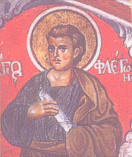 St. Phlegon, who is mentioned in the same place as St.
Rufus, was bishop in the Thracian city of Marathon. St. Phlegon, who is mentioned in the same place as St.
Rufus, was bishop in the Thracian city of Marathon.
|
St. Hermas, mentioned with the others, was bishop in Dalmatia.
All these, with bee-like industry, spread the Gospel, suffering greatly for the love of Christ. They all went to the eternal kingdom of their beloved Christ.
2. St. Niphon, Bishop of Novgorod.
He was adorned with zeal in the building and repairing of churches and with great courage in opposing tyrannical princes. Thirteen days before his death, St. Theodosius appeared to him and predicted his imminent departure to the other world. He entered into rest in 1156.
3. St. Celestine, Bishop of Rome.
A great zealot for the Orthodox Faith, he wrote an epistle against the Nestorian heresy at the time of the Third Ecumenical Council. He entered peacefully into rest in 432.
FOR CONSIDERATION
There is a heroism that is more than heroism, and an asceticism that is more than asceticism. St. Epiphanios of Cyprus once invited Hilarion the Great to lunch, and to show even greater honor to his guest, brought baked chicken to the table and offered it to him. Hilarion said to him: ‘Please excuse me; from the time I became a monk I have eaten nothing slaughtered.’—to which Epiphanios retorted: ‘And I, since becoming a monk, have never lain down on my bed without forgiving all my enemies!’ Hilarion exclaimed in wonder: ‘Yours, holy bishop, is a greater virtue than mine.’ This is an important teaching for us all. Fasting is a thing of primary importance, but forgiveness of insults is greater. A man trains himself by fasting for greatness of soul, and shows this greatness of soul by forgiveness. The latter surpasses the former, but is not attained without the former.
Daily Scripture Readings taken from The Orthodox New Testament, translated and published by Holy Apostles Convent, Buena Vista, Colorado, copyright © 2000, used with permission, all rights reserved.
Daily Prologue Readings taken from The Prologue of Ochrid, by Bishop Nikolai Velimirovic, translated by Mother Maria, published by Lazarica Press, Birmingham, England, copyright © 1985, all rights reserved. Edited by Dormition Skete.