

Daily Devotional
Saturday, March 31, 2029 (NS), March 18, 2029 (OS)
Fast Day, but Shellfish, Wine and Olive Oil Allowed.
Holy & Great Fast
| Saturday of the Holy and Righteous Lazarus |

The commemoration of our holy father among the saints, Kyril, Archbishop of Jerusalem.
Scripture Readings
Paschalion — Movable Calendar
Saturday of the Holy and Righteous Lazarus
Epistle
The Reading is from the Epistle of Saint Paul to the Hebrews [§ mid 333]. Brethren:
12 28Since we are receiving an unshakable kingdom, let us be having gratitude by which we may worship God well pleasingly with reverence and piety. 29For also, “Our God is a consuming fire [cf. Deut. 4:24].”
13 1Let brotherly love abide. 2Cease being forgetful of hospitality, for by this some entertained angels unawares. 3Be mindful of those in bonds as bound with them, of those being ill-treated as being yourselves also in the body. 4Marriage is honorable in all, and the bed undefiled; but fornicators and adulterers God will judge. 5Let your manner of life be without covetousness, being satisfied with things at hand; for He hath said, “In no wise will I leave thee, nor in any wise will I abandon thee [cf. Deut. 31:6].” 6So that being of good courage we may say, “The Lord is a helper to me, and I will not be afraid; what shall man do to me [cf. Ps. 117(118):6]?”
7Be remembering those who lead you, who spoke to you the word of God, whose faith keep on imitating, observing attentively the end of their conduct: 8Jesus Christ, the same yesterday and today and to the ages.
Gospel
The Reading is from the Holy Gospel according to Saint John [§ 39]. At that time:
11 1There was a certain sick man, Lazarus of Bethany, of the village of Mary and her sister Martha. 2And it was that Mary who anointed the Lord with perfumed ointment and wiped His feet with her hair, whose brother Lazarus was sick. 3Therefore the sisters sent to Him, saying, “Lord, behold, he whom Thou lovest is sick.” 4And after Jesus heard that, He said, “This sickness is not to death, but for the glory of God, in order that the Son of God might be glorified by it.” 5Now Jesus loved Martha and her sister and Lazarus. 6When He heard therefore that “he is sick,” then indeed He remained in the place which He was for two days. 7Then after this He saith to His disciples, “Let us go into Judæa again.” 8The disciples say to Him, “Rabbi, just now the Jews were seeking to stone Thee, and goest Thou there again?” 9Jesus answered, “There are twelve hours in the day, are there not? If anyone walk about in the day, he stumbleth not, because he seeth the light of this world; 10“but if anyone walk about in the night, he stumbleth, because the light is not in him.” 11These things He said, and after this He saith to them, “Our friend Lazarus hath fallen asleep; but I go that I might awaken him.” 12Then said His disciples, “Lord, if he hath fallen asleep, he shall recover.” 13But Jesus had spoken about his death; but they thought that He spoke about taking rest in sleep. 14Therefore Jesus then said to them openly, “Lazarus died. 15“And I rejoice on your account that I was not there, in order that ye might believe; but let us go to him.” 16Then Thomas, the one who was called Didymos, said to his fellow disciples, “Let us also go, that we might die with Him.”
17Then after Jesus came, He found that he already had been in the sepulcher four days. 18Now Bethany was nigh to Jerusalem, about fifteen stadia away, 19and many of the Jews had come to join the women around Martha and Mary, in order that they might console them concerning their brother. 20Then Martha, when she heard that “Jesus is coming,” went to meet Him; but Mary was sitting in the house. 21Then Martha said to Jesus, “Lord, if Thou wert here, my brother would not have died. 22“But even now I know that whatsoever Thou Thyself shalt ask of God, God will give it to Thee.” 23Jesus saith to her, “Thy brother shall rise up.” 24Martha saith to Him, “I know that he shall rise up in the resurrection in the last day.” 25Jesus said to her, “I am the resurrection and the life. The one who believeth in Me, though he die, he shall live; 26“and everyone who liveth and believeth in Me, in no wise shall ever die. Believest thou this?” 27She saith to Him, “Yea, Lord, I have believed that Thou art the Christ, the Son of God, Who cometh into the world.” 28And after she said these things, she went away and called Mary her sister secretly, and saith, “The Teacher is present and calleth thee.” 29And the latter, when she heard, rose up quickly and came to Him. 30Now Jesus had not yet come into the village, but was in the place where Martha went to meet Him. 31The Jews then who were with her in the house, and consoling her, after they saw that Mary quickly rose up and went out, followed her, saying, “She is going to the sepulcher that she might weep there.” 32Then when Mary came where Jesus was, and saw Him, she fell at His feet, saying to Him, “Lord, if Thou wert here, my brother would not have died.” 33When Jesus therefore saw her weeping, and the Jews who came down with her weeping, He rebuked His deep feelings in the spirit and troubled Himself, 34and said, “Where have ye laid him?” They said to Him, “Lord, come and see.” 35Jesus wept. 36Then the Jews were saying, “Behold, how He was loving him.” 37But some of them said, “Was not this One able, Who opened the eyes of the blind, to have caused that this one should not die?” 38Then Jesus, again rebuking His deep feelings in Himself, cometh to the sepulcher. Now it was a cave, and a stone was lying upon it. 39Jesus saith, “Take away the stone.” Martha, the sister of the one who was dead, saith to Him, “Lord, already he stinketh, for it is the fourth day.” 40Jesus saith to her, “I said to thee that if thou wouldest believe, thou shouldest see the glory of God, did I not?” 41Then they took away the stone where the dead one was laid. And Jesus lifted His eyes upwards, and said, “Father, I give thanks to Thee that Thou heardest Me. 42“But I know that Thou hearest Me always; but on account of the crowd which stood around I said it, that they might believe that Thou didst send Me forth.” 43And after He said these things, He cried with a loud voice, “Lazarus, come forth.” 44And the one who was dead came forth, his feet and hands having been bound with graveclothes; and his face had been bound about with a napkin. Jesus saith to them, “Loose him, and let him go.”
45Then many of the Jews who came to Mary, and saw what Jesus did, believed in Him.
Menaion — Fixed Calendar
The commemoration of our holy father among the saints, Kyril, Archbishop of Jerusalem.
Epistle
The Reading is from the Epistle of Saint Paul to the Hebrews [§ 334]. Brethren:
13 7Be remembering those who lead you, who spoke to you the word of God, whose faith keep on imitating, observing attentively the end of their conduct: 8Jesus Christ, the same yesterday and today and to the ages. 9Cease being carried about by various and strange teachings. For it is good for the heart to be confirmed by grace, not by foods, in which those walking therein were not profited. 10We have an altar from which those serving the tabernacle have no authority to eat; 11for the bodies of those animals, “whose blood is being brought into the holies for sins” by the high priest, “are being burned outside of the encampment [cf. Lev. 16:27].” 12Wherefore Jesus also, that He might sanctify the people by His own blood, suffered outside of the gate. 13Let us be going forth therefore to Him outside of the encampment, bearing His reproach; 14for we have no abiding city here, but we seek the coming one. 15Through Him, then, let us be offering up a “sacrifice of praise [Lev. 7:2(12)]” continually to God, that is, “the fruit of the lips [cf. Hos. 14:3(2); Is. 57:19],” giving thanks to His name. 16But cease being forgetful of doing good and of contributing; for God is well pleased with such sacrifices.
Gospel
The Reading is from the Holy Gospel according to Saint Matthew [§ 11]. The Lord said to His disciples:
5 14“Ye are the light of the world. A city situated on the top of a mountain cannot be hid. 15“Nor do they light a lamp and put it under the bushel, but upon the lampstand, and it giveth light to all those in the house. 16“Thus, let your light shine before men, that they might see your good works, and might glorify your Father Who is in the heavens.
17“Do not begin to think that I came to abolish the law or the prophets; I came not to abolish, but to fulfill. 18“For verily I say to you, until the heaven and the earth shall have passed away, one iota or one tittle in no wise shall pass away from the law, until all shall have taken place. 19“Whosoever then shall break one of the least of these commandments, and shall teach men so, he shall be called least in the kingdom of the heavens; but whosoever shall do and teach them, this one shall be called great in the kingdom of the heavens.”
Lives of the Saints (Prologue)
March 31st – Civil Calendar
March 18th – Church Calendar
1. St. Kyril, Archbishop of Jerusalem.
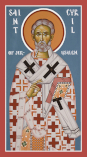 Born in Jerusalem in the time of Constantine the
Great, he died in 386, in the time of Theodosios the Great. He was ordained priest in 346, and in
350 succeeded the blessed Patriarch Maximus on the patriarchal throne of Jerusalem. He was three
times deposed from his throne and sent into exile; until in the end, in the time of Theodosios,
he did not return but lived a further eight years in peace and gave his soul to the Lord. He had
two great struggles: one against the Arians, who became strong under Constantius,
Constantine’s son, and the other in the time of Julian the Apostate, with this renegade and
with the Jews. In a time of Arian domination, at Pentecost, the sign of the Cross, brighter than
the sun, appeared stretching over Jerusalem and the Mount of Olives and remained for several
days. A letter was sent to the Emperor Constans about this happening, which was seen by all
living in Jerusalem, and this served for the strengthening of Orthodoxy against the heretics. In
the time of the Apostate, another sign took place. In order to humiliate the Christians, Julian
arranged with the Jews for them to rebuild the Temple of Solomon. Kyril prayed to God that this
should not happen. And there was a terrible earthquake which destroyed all that had been
newly-built. The Jews began again, but again there was an earthquake, which destroyed not only
the new building but also the old stones that were still in place beneath the earth. And so the
words of the Lord came true: ‘Not one stone shall remain on another.’ Of this
saint’s many writings there has been kept his ‘Catecheses,’ a first-class work,
which sets out the Faith and practice of Orthodoxy to the present day. A rare arch-pastor and a
great ascetic, he was meek, humble, worn out by fasting and pale of face. After a life of great
labor and knightly battle for the Orthodox Faith, he entered peacefully into rest and went to the
eternal courts of the Lord.
Born in Jerusalem in the time of Constantine the
Great, he died in 386, in the time of Theodosios the Great. He was ordained priest in 346, and in
350 succeeded the blessed Patriarch Maximus on the patriarchal throne of Jerusalem. He was three
times deposed from his throne and sent into exile; until in the end, in the time of Theodosios,
he did not return but lived a further eight years in peace and gave his soul to the Lord. He had
two great struggles: one against the Arians, who became strong under Constantius,
Constantine’s son, and the other in the time of Julian the Apostate, with this renegade and
with the Jews. In a time of Arian domination, at Pentecost, the sign of the Cross, brighter than
the sun, appeared stretching over Jerusalem and the Mount of Olives and remained for several
days. A letter was sent to the Emperor Constans about this happening, which was seen by all
living in Jerusalem, and this served for the strengthening of Orthodoxy against the heretics. In
the time of the Apostate, another sign took place. In order to humiliate the Christians, Julian
arranged with the Jews for them to rebuild the Temple of Solomon. Kyril prayed to God that this
should not happen. And there was a terrible earthquake which destroyed all that had been
newly-built. The Jews began again, but again there was an earthquake, which destroyed not only
the new building but also the old stones that were still in place beneath the earth. And so the
words of the Lord came true: ‘Not one stone shall remain on another.’ Of this
saint’s many writings there has been kept his ‘Catecheses,’ a first-class work,
which sets out the Faith and practice of Orthodoxy to the present day. A rare arch-pastor and a
great ascetic, he was meek, humble, worn out by fasting and pale of face. After a life of great
labor and knightly battle for the Orthodox Faith, he entered peacefully into rest and went to the
eternal courts of the Lord.
2. St. Aninus the Wonder-worker.
Born in Chalcedon, he was little of stature, like Zaccheus, but great in spirit and faith. He denied himself to the world at the age of fifteen and settled near the River Euphrates in a little hut, where he repented for his sins and prayed to God, at first with his teacher Mayum and then, after Mayum’s death, alone. By the power of his prayers he filled an empty well with water, healed the sick of various pains and tamed wild beasts. There was a tamed lion with him as his servant. He had insight into distant happenings. When robbers attacked a stylite, Pionius, at some distance from him, and beat him up to such an extent that he decided to come down from his pillar and go to complain to the judges, St. Aninus saw his intention in his soul and sent him a letter by means of his lion, telling him to set aside his intention, to forgive his assaulters and to continue in his asceticism. He was inexpressibly generous. The bishop of Neocaesarea made a gift to him of a donkey, to ease his carrying of water from the river, but he gave this donkey to some poor man who had complained to him of his poverty. The bishop gave him a second donkey, but he gave that away, too. Then the bishop gave him a third donkey, not for his own but only to serve as a water-carrier, to be kept and returned. At the time of his death, he saw Moses, Aaron and Or coming to him and calling: ‘Aninus, the Lord is calling you. Get up and come with us.’ This he revealed to his disciples, and gave his spirit to the Lord Whom he had served so faithfully. He was 110 years old when he finished his earthly course.
FOR CONSIDERATION
There are malicious people who think that time has brought Christ glorification, and that in the first ages of Christianity the Lord was not thought of so highly as in later ages. There is nothing easier than to shatter this untruth. Here is how St. Kyril of Jerusalem writes of the Lord Christ: ‘This is He Who is and He Who was, coessential with the Father, only-begotten, only-enthroned, equal in power, almighty, without beginning, uncreated, unchangeable, indescribable, invisible, inexpressible, incomprehensible, immense, unthinkable, uncircumscribed. He is “the brightness of the glory of the Father” (Heb. 1:3). He is the Creator of the substance of all created things. He—the Light of light—shines from the bosom of the Father. He is the God of gods (Ps. 49:1), and God of God, Who gives us the knowledge of Himself. He is the Well of life (Ps. 35:10), flowing forth from the Father’s well of life. He is the River of God (Ps. 45:5; 64:10), which comes forth from the infinity of God but is not separated from Him. He is the treasury of the Father’s good gifts and endless blessings. He is the living Water (Jn. 4:14) that gives life to the world. He is the uncreated Ray that is begotten but not cut off from the primal Sun. He is God the Logos (Jn. 1:1), Who with one word brought all things from non-being into being.... This is He Who created us in the image of God, and has now made Himself man in our image; man, but at the same time God.’ And today, sixteen centuries after this confession of faith was written, the Orthodox Church holds the same faith, word for word and letter for letter.
Daily Scripture Readings taken from The Orthodox New Testament, translated and published by Holy Apostles Convent, Buena Vista, Colorado, copyright © 2000, used with permission, all rights reserved.
Daily Prologue Readings taken from The Prologue of Ochrid, by Bishop Nikolai Velimirovic, translated by Mother Maria, published by Lazarica Press, Birmingham, England, copyright © 1985, all rights reserved. Edited by Dormition Skete.