

Daily Devotional
Saturday, March 3, 2029 (NS), February 18, 2029 (OS)
Fast Day, but Shellfish, Wine and Olive Oil Allowed.
Holy & Great Fast
The Saturday of the Second Week of the Great Fast
The commemoration of our holy father among the saints, Leo, Pope of Rome.
Scripture Readings
Paschalion — Movable Calendar
The Saturday of the Second Week of the Great Fast
Epistle
The Reading is from the Epistle of Saint Paul to the Hebrews [§ 309].
3 12Brethren, be taking heed, lest ever there shall be in any one of you an evil heart of unbelief in apostatizing from the living God; 13but be exhorting one another every day, as long as it is being called “Today,” lest any of you be hardened by the deceit of sin. 14For we have become partakers of Christ, if indeed we should hold fast the first principle of our subsistence firm even to the end, 15while it is being said, “Today, if ye will hear His voice, do not go on hardening your hearts as in the provocation [Ps. 94(95):8(7, 8)].” 16For who, having heard, did provoke? But was it not all those who came out of Egypt by Moses?
Another Reading for Saturday of the Second Week of the Great Fast in Commemoration of the Departed
The Reading is from the First Epistle of Saint Paul to the Thessalonians [§ 270].
4 13Brethren, we do not wish you to be ignorant concerning those who have fallen asleep, that ye may not be grieving, even as the rest who have no hope. 14For if we believe that Jesus died and is risen, so also those who fell asleep through Jesus will God bring with Him. 15For we say this to you by the word of the Lord, that we the living, the ones remaining over until the coming of the Lord, in no wise shall precede those who fell asleep. 16For the Lord Himself shall descend from heaven with a shout of command, with a voice of an archangel, and with a trumpet of God; and the dead in Christ shall rise first. 17Then we the living, the ones remaining over, shall be carried off together with them in clouds to a meeting of the Lord in the air, and so shall we always be with the Lord.
Gospel
The Reading is from the Holy Gospel according to Saint Mark [§ 6]. At that time:
1 35Jesus, having risen up very early at night, went out and departed into a desolate place, and was praying there. 36And Simon and those with him followed hard after Him. 37And having found Him, they say to Him, “All are seeking Thee.” 38And He saith to them, “Let us be going into the neighboring village-towns, in order that I might preach there also; for it was for this I have come forth.” 39And He was preaching in their synagogues in all Galilee, and casting out the demons.
40And a leper cometh to Him, beseeching Him, and kneeling down to Him and saying to Him, “If Thou art willing, Thou art able to cleanse me.” 41And Jesus, having been moved with compassion, stretched forth His hand and touched him, and saith to him, “I am willing; be thou cleansed.” 42And after He spoke, immediately the leprosy departed from him, and he was cleansed. 43And having sternly admonished him, forthwith He sent him away, 44also saying to him, “See that thou say nothing to anyone; but go thy way, show thyself to the priest, and offer for thy cleansing what Moses commanded, for a testimony to them.”
Commemoration of the Departed
The Reading is from the Holy Gospel according to Saint John [§ 16]. The Lord said to the Jews who had come to Him:
5 24“Verily, verily, I say to you, that the one who heareth My word and believeth the One Who sent Me hath everlasting life, and cometh not into judgment, but hath passed over out of death into life. 25“Verily, verily, I say to you, that an hour cometh, and now is, when the dead shall hear the voice of the Son of God, and they who hear shall live. 26“For even as the Father hath life in Himself, so He also gave to the Son to have life in Himself, 27“and He also gave to Him authority to execute judgment. That He is Son of Man, 28“cease marvelling at this; for an hour is coming in which all those in the graves shall hear His voice, 29“and shall go forth—they who did good things to a resurrection of life, but they who practised bad things to a resurrection of condemnation. 30“I am not able to do anything of Myself. Even as I hear, I judge; and My judgment is just, because I seek not Mine own will, but the will of the One Who sent Me, the Father.”
Menaion — Fixed Calendar
The commemoration of our holy father among the saints, Leo, Pope of Rome.
No readings given.
Lives of the Saints (Prologue)
March 3rd – Civil Calendar: Non-Leap Year
March 2nd – Civil Calendar: Leap Year
February 18th – Church Calendar
1. St. Leo the Great, Pope of Rome.
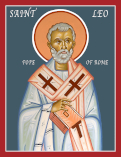 Born in Italy of devout parents, he was
first archdeacon with Pope Sixtus the Third, then elected against his own will to the papal
throne after Sixtus’ death. When Attila drew near to Rome with his Huns and prepared to
ravage and burn the city, Leo went out to him in his episcopal vestments, tamed the wrath of the
Hun leader and averted the fall of Rome. Attila was willing to be guided by Leo both because of
his holiness and because of a vision he had of the Apostles Peter and Paul, standing behind Leo
and threatening Attila with a flaming sword.
Born in Italy of devout parents, he was
first archdeacon with Pope Sixtus the Third, then elected against his own will to the papal
throne after Sixtus’ death. When Attila drew near to Rome with his Huns and prepared to
ravage and burn the city, Leo went out to him in his episcopal vestments, tamed the wrath of the
Hun leader and averted the fall of Rome. Attila was willing to be guided by Leo both because of
his holiness and because of a vision he had of the Apostles Peter and Paul, standing behind Leo
and threatening Attila with a flaming sword.
Leo not only saved Rome; he also contributed greatly to the safeguarding of Orthodoxy against the heresy of Eftyches and Dioscoros. This heresy consisted in the merging of the divine and human natures of Christ into one, and following from this, the denial of the existence of two wills in the Person of our Lord and Savior. This led to the summoning of the Fourth Ecumenical Council at Chalcedon, at which St. Leo’s Epistle was read—a letter which St. Leo, after writing it, had placed on the tomb of St. Peter, and which St. Peter had corrected. As death drew near, he spent forty days in fasting and prayer by the tomb of the Apostle Peter, begging him to tell him if his sins were forgiven. The apostle appeared to him and assured him that they were, except for his sins in the ordaining of priests (from which it is seen how grave a sin it is to ordain an unworthy man). The saint fell to prayer again, until he was told that these also were wiped out. Then he gave his soul to the Lord in peace. St. Leo entered into rest in the year 461.
FOR CONSIDERATION
Grass is the most important thing in a meadow, as are grain in a field and vegetables in a market-garden. No one would boast of the fence of a meadow rather than its hay, or of the hut in a field rather than its crop, or the ditch in a market garden rather than its vegetables. Why do people boast of their country, or of the highways in that country, or its frontier ditches or the towns in it—or about anything else that has just about as much value as the fence of a meadow or the hut in a field or the ditch in a market garden when weighed against the main crop; that is, people? People do not exist for the sake of the country, but the country for their sake. Christ came to save, not the country, but the people. A country is valued by the goodness of its citizens. But of what use is a great country to evil men? They fill the field with brambles.
Daily Scripture Readings taken from The Orthodox New Testament, translated and published by Holy Apostles Convent, Buena Vista, Colorado, copyright © 2000, used with permission, all rights reserved.
Daily Prologue Readings taken from The Prologue of Ochrid, by Bishop Nikolai Velimirovic, translated by Mother Maria, published by Lazarica Press, Birmingham, England, copyright © 1985, all rights reserved. Edited by Dormition Skete.