

Daily Devotional
Wednesday, February 7, 2029 (NS), January 25, 2029 (OS)
Fast Day, but Wine and Olive Oil Allowed.
Wednesday of the Thirty-Fifth Week
25. The commemoration of our father among the saints, Gregory the Theologian, Archbishop of Constantinople.
Scripture Readings
Paschalion — Movable Calendar
Wednesday of the Thirty-Fifth Week
Epistle
The Reading is from the First General Epistle of Saint John [§ 73].
For Gk. usage, see 1 Jn. 3:21-4:11; for Sl. usage, see 1 Jn. 3:21-4:6.
3 21Beloved, if our heart be not condemning us, we have boldness toward God. 22And whatsoever we may ask, we receive from Him, because we keep His commandments and do the things that are pleasing before Him. 23And this is His commandment, that we should believe in the name of His Son Jesus Christ and be loving one another, even as He gave us commandment. 24And the one keeping His commandments abideth in Him, and He in him. And in this we know that He abideth in us, by the Spirit Whom He gave to us.
4 1Beloved, cease believing every spirit, but keep on putting the spirits to the test, if they are of God; because many false prophets have gone out into the world. 2In this know ye the Spirit of God: Every spirit which confesseth that Jesus Christ hath come in the flesh is of God; 3and every spirit which confesseth not that Jesus Christ hath come in the flesh is not of God. And this is that spirit of the antichrist, which ye have heard that it is coming, and now already it is in the world. 4Ye are of God, little children, and have overcome them, because greater is the One in you than the one in the world. 5They are of the world; therefore they speak of the world, and the world heareth them. 6We are of God: the one knowing God heareth us; he who is not of God heareth us not. From this we know the spirit of truth and the spirit of error.
7Beloved, let us be loving one another, for love is of God, and everyone who loveth hath been born of God and knoweth God. 8The one who loveth not knoweth not God, for God is love. 9In this was manifest the love of God among us, because God hath sent forth His only-begotten Son into the world, in order that we might live through Him. 10In this is love, not that we loved God, but that He Himself loved us, and sent forth His Son to be an expiation for our sins. 11Beloved, if God so loved us, we ought also to love one another.
Gospel
The Reading is from the Holy Gospel according to Saint Mark [§ 65]. At that time:
14 43While Jesus spoke to the disciples, there came up Judas the Iscariote, one of the twelve, and with him a great crowd with swords and clubs, from the chief priests and the scribes and the elders. 44And the one who delivered Him up had given a signal to them, saying, “Whomsoever I shall kiss, it is He Himself; lay hold of Him and lead Him away safely.” 45And having come, straightway, he went to Him and saith, “Hail, Rabbi!” and ardently kissed Him. 46And they laid their hands upon Him and seized Him. 47And a certain one of those who stood by drew the sword and struck the slave of the high priest, and took off his ear. 48And Jesus answered and said to them, “As against a robber ye came out with swords and clubs to arrest Me. 49“Daily I was with you in the temple teaching, and ye did not lay hold of Me. But it is that the Scriptures might be fulfilled.” 50And having left Him, they all fled. 51Now a certain young man was following Him, having a linen cloth thrown about over his naked body. And the young men laid hold of him, 52but he left behind the linen cloth and fled from them naked.
53And they led Jesus away to the high priest; and there came together with him all the chief priests and the elders and the scribes. 54And Peter followed Him from afar, even to inside the court of the high priest. And he was sitting together with the servants, and warming himself by the light of the fire. 55And the chief priests and the whole sanhedrin were seeking testimony against Jesus, in order to put Him to death; and they were not finding any. 56For many were bearing false witness against Him, but their testimonies were not alike. 57And some rose up and were bearing false witness against Him, saying, 58“We heard Him saying, ‘I will destroy this temple, the one made with hands, and in three days I will build another made without hands.’” 59And not even so was their testimony alike. 60And the high priest stood up in the midst and questioned Jesus, saying, “Answerest Thou nothing? What is it which these bear witness against?” 61But He was silent, and answered nothing. Again the high priest was questioning Him, and saith to Him, “Art Thou the Christ, the Son of the Blessed?” 62And Jesus said, “I am; and ye shall see the Son of Man sitting on the right of the power, and coming on the clouds of the heaven.” 63And the high priest, having torn his tunics, saith, “What need have we still of witnesses? 64“Ye heard the blasphemy; what doth it appear to you?” And they all condemned Him to be liable to the penalty of death. 65And some began to spit upon Him, and to cover His face all around, and to buffet Him, and to say to Him, “Prophesy to us: Who is the one that smote Thee?” And the servants were striking Him with slaps on the face with the palms of their hands.
66And as Peter was in the court below, there cometh one of the young maidservants of the high priest. 67And when she saw Peter warming himself, she looked at him and said, “Thou also wast with Jesus the Nazarene.” 68But he denied it, saying, “I neither know nor even understand what thou sayest.” And he went forth outside to the forecourt, and a cock crowed. 69And the young maidservant, having seen him again, began to say to those standing by, “This is one of them.” 70And again he kept on denying it. And a little after, again, they who stood by were saying to Peter, “Truly thou art one of them; for thou art also a Galilæan, and thy mode of speech is like one.” 71But he began to curse and to swear, saying, “I know not this Man of Whom ye speak.” 72And for the second time a cock crowed. And Peter was reminded of the word which Jesus said to him, “Before a cock crow twice, thou shalt deny Me thrice.” And having thought thereon, he began to weep.
15 1And straightway in the morning, the chief priests held a consultation with the elders and scribes and the whole sanhedrin, and bound Jesus, and carried Him away, and delivered Him up to Pilate.
Menaion — Fixed Calendar
25. The commemoration of our father among the saints, Gregory the Theologian, Archbishop of Constantinople.
Epistle
The Reading is from the Epistle of Saint Paul to the Hebrews [§ 318]. Brethren:
7 26Such a High Priest was fitting for us: holy, guileless, undefiled, Who hath been separated from the sinners and hath become higher than the heavens, 27Who hath no need daily, even as the high priests, to offer up sacrifices, first for his own sins, then for those of the people; for this He did once for all after He offered up Himself. 28For the law appointeth men high priests who have weakness; but the word of the oath, which is after the law, appointeth the Son, Who hath been perfected forever.
8 1Now in reference to the things being spoken of, the chief point is: We have such a High Priest, Who sat down on the right of the throne of the majesty in the heavens, 2a Liturgist of the holies and of the tabernacle, the true one, which the Lord pitched, and not man.
for Sl. usage, see [1 Cor. 12:7-11].
Gospel
The Reading is from the Holy Gospel according to Saint John [§ 36]. The Lord said to the Jews who had come to Him:
10 9“I am the door; by Me if anyone should enter, he shall be saved, and shall go in and go out and find pasture. 10“The thief cometh not, except that he might steal, and slay, and destroy. I came that they may have life, and may have it abundantly. 11“I am the good shepherd. The good shepherd layeth down his life for the sheep. 12“But the hireling, who indeed is not a shepherd, whose own the sheep are not, seeth the wolf coming, and leaveth the sheep and fleeth; and the wolf seizeth them and scattereth the sheep. 13“Now the hireling fleeth, because he is a hireling and careth not about the sheep. 14“I am the good shepherd; and I know those that are Mine, and am known of those that are Mine. 15“Even as the Father knoweth Me, I also know the Father; and I lay down My life for the sheep. 16“And I have other sheep which are not of this fold; them also it is needful for Me to bring, and they shall hear My voice; and there shall be one flock and one Shepherd.”
Lives of the Saints (Prologue)
February 7th – Civil Calendar
January 25th – Church Calendar
1. St. Gregory the Theologian, Archbishop of Constantinople.
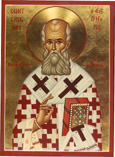 Born in Nazianzus of a Greek
father (who later became a Christian and a bishop) and a Christian mother, he studied in Athens
before his Baptism with St. Basil the Great and Julian the Apostate. He often foretold to Julian
that he would be an apostate and a persecutor of the Church, and so it came to pass. Gregory was
especially influenced by his mother, Nonna. He was baptized when he had completed his studies.
St. Basil consecrated him bishop of Sasima, and Emperor Theodosios called him to the vacant
archiepiscopal throne of Constantinople. His works were manifold, the best-known being his
theological writings, for which he received the title ‘the Theologian’. He is
particularly famed for the depth of his Sermons on the Holy Trinity. He also wrote against the
heretic Macedonius, who taught wrongly that the Spirit was a creature of God, and against
Apollinarius who taught that Christ did not have a human soul but that His divinity was in place
of His soul. He also wrote against the Emperor Julian the Apostate, his one time school-fellow.
In the year 381, when a quarrel broke out in the council concerning his election as archbishop,
he withdrew himself, declaring: ‘Those who deprive us of the (archiepiscopal) throne cannot
deprive us of God.’ He then left Constantinople and went to Nazianzus, remaining there in
retirement, prayer and the writing of instructive books until his death. And, although he was in
weak health all his life due to the ceaseless attacks of the heretics, he lived to the age of
seventy. His relics were later taken to Rome, and his head to the Cathedral of the Dormition in
Moscow. He was, and remains, a great and wonderful light of the Orthodox Church, as much for the
meekness and purity of his character as for the unsurpassable depth of his mind. He entered into
rest in the Lord in the year 389.
Born in Nazianzus of a Greek
father (who later became a Christian and a bishop) and a Christian mother, he studied in Athens
before his Baptism with St. Basil the Great and Julian the Apostate. He often foretold to Julian
that he would be an apostate and a persecutor of the Church, and so it came to pass. Gregory was
especially influenced by his mother, Nonna. He was baptized when he had completed his studies.
St. Basil consecrated him bishop of Sasima, and Emperor Theodosios called him to the vacant
archiepiscopal throne of Constantinople. His works were manifold, the best-known being his
theological writings, for which he received the title ‘the Theologian’. He is
particularly famed for the depth of his Sermons on the Holy Trinity. He also wrote against the
heretic Macedonius, who taught wrongly that the Spirit was a creature of God, and against
Apollinarius who taught that Christ did not have a human soul but that His divinity was in place
of His soul. He also wrote against the Emperor Julian the Apostate, his one time school-fellow.
In the year 381, when a quarrel broke out in the council concerning his election as archbishop,
he withdrew himself, declaring: ‘Those who deprive us of the (archiepiscopal) throne cannot
deprive us of God.’ He then left Constantinople and went to Nazianzus, remaining there in
retirement, prayer and the writing of instructive books until his death. And, although he was in
weak health all his life due to the ceaseless attacks of the heretics, he lived to the age of
seventy. His relics were later taken to Rome, and his head to the Cathedral of the Dormition in
Moscow. He was, and remains, a great and wonderful light of the Orthodox Church, as much for the
meekness and purity of his character as for the unsurpassable depth of his mind. He entered into
rest in the Lord in the year 389.
2. Our Holy Father Publius.
A senator at first, Publius came to know the light of Christ, left his honors and gave his goods to the poor and himself to the ascetic life in the vicinity of his town, Zeugma, on the Euphrates. He founded two communities and entered into rest in the Lord in the year 380.
3. Our Holy Father Mares.
He was distinguished by external beauty and a sweet singing voice. He retired from the world and lived in a hut for thirty-seven years in fasting and prayer and in cleansing his heart from thoughts. He entered into rest in the Lord as an elderly man of ninety in the year 430.
4. The Holy Martyr Felicitas and her seven sons.
She, together with her seven sons, was condemned to death for her Christian Faith in 164, in the reign of the Emperor Antoninus. She begged God only that she should not be killed before her sons, so that she might be able to encourage them in their torture and death not to deny Christ. And so it came to pass, by the providence of God. This mother joyfully bade her sons farewell one after the other, until she had seen all seven executed. Then she also, with thanksgiving to God, embraced a martyr’s death. They all suffered in Rome, where their relics are preserved.
FOR CONSIDERATION
They deceive themselves who self-confidently assert that they know men well and that no one can deceive them. Who, but the one God Who knows the secrets of the heart, can guess what kind of spiritual being any man is? Even the great saints were mistaken in people. For example: St. Basil for a long time considered a hypocritical heretic to be a holy man, and defended him against his many attackers until he was in the end, in bitter disappointment, convinced of the other’s deceit. St. Gregory the Theologian baptized a philosopher called Maximus and loved him so greatly that he shared his house and table with him. But this Maximus was as wicked and cunning as a snake, and after a while he managed by intrigues and bribes to be accepted by the citizens of Constantinople as patriarch in place of St. Gregory. When, after many intrigues, this trial was removed, Gregory was upbraided for having kept his greatest enemy at his side. ‘We are not to blame,’ replied the saint, ‘if we cannot see through a man’s wickedness. God alone knows man’s inner secrets. And we are told by the commandments to open our hearts with fatherly love to anyone who approaches us.’ The good, kindly man cannot easily comprehend the wickedness of the wicked man.
Daily Scripture Readings taken from The Orthodox New Testament, translated and published by Holy Apostles Convent, Buena Vista, Colorado, copyright © 2000, used with permission, all rights reserved.
Daily Prologue Readings taken from The Prologue of Ochrid, by Bishop Nikolai Velimirovic, translated by Mother Maria, published by Lazarica Press, Birmingham, England, copyright © 1985, all rights reserved. Edited by Dormition Skete.