

Daily Devotional
Wednesday, January 31, 2029 (NS), January 18, 2029 (OS)
No Fasting.
Wednesday of the Thirty-Fourth Week
The commemoration of our fathers among the saints, Athanasios and Kyril, Archbishops of Alexandria.
Scripture Readings
Paschalion — Movable Calendar
Wednesday of the Thirty-Fourth Week
Epistle
The Reading is from the Second General Epistle of Saint Peter [§ 68 A].
3 1Beloved, this second epistle, I now write to you, in which I stir up your sincere mind 2to be mindful of the words which were spoken before by the holy prophets, and of the commandment of us, the apostles of the Lord and Savior, 3knowing this first, that during the last days mockers shall come, walking according to their own desires, 4and saying, “Where is the promise of His coming? For since the fathers fell asleep, all things continue thus as they were from the beginning of creation.” 5For this escapeth their notice willingly: that by the word of God were there heavens of old, and an earth having stood together out of water and in water, 6by which the world of that time, having been deluged by water, perished. 7But the present heavens and the earth, which have been laid up in store by the same word, are being kept for fire until a day of judgment and perdition of ungodly men. 8But, beloved, let not this one thing escape you, that one day with the Lord is as a thousand years, and a thousand years as one day. 9The Lord is not slow as to the promise, as some deem slowness, but is long-suffering toward us, not willing to have any perish, but to have all come to repentance. 10But the day of the Lord shall come as a thief in the night, in which the heavens shall pass away with a rushing sound, and the elements, being burned with intense heat, shall be dissolved; and the earth and the works in it shall be burned completely. 11Therefore, because of all these things being dissolved, what manner of persons ought ye to be in holy modes of life and acts of piety, 12expecting and earnestly desiring the coming of the day of the Lord, by reason of which the heavens, being set on fire, shall be dissolved, and the elements, being burned with intense heat, shall be melted! 13But according to His promise, we look for new heavens and a new earth, wherein dwelleth righteousness.
14Wherefore, beloved, looking for these things, earnestly endeavor to be found by Him in peace, spotless and blameless; 15and be deeming that the long-suffering of the Lord is salvation, even as also our beloved brother Paul, according to the wisdom which was given to him, wrote to you, 16as also in all his epistles, speaking in them concerning these things, in which are some things hard to be understood, which the unlearned and unstable twist, as they do also the rest of Scriptures, to their own destruction.
17Ye therefore, beloved, since ye know these things beforehand, be on your guard lest, having been led away by the error of the lawless, ye should fall from your own steadfastness; 18but keep on increasing in grace and in knowledge of our Lord and Savior Jesus Christ. To Him be the glory, both now and to the day of eternity. Amen.
Gospel
The Reading is from the Holy Gospel according to Saint Mark [§ 61]. The Lord said to His disciples:
13 24“In those days, after that affliction, the sun shall be darkened, and the moon shall not give her light; 25“and the stars shall be falling from the heaven, and the powers which are in the heavens shall be shaken. 26“And then shall they see the Son of Man coming in clouds with great power and glory. 27“And then He shall send forth His angels, and shall gather together His elect from the four winds, from the uttermost part of the earth unto the uttermost part of the heaven. 28“Now learn the parable from the fig tree: Whenever its branch at once should become tender and put forth leaves, ye know that the summer is near; 29“thus also ye, whenever ye see these things coming to pass, know ye that it is near, even at the doors. 30“Verily I say to you that in no wise shall this generation pass away until all these things take place. 31“The heaven and the earth shall pass away, but My words in no wise shall pass away.”
Menaion — Fixed Calendar
The commemoration of our fathers among the saints, Athanasios and Kyril, Archbishops of Alexandria.
Epistle
The Reading is from the Epistle of Saint Paul to the Hebrews [§ 334]. Brethren:
13 7Be remembering those who lead you, who spoke to you the word of God, whose faith keep on imitating, observing attentively the end of their conduct: 8Jesus Christ, the same yesterday and today and to the ages. 9Cease being carried about by various and strange teachings. For it is good for the heart to be confirmed by grace, not by foods, in which those walking therein were not profited. 10We have an altar from which those serving the tabernacle have no authority to eat; 11for the bodies of those animals, “whose blood is being brought into the holies for sins” by the high priest, “are being burned outside of the encampment [cf. Lev. 16:27].” 12Wherefore Jesus also, that He might sanctify the people by His own blood, suffered outside of the gate. 13Let us be going forth therefore to Him outside of the encampment, bearing His reproach; 14for we have no abiding city here, but we seek the coming one. 15Through Him, then, let us be offering up a “sacrifice of praise [Lev. 7:2(12)]” continually to God, that is, “the fruit of the lips [cf. Hos. 14:3(2); Is. 57:19],” giving thanks to His name. 16But cease being forgetful of doing good and of contributing; for God is well pleased with such sacrifices.
Gospel
The Reading is from the Holy Gospel according to Saint Matthew [§ 11]. The Lord said to His disciples:
5 14“Ye are the light of the world. A city situated on the top of a mountain cannot be hid. 15“Nor do they light a lamp and put it under the bushel, but upon the lampstand, and it giveth light to all those in the house. 16“Thus, let your light shine before men, that they might see your good works, and might glorify your Father Who is in the heavens.
17“Do not begin to think that I came to abolish the law or the prophets; I came not to abolish, but to fulfill. 18“For verily I say to you, until the heaven and the earth shall have passed away, one iota or one tittle in no wise shall pass away from the law, until all shall have taken place. 19“Whosoever then shall break one of the least of these commandments, and shall teach men so, he shall be called least in the kingdom of the heavens; but whosoever shall do and teach them, this one shall be called great in the kingdom of the heavens.”
Lives of the Saints (Prologue)
January 31st – Civil Calendar
January 18th – Church Calendar
1. St. Athanasius the Great, Archbishop of Alexandria.
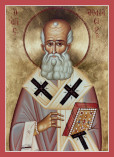 Born in Alexandria in 296, he had from
childhood an inclination to the spiritual life. He was a deacon with Archbishop Alexander and
accompanied him to Nicaea, to the First Ecumenical Council in 325. At this council, Athanasius
became famed for his learning, his devotion and his zeal for Orthodoxy, and contributed very
greatly to the containing of the Arian heresy and the strengthening of Orthodoxy. After the death
of Alexander, Athanasius was chosen as Archbishop of Alexandria. He remained in his
archiepiscopal calling for more than forty years, although he was not on the archiepiscopal
throne the whole time. He was persecuted by heretics through almost the whole of his life,
particularly by the Emperors Constantius, Julian and Valens, by Bishop Evsevios (Eusebius) of
Nikomedia and many others, and by the heretic Arius and his followers. He was forced to hide from
his persecutors in a well, a grave, private houses and the deserts. Twice he was forced to flee
to Rome. Only just before his death did he have a peaceful period as a good shepherd with his
flock, which truly loved him. There are few saints who have been so callously slandered and so
criminally persecuted as St. Athanasius. But his great soul endured all with patience for the
love of Christ and at last emerged victorious from all these terrible and lengthy struggles. He
often went to St. Anthony for advice and moral support, revering him as his spiritual father. He
suffered greatly for the truth, until the Lord gave him rest in His kingdom as His faithful
servant in the year 373.
Born in Alexandria in 296, he had from
childhood an inclination to the spiritual life. He was a deacon with Archbishop Alexander and
accompanied him to Nicaea, to the First Ecumenical Council in 325. At this council, Athanasius
became famed for his learning, his devotion and his zeal for Orthodoxy, and contributed very
greatly to the containing of the Arian heresy and the strengthening of Orthodoxy. After the death
of Alexander, Athanasius was chosen as Archbishop of Alexandria. He remained in his
archiepiscopal calling for more than forty years, although he was not on the archiepiscopal
throne the whole time. He was persecuted by heretics through almost the whole of his life,
particularly by the Emperors Constantius, Julian and Valens, by Bishop Evsevios (Eusebius) of
Nikomedia and many others, and by the heretic Arius and his followers. He was forced to hide from
his persecutors in a well, a grave, private houses and the deserts. Twice he was forced to flee
to Rome. Only just before his death did he have a peaceful period as a good shepherd with his
flock, which truly loved him. There are few saints who have been so callously slandered and so
criminally persecuted as St. Athanasius. But his great soul endured all with patience for the
love of Christ and at last emerged victorious from all these terrible and lengthy struggles. He
often went to St. Anthony for advice and moral support, revering him as his spiritual father. He
suffered greatly for the truth, until the Lord gave him rest in His kingdom as His faithful
servant in the year 373.
2. St. Maxim, Archbishop of Wallachia.
Son of the Serbian despot Stefan the Blind and his wife Angelina, he received the monastic schema in the monastery of Manasija. Having pressure put on him by the Turks, he fled into the mountainous part of Romania, where he was consecrated to the vacant archiepiscopal see of Wallachia. He reconciled the disputing military commanders Radul and Bogdan and averted war between them. He returned to Krušedol in his last years, founded a monastery there, and after great spiritual endeavor, entered into rest on January 18th, 1546. His incorrupt and wonder-working relics lie even to this day in that monastery.
FOR CONSIDERATION
To the question, why did the Son of God reveal Himself to the world as man and not in the shape of some other creature, the wise Saint Athanasius replied thus: ‘If they ask why He did not reveal Himself in the form of some greater creature: for example, the sun, the moon or stars, or as flame or space, but as man, let them know that the Lord did not come simply to reveal Himself but to heal and teach those that suffer. For simply to reveal Himself and make His spectators marvel would mean to come as a show. Coming as a healer and teacher, He had not only to come, but to come in such a way that the revelation should be bearable to the wretched men whom He had come to serve. No single creature has been in error in the eyes of God save man alone; neither the sun nor the moon nor the sky, the stars nor water nor space has been unfaithful to its state, but on the contrary, knowing their Creator and their King—the Logos—they all live as they were created. Only human beings have turned themselves from good and changed that truth which belongs to God into deceit, as they transferred the knowledge of Him to devils and idols. What is there, therefore, unlikely in the Logos’ (the Son of God’s) revealing Himself as man in order to save mankind?’ Indeed, we ask the unbelievers of our generation: ‘In what form would you wish God to reveal Himself, if not as man?’
Daily Scripture Readings taken from The Orthodox New Testament, translated and published by Holy Apostles Convent, Buena Vista, Colorado, copyright © 2000, used with permission, all rights reserved.
Daily Prologue Readings taken from The Prologue of Ochrid, by Bishop Nikolai Velimirovic, translated by Mother Maria, published by Lazarica Press, Birmingham, England, copyright © 1985, all rights reserved. Edited by Dormition Skete.