

Daily Devotional
Sunday, January 28, 2029 (NS), January 15, 2029 (OS)
No Fasting.
| Sunday of the Thirty-Third Week or Sunday of the Publican and the Pharisee Mode One — First Eothinon |
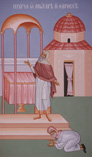
The commemoration of our venerable Fathers Paul of Thebes and John the Hut-dweller (Kalyvites).
Scripture Readings
Paschalion — Movable Calendar
Sunday of the Thirty-Third Week or Sunday of the Publican and the Pharisee
Mode One — First Eothinon
Epistle
The Reading is from the Second Epistle of Saint Paul to Saint Timothy [§ 296]. Child Timothy:
3 10Thou hast closely followed my teaching, conduct, purpose, faith, long-suffering, love, patience, 11persecutions, sufferings, such as happened to me in Antioch, in Iconium, in Lystra—what persecutions I endured! And out of them all the Lord delivered me. 12Yes, and all those who wish to live piously in Christ Jesus shall be persecuted. 13But evil men and cheats shall advance to the worse, leading astray and being led astray. 14But thou, keep on abiding in what thou didst learn and wast assured of, knowing from whom thou didst learn, 15and that from a babe thou hast known the sacred writings, which are able to make thee wise in regard to salvation through faith which is in Christ Jesus.
Gospel
The Reading is from the Holy Gospel according to Saint Luke [§ 89]. The Lord said this parable:
18 10“Two men went up into the temple to pray, the one a Pharisee and the other a tax collector. 11“The Pharisee, having assumed a stance, was praying these things to himself, ‘God, I thank Thee that I am not as the rest of men—rapacious, unjust, adulterers, or even as this one, the tax collector. 12“‘I fast twice a week; I tithe all things, as much as I acquire.’ 13“And the tax collector, having stood afar off, was not willing even to lift up his eyes to the heaven, but kept beating upon his breast, saying, ‘God, be gracious to me the sinner.’ 14“I say to you, this one went down to his house having been justified rather than that one; for everyone who exalteth himself shall be humbled, and the one who humbleth himself shall be exalted.”
Menaion — Fixed Calendar
The commemoration of our venerable Fathers Paul of Thebes and John the Hut-dweller (Kalyvites).
Epistle
The Reading is from the Epistle of Saint Paul to the Galatians [§ 213]. Brethren:
5 22The fruit of the Spirit is love, joy, peace, long-suffering, kindness, goodness, faith, 23meekness, self-control; against such things there is no law. 24But they who are of the Christ crucified the flesh with the passions and the lusts. 25If we live by the Spirit, let us also be walking by the Spirit. 26Let us not become vainglorious, provoking one another, envying one another.
6 1Brethren, even if a man should be overtaken in some transgression, ye, the spiritual ones, be restoring such a one in the spirit of meekness, looking out for thyself, lest thou also be tempted. 2Keep on bearing one another’s burdens, and thus fill up the law of the Christ.
Gospel
The Reading is from the Holy Gospel according to Saint Luke [§ 67]. The Lord said:
12 32“Cease being afraid, little flock, for your Father is well pleased to give you the kingdom. 33“Sell your possessions and give alms. Make for yourselves purses which do not become old, an unfailing treasure in the heavens, where no thief draweth near nor moth destroyeth; 34“for where your treasure is, there your heart will be also. 35“Let your loins be girded about and the lamps be kept burning; 36“and be ye like to men waiting for their own lord—whenever he should depart from the wedding festivities—that when he cometh and knocketh, straightway, they might open to him. 37“Happy are those slaves whom the lord, after he cometh, shall find watching. Verily I say to you that he shall gird himself about and shall have them recline at table, and will come forth and minister to them. 38“And if he should come in the second watch, and in the third watch should he come, and find them thus, happy are those slaves. 39“But know ye this, that if the master of the house had known in what hour the thief was coming, he would have watched and not let his house be broken into. 40“Ye therefore also keep on becoming ready, for in the hour ye think not, the Son of Man cometh.”
for Sl. usage, see [Mt. 11:27-30].
Synaxarion Readings
Sunday of the Publican and the Pharisee
O Creator of all above and below, as Thou receivest the thrice-holy hymn from the angels, so also from mankind receive the Triodion. He who lives like a Pharisee is far from the Church, for Christ is received within, O ye humble of heart.
With God on this present day we begin the Triodion, the hymns of which were composed by many of our holy and God-bearing fathers, inspired by the Holy Spirit according to their worthiness. The first of all was the great author St. Cosmas of Maiuma, who composed the three odes (symbolic of the Holy and life-creating Trinity) for the Great and Holy Week of the Passion of our Lord and God and Savior Jesus Christ. After him, others of the fathers, including Saints Theodore and Joseph of the Studite Monastery, following his zealous example, arranged the services of the other weeks of the Holy and Great Forty-day Fast, reserving them at first for the use of the Studite Monastery. Furthermore they composed and arranged hymns, seeking them and collecting them from other books of the fathers. Since, according to the Triodion, Sunday, the celebration of the Resurrection, is the first day of the week as well as the last or eighth day, they prescribed the first ode (canticle) of the canon to be sung on the second day of the week, i.e. Monday. The second ode was prescribed for Tuesday, the third day of the week, the third ode for Wednesday, the fourth ode for Thursday, the fifth ode for Friday, and the sixth and seventh odes for Saturday. The rest, the eighth and ninth odes, are prescribed for every day.
It must be known, however, that although it is called the Triodion, it does have services with other than three-ode canons. It is so named because the majority of the services have three-ode canons, especially during Holy Week. For it was our holy fathers’ idea that through the entire Triodion would be commemorated in a concise form all God’s benefits to us from the beginning, using it as a reminder for all of us that we were created by Him, and were exiled from Paradise through the tasting of the fruit, rejecting the commandment that was given to us for our knowledge, and we were cast out through the envy of the arch villain serpent and enemy, who was made to crawl for his arrogance; that we remained cut off from the benefits of Paradise and were led by the devil; that the Son and Logos of God, having suffered in His mercy, bowing the heavens, descended and made His abode in the Virgin and became man for our sake, showing us through His life the ascent into the heavens, through humility first of all, then by fasting and the rejection of evil, and through His other deeds; that He suffered and rose from the dead and ascended once more into heaven, and He sent down the Holy Spirit upon His holy disciples and apostles, who all proclaimed Him to be the Son of God and the most perfect God. And that once more the divine apostles acted through the grace of the most Holy Spirit and gathered all the saints from the ends of the earth through their preaching, filling the world on high, which was the intention of the Creator from the beginning.
Now the purpose of the Triodion intended by the holy fathers on these three present feasts of the Publican and the Pharisee, the Prodigal Son, and the Second Coming is a kind of preparatory lesson and stimulation to prepare ourselves for the spiritual labors of the Fast, having put aside our usual corrupt habits. First of all they present to us the parable of the Publican and the Pharisee, and they call the week following precursory. For those who desire to go off to do military battle first ascertain the time of the battle from the leaders, so that having cleaned and polished their weapons, and preparing well all their other matters, and having removed all obstacles from their path, they earnestly go forth to their labors, taking the necessary supplies. Often before battle they tell anecdotes and tales and parables to incite their hearts to zeal, driving off idleness, fear, despair, and other unworthy feelings. So the divine fathers herald the coming fast against the armies of demons as a struggle which constrains our souls to cleanse ourselves of the poison accumulated over a long period of time. Not yet possessing those benefits, let us strive to obtain them, and arming ourselves properly, so let us embark on the labors of the Fast.
Now the first weapon among the virtues is repentance and humility. And the adversary of attaining the greatest humility is pride and arrogance. So they place before us first of all this present trustworthy parable from the divine Gospel. It encourages us to shun the desire for the pride and arrogance of the Pharisee and to cultivate the opposite desire of the Publican for humility and repentance. For the greatest and most grievous passion is pride and arrogance, since this is how the devil fell from the heavens before the morning star and was cast into darkness. Because of this Adam, the father of our race, was driven from Paradise through partaking of the fruit. Through this example the holy fathers encourage all not to be proud of their successes, but to always be humble. For the Lord sets Himself against the proud, but He gives grace to the humble. Better a man who has sinned, if he knows that he has sinned and repents, than a man who has not sinned and thinks of himself as righteous. For Christ said, “I say to you that the publican went down to his house justified rather than the Pharisee.” This parable reveals that no one should exalt himself, even though he has done good deeds, but rather should always be humble and pray from his heart to God, for even if he should fall into the most serious sin, salvation is not far off.
Through the prayers of all Thy holy hymnographers, O Christ our God, have mercy on us. Amen.
Translated from Triodion, siest ‘Tripesnets: Triod’ Postnaya, Moscow, 1904, by Robert Parent.
Lives of the Saints (Prologue)
January 28th – Civil Calendar
January 15th – Church Calendar
1. Our Holy Father Paul of Thebes.
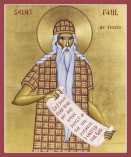 Born of wealthy parents in Lower Thebes in Egypt in the
reign of the Emperor Decius, he and a sister of his together inherited all their parents’
property. But his brother-in-law, an idol-worshipper, plotted to seize Paul’s half of the
inheritance. He therefore threatened Paul that he would betray him to the authorities as a
Christian if he did not hand over his share of the property. This misfortune, coupled with the
examples of self-sacrifice by the Christian martyrs that Paul saw with his own eyes, induced him
to give his half of the property to his sister and go off into the desert, where he lived in
asceticism until his death. The spiritual heights attained by this giant of a monk are testified
to by no less a person than St. Anthony the Great, who once visited Paul and saw how the wild
animals and birds of the air ministered to him. Returning from this visit, Anthony said to his
monks: ‘Woe is me, my children, a sinful and false monk, who am a monk in name only. I have
seen Elias, I have seen John in the desert, and I have seen Paul—in Paradise!’ St. Paul
lived 113 years, and entered peacefully into rest in the Lord in the year 342.
Born of wealthy parents in Lower Thebes in Egypt in the
reign of the Emperor Decius, he and a sister of his together inherited all their parents’
property. But his brother-in-law, an idol-worshipper, plotted to seize Paul’s half of the
inheritance. He therefore threatened Paul that he would betray him to the authorities as a
Christian if he did not hand over his share of the property. This misfortune, coupled with the
examples of self-sacrifice by the Christian martyrs that Paul saw with his own eyes, induced him
to give his half of the property to his sister and go off into the desert, where he lived in
asceticism until his death. The spiritual heights attained by this giant of a monk are testified
to by no less a person than St. Anthony the Great, who once visited Paul and saw how the wild
animals and birds of the air ministered to him. Returning from this visit, Anthony said to his
monks: ‘Woe is me, my children, a sinful and false monk, who am a monk in name only. I have
seen Elias, I have seen John in the desert, and I have seen Paul—in Paradise!’ St. Paul
lived 113 years, and entered peacefully into rest in the Lord in the year 342.
2. Our Holy Father John (The Hut-Dweller).
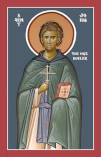 He was born in
Constantinople in the early part of the 5th century, and was the only child of rich and eminent
parents. Drawn by inclination to the spiritual life, the young John fled with a monk to a
monastery in Asia Minor. He spent six years in this monastery in the greatest restraint, prayer
and obedience to the superior. Then the devil attacked him with the temptation to leave the
monastery and return to his parents, to live with them as a nobleman. He indeed returned to his
parents’ home, but dressed as a beggar. He saw his parents, but not wishing to reveal
himself to them as their son, remained as a beggar in their courtyard, living off the crumbs that
the servants threw to him and enduring much ridicule from all. He lived thus for three years,
praying to God that He would save the souls of his father and mother. When he fell ill and felt
death approaching, he revealed himself to his parents. They recognized him by a precious
Gospel-book which they had given him in childhood and which he had kept with him as his sole
possession. And so this young man, albeit so rich, saved his soul and those of his parents,
overcame the devil, and entered into rest in the Lord in about the year 450.
He was born in
Constantinople in the early part of the 5th century, and was the only child of rich and eminent
parents. Drawn by inclination to the spiritual life, the young John fled with a monk to a
monastery in Asia Minor. He spent six years in this monastery in the greatest restraint, prayer
and obedience to the superior. Then the devil attacked him with the temptation to leave the
monastery and return to his parents, to live with them as a nobleman. He indeed returned to his
parents’ home, but dressed as a beggar. He saw his parents, but not wishing to reveal
himself to them as their son, remained as a beggar in their courtyard, living off the crumbs that
the servants threw to him and enduring much ridicule from all. He lived thus for three years,
praying to God that He would save the souls of his father and mother. When he fell ill and felt
death approaching, he revealed himself to his parents. They recognized him by a precious
Gospel-book which they had given him in childhood and which he had kept with him as his sole
possession. And so this young man, albeit so rich, saved his soul and those of his parents,
overcame the devil, and entered into rest in the Lord in about the year 450.
3. Our Holy Father Gabriel of Lesnov.
A Slav and a friend of St. Prochorus of Pchinja and St. John of Rila, he lived a life of asceticism in the 10th century at Kratov on the mountain of Lesnov, where he built a church to the Archangel Michael. He was a wonder-worker both during his lifetime and after his death. The present beautiful church in this place was built by King Dušan’s commander-in-chief, Jovan Oliver. St. Gabriel entered into rest in the Lord at the end of the tenth century.
4. The Holy Martyr Pansophios.
The son of the Alexandrian proconsul, Nilus, he laid aside worldly honor and riches as a young man and embraced the monastic state. He lived in great asceticism for 27 years, lifting up his soul to the higher world. In the reign of Decius, he was dragged before the judge, where he was flogged for the name of Christ until, under great torture, he delivered his soul to God.
FOR CONSIDERATION
Never think that God does not hear you when you pray to Him. He hears our thoughts as we hear one another’s voices and words. And if He does not act at once in response to your prayer, that is either because your prayer was unworthy, or you were seeking something that would be dangerous for you, or, again, because He, by His wisdom and providence, delays the fulfilling of your request until the right moment. Saint John of Kronstadt writes: ‘As we are able to communicate quickly by means of the electric telegraph with people far away from us, so, through a living faith, as through such a telegraph, we are quickly in contact with God, the angels and the saints. Send your requests to God and the saints by the telegraph of faith, and you will immediately get an answer.’ And again, in another place: ‘God and His created souls and spirits, the living and the dead, are thinking beings, and thought is swift and somehow omnipresent. Think about them with your whole heart, and they will be present with you. God will ever be with you, and by His gift and power, the others will be also.’
Daily Scripture Readings taken from The Orthodox New Testament, translated and published by Holy Apostles Convent, Buena Vista, Colorado, copyright © 2000, used with permission, all rights reserved.
Daily Prologue Readings taken from The Prologue of Ochrid, by Bishop Nikolai Velimirovic, translated by Mother Maria, published by Lazarica Press, Birmingham, England, copyright © 1985, all rights reserved. Edited by Dormition Skete.