

Daily Devotional
Monday, January 22, 2029 (NS), January 9, 2029 (OS)
No Fasting.
Monday of the Thirty-Fourth Week
The commemoration of the Afterfeast of Theophany, and the holy Martyr Polyefktos of Melitene in Armenia, and the holy Metropolitan Philip of Moscow and All Russia, the new confessor.
Scripture Readings
Paschalion — Movable Calendar
Monday of the Thirty-Fourth Week
Epistle
The Reading is from the Epistle of Saint Paul to the Ephesians [§ 219]. Brethren:
1 22God, the Father of our Lord Jesus Christ [cf. Eph. 1:17], put in subjection all things under the feet of His Son, and gave Him to be head over all things to the Church, 23which is His body, the fullness of Him Who filleth all things in all.
2 1And you He made alive [Eph. 2:5], when ye were dead in transgressions and sins, 2in which once ye walked according to the age of this world, according to the prince of the power of the air, the spirit now energizing in the sons of disobedience, 3among whom also we all once conducted ourselves in the desires of our flesh, doing the things willed of the flesh and of the thoughts, and were by nature children of wrath, as even the rest.
Gospel
The Reading is from the Holy Gospel according to Saint Luke [§ 10]. At that time:
3 19Herod the tetrarch, being reproved by John for Herodias, the wife of his brother Philip, and for all the evils which Herod did, 20added also this above all, he even shut up John in the prison.
21Now it came to pass, as all the people were being baptized, Jesus also was baptized; and while He prayed, the heaven was opened. 22And the Holy Spirit descended in a bodily shape as a dove upon Him; and there came to be a voice out of heaven, saying, “Thou art My Son, the Beloved; in Thee I am well pleased.”
Menaion — Fixed Calendar
The commemoration of the Afterfeast of Theophany, and the holy Martyr Polyefktos of Melitene in Armenia, and the holy Metropolitan Philip of Moscow and All Russia, the new confessor.
Epistle
For the Martyr:
The Reading is from the Second Epistle of Saint Paul to Saint Timothy [§ 292]. Child Timothy:
2 1Be thou empowered in the grace that is in Christ Jesus; 2and the things which thou heardest from me in the midst of many witnesses, commit thou these things to faithful men who shall be competent also to teach others. 3Thou therefore suffer hardship as a good soldier of Jesus Christ. 4No one serving as a soldier is entangled with the affairs of life, in order that he might please the one who enlisted him. 5And if anyone also contend as an athlete in the games, he is not crowned unless he contend lawfully. 6The farmer who laboreth must be first to partake of the fruits. 7Be considering what I say; O may the Lord give thee understanding in all things! 8Be remembering Jesus Christ, of the seed of David, Who hath been raised from the dead, according to my Gospel, 9in which I suffer hardship even to bonds as a malefactor, but the word of God hath not been bound. 10On this account I endure all things for the sake of the elect, that they might also attain salvation that is in Christ Jesus with eternal glory.
For the Hierarch:
The Reading is from the Epistle of Saint Paul to the Hebrews [§ 335]. Brethren:
13 17Be obedient to those who lead you, and keep on submitting, for they are watchful for your souls, as those about to render an account, that they may do this with joy, and not groaning; for this would be unprofitable for you. 18Keep on praying for us; for we trust that we have a good conscience, in all things wishing to conduct ourselves well. 19But I beseech you more abundantly to do this, that I might be restored more quickly to you.
20Now the God of peace Who brought up from the dead our Lord Jesus, the Shepherd of the sheep, the great One, in the blood of an everlasting covenant, 21may He render you perfect in every good work, in order to do His will, doing in you that which is well-pleasing before His face, through Jesus Christ, to Whom be glory to the ages of the ages. Amen.
Gospel
For the Mid-feast:
The Reading is from the Holy Gospel according to Saint Mark [§ 2]. In those days:
1 9Jesus came from Nazareth of Galilee, and was baptized by John in the Jordan. 10And straightway, coming up from the water, He saw the heavens being parted, and the Spirit as a dove descending upon Him; 11and there came to be a voice out of the heavens, “Thou art My Son, the Beloved, in Thee I am well pleased.”
12And straightway, the Spirit driveth Him forth into the desert. 13And He was there in the desert forty days, being tempted by Satan; and He was with the wild beasts; and the angels were ministering to Him.
14Now after John was delivered up, Jesus came into Galilee, proclaiming the Gospel of the kingdom of God, 15and saying, “The time hath been fulfilled, and the kingdom of God hath drawn near; repent ye and believe ye in the Gospel.”
For the Hierarch:
The Reading is from the Holy Gospel according to Saint John [§ 36]. The Lord said to the Jews who had come to Him:
10 9“I am the door; by Me if anyone should enter, he shall be saved, and shall go in and go out and find pasture. 10“The thief cometh not, except that he might steal, and slay, and destroy. I came that they may have life, and may have it abundantly. 11“I am the good shepherd. The good shepherd layeth down his life for the sheep. 12“But the hireling, who indeed is not a shepherd, whose own the sheep are not, seeth the wolf coming, and leaveth the sheep and fleeth; and the wolf seizeth them and scattereth the sheep. 13“Now the hireling fleeth, because he is a hireling and careth not about the sheep. 14“I am the good shepherd; and I know those that are Mine, and am known of those that are Mine. 15“Even as the Father knoweth Me, I also know the Father; and I lay down My life for the sheep. 16“And I have other sheep which are not of this fold; them also it is needful for Me to bring, and they shall hear My voice; and there shall be one flock and one Shepherd.”
Lives of the Saints (Prologue)
January 22nd – Civil Calendar
January 9th – Church Calendar
1. The Holy Martyr Polyefktos (Polyeuctus).
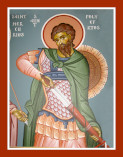 The Armenian town of Melitene was
soaked in Christian blood, as was all the land of Armenia. The first blood shed for Christ in
that town was that of St. Polyefktos, spilled in about the year 259, during the reign of
Valerian. There were in the town two friends who were officers: Nearchos and Polyefktos, the
former baptized and the latter unbaptized. When a decree went out from the emperor that all
Christians were to be killed, Nearchos prepared himself for death, though with great sorrow at
not having brought his friend Polyefktos to the true Faith. When Polyefktos became aware of
Nearchos’ sorrow, he promised to become a believer. On the following day, he related to
Nearchos a dream that he had: the Lord Himself had appeared to him in light, stripped his old
clothing from him, clothed him in new and shining raiment and set him upon the saddle of a winged
horse. After relating this dream, Polyefktos went off to the town, tore up the royal decree on
the persecution of Christians and smashed many statues of idols. He was tortured and condemned to
death. On the way to the place of execution, he caught sight of Nearchos in the crowd and called
joyfully to him: ‘O Nearchos, farewell, and remember the pact between us!’ And St.
Nearchos later ended a martyr for Christ in the fire. His feast is on April 22nd.
The Armenian town of Melitene was
soaked in Christian blood, as was all the land of Armenia. The first blood shed for Christ in
that town was that of St. Polyefktos, spilled in about the year 259, during the reign of
Valerian. There were in the town two friends who were officers: Nearchos and Polyefktos, the
former baptized and the latter unbaptized. When a decree went out from the emperor that all
Christians were to be killed, Nearchos prepared himself for death, though with great sorrow at
not having brought his friend Polyefktos to the true Faith. When Polyefktos became aware of
Nearchos’ sorrow, he promised to become a believer. On the following day, he related to
Nearchos a dream that he had: the Lord Himself had appeared to him in light, stripped his old
clothing from him, clothed him in new and shining raiment and set him upon the saddle of a winged
horse. After relating this dream, Polyefktos went off to the town, tore up the royal decree on
the persecution of Christians and smashed many statues of idols. He was tortured and condemned to
death. On the way to the place of execution, he caught sight of Nearchos in the crowd and called
joyfully to him: ‘O Nearchos, farewell, and remember the pact between us!’ And St.
Nearchos later ended a martyr for Christ in the fire. His feast is on April 22nd.
2. Our Holy Father Efstratios.
A native of Tarsus, he was a great ascetic and man of prayer. During seventy-five years of monastic life, he never lay on his left side to sleep, but always on his right. In church, he repeated to himself throughout the service: ‘Lord, have mercy’. He died at the age of 95.
3. St. Philip, Metropolitan of Moscow.
Born on February 11th, 1507, he was standing one day in church, while still a young man, when he heard the priest read from the Gospel the words: “No man can serve two masters” (Matt. 6:24). He was filled with awe at these words, as though they were said to him alone, and was enlightened in that same moment. He went off to the monastery of Solovetsky (Solovki), where, after a long and hard novitiate, he received the monastic schema. In time he became abbot, and resplendent as the sun in holiness, became known throughout the land of Russia. Because of this, Tsar Ivan the Formidable, a great ally of the saint, translated him to the vacant See of Moscow as metropolitan in 1566. But soon the Judaizer sect and the nobles plotted against the new metropolitan, slandering him and succeeding in having him deposed and imprisoned at Tver. When Tsar Ivan later began to investigate the lawfulness of this deposition, the Judaizer conspirators, desiring to silence Philip, murdered him in the monastery of his exile on December 23rd, 1569.
After some years, the body of the saint was found to be whole and incorrupt, and giving off a very beautiful fragrance. It was transferred to the monastery of Solovetsky.
FOR CONSIDERATION
The Orthodox Church, in teaching men perfect love, at the same time teaches them perfect obedience, from which flow both order and harmony among the faithful. The bishops owe obedience to the Lord, the priests to the bishops and the faithful to the one and the other. St. Ignatius writes about this: “It is your duty to obey without hypocrisy; he who would deceive his visible bishop would scorn also the Invisible.... I beg you, take care to fulfill all in the unity of God, under the guidance of your bishops, who occupy the place of God, and the priests, who constitute the assembly of the apostles,...not thinking that whatever may seem to you to be right, that should you do on your own, in isolation.”
[The Orthodox have always accepted this, but when the bishop preaches anything other than true Orthodoxy, the faithful are admonished by the testimony of the apostles, who were contemporaries of St. Ignatius, that they must not be obedient to disobedience. The faithful have, in such instances, ousted the bishop and replaced him with one who is Orthodox.]
Daily Scripture Readings taken from The Orthodox New Testament, translated and published by Holy Apostles Convent, Buena Vista, Colorado, copyright © 2000, used with permission, all rights reserved.
Daily Prologue Readings taken from The Prologue of Ochrid, by Bishop Nikolai Velimirovic, translated by Mother Maria, published by Lazarica Press, Birmingham, England, copyright © 1985, all rights reserved. Edited by Dormition Skete.