

Daily Devotional
Sunday, November 5, 2028 (NS), October 23, 2028 (OS)
No Fasting.
Sunday of the Twenty-Second Week
Mode Plagal One — Eleventh Eothinon
The commemoration of the holy Apostle Iakovos, the Brother of the Lord, first Bishop of Jerusalem.
Scripture Readings
Paschalion — Movable Calendar
Sunday of the Twenty-Second Week
Mode Plagal One — Eleventh Eothinon
Epistle
The Reading is from the Epistle of Saint Paul to the Galatians [§ 215]. Brethren:
6 11See with what size letters I am writing to you with mine own hand. 12As many as wish to make a good show in the flesh, these constrain you to be circumcised, only that they may not be persecuted for the Cross of Christ. 13For not even they themselves who are circumcised keep the law, but they wish you to be circumcised, in order that they might boast in your flesh. 14But may it not be for me to boast, except in the Cross of our Lord Jesus Christ, through Whom the world hath been crucified to me, and I to the world. 15For in Christ Jesus neither circumcision hath any strength, nor uncircumcision, but a new creation. 16And as many as walk by this rule, peace be upon them and mercy, and upon the Israel of God.
17Henceforth, let no one be giving me troubles, for I bear in my body the marks of the Lord Jesus.
18The grace of our Lord Jesus Christ be with your spirit, brethren. Amen.
Gospel
The Reading is from the Holy Gospel according to Saint Luke [§ 38]. At that time:
8 26Jesus and His disciples sailed down to the country of the Gadarenes, which is over against Galilee. 27And after He went out upon the land, there met Him a certain man out of the city who had demons for a long time, and had not put a garment on himself, and was not abiding in a house but in the sepulchers. 28And after he saw Jesus and cried out, he fell down before Him and with a loud voice said, “What is it to me and to Thee, Jesus, Son of God the Most High? I entreat Thee, do not begin to torment me.” 29For He was commanding the spirit, the unclean one, to come out from the man. For many times it had seized him; and he was kept bound with chains and fetters. And breaking through the bonds, he was driven by the demon into the wildernesses. 30And Jesus asked him, saying, “What is thy name?” And he said, “Legion,” because many demons entered into him. 31And he besought Him that He would not command them to go away into the abyss. 32Now there was there a herd of considerable swine being fed on the mountain. And they besought Him that He would permit them to enter into those. And He permitted them. 33And the demons went out from the man and entered into the swine; and the herd rushed down the cliff into the lake and were drowned. 34And after they who fed them saw what had taken place, they fled and went away and brought back tidings to the city and to the country. 35And they went out to see what had taken place. And they came to Jesus, and found the man from whom the demons had gone out, sitting at the feet of Jesus, clothed and of a sound mind; and they were afraid. 36And they who saw related to them how the one who had been possessed by demons was made well. 37And the whole multitude of the country round about the Gadarenes asked Him to depart from them, for they were constrained with great fear. And He embarked into the ship and turned back. 38Now the man from whom the demons had gone out was entreating Him to be with Him. But Jesus dismissed him, saying, 39“Return to thy house, and go on relating how much God did for thee.” And he departed, proclaiming throughout the whole city how much Jesus did for him.
Menaion — Fixed Calendar
The commemoration of the holy Apostle Iakovos, the Brother of the Lord, first Bishop of Jerusalem.
Epistle
The Reading is from the Epistle of Saint Paul to the Galatians [§ 200].
1 11Brethren, I make known to you the Gospel which was preached as good tidings by me, that it is not according to man; 12for I neither received it from man, nor was I taught it, but by a revelation of Jesus Christ. 13For ye heard of my manner of life at one time in Judaism, that according to excess, I used to persecute the Church of God, and was ravaging her. 14And I kept on advancing in Judaism beyond many contemporaries in mine own race, being more exceedingly a zealot of the traditions of my fathers. 15But when it pleased God, Who separated me from my mother’s womb and called me by His grace, 16to reveal His Son in me, that I be preaching Him as good tidings among the nations, immediately I conferred not with flesh and blood, 17neither did I go up to Jerusalem to those who were apostles before me, but I went away into Arabia, and again returned to Damascus. 18Then after three years I went up to Jerusalem to visit Peter, and remained with him fifteen days; 19but of the other apostles I saw none, except Iakovos the brother of the Lord.
Gospel
The Reading is from the Holy Gospel according to Saint Matthew [§ 56]. At that time:
13 54After Jesus came into His own country, He was teaching the crowds in their synagogue, insomuch that they were astonished and said, “From what place hath this One this wisdom and the works of power? 55“This is the carpenter’s Son, is it not? His Mother is called Mariam, is she not, and His brothers, Iakovos, and Joses, and Simon, and Judas? 56“And His sisters are all with us, are they not? From what place then hath this One all these things?” 57And they were offended in Him. But Jesus said to them, “A prophet is not without honor, except in his own country and in his own house.” 58And He did not do many works of power there because of their unbelief.
Lives of the Saints (Prologue)
November 5th – Civil Calendar
October 23rd – Church Calendar
1. The Holy Apostle Iakovos, the Lord’s Brother.
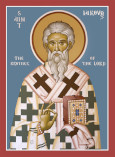 He is called ‘the Lord’s
brother’ because he was the son of righteous Joseph, the betrothed of the most holy Mother
of God. When Joseph was dying, he shared out his goods among his sons and wanted to leave a share
to the Lord Jesus, the Son of the most holy Virgin Mary, but his sons opposed this, not reckoning
Jesus to be a brother of theirs. Iakovos, though, loved Jesus greatly and announced that he would
include Him in his share, counting himself to be indeed brother to the Lord. Iakovos was, from
the first, devoted to the Lord Jesus. According to tradition, he went to Egypt with the most holy
Virgin and Joseph when Herod tried to kill the newborn King. As soon as he heard Christ’s
teaching, he began to live by it. It is said that, during the whole of his life, he ate neither
fat nor oil, but lived only on bread and water, and he was chaste to the end of his days. He
often kept a vigil of prayer at night. The Lord included him among His Seventy apostles,
appearing to him after His glorious Resurrection, as the Apostle Paul testifies (I Cor. 15:7). He
was bishop in Jerusalem for thirty years, and governed the Church of God with zeal. On the
Lord’s instructions, he composed the first Liturgy, which was far too long for later
Christians and was shortened by St. Basil and St. John Chrysostom. He brought many Jews and
Greeks to the Christian Faith, and even unbelieving Jews marveled at his justice, nicknaming him
Iakovos the Just.
He is called ‘the Lord’s
brother’ because he was the son of righteous Joseph, the betrothed of the most holy Mother
of God. When Joseph was dying, he shared out his goods among his sons and wanted to leave a share
to the Lord Jesus, the Son of the most holy Virgin Mary, but his sons opposed this, not reckoning
Jesus to be a brother of theirs. Iakovos, though, loved Jesus greatly and announced that he would
include Him in his share, counting himself to be indeed brother to the Lord. Iakovos was, from
the first, devoted to the Lord Jesus. According to tradition, he went to Egypt with the most holy
Virgin and Joseph when Herod tried to kill the newborn King. As soon as he heard Christ’s
teaching, he began to live by it. It is said that, during the whole of his life, he ate neither
fat nor oil, but lived only on bread and water, and he was chaste to the end of his days. He
often kept a vigil of prayer at night. The Lord included him among His Seventy apostles,
appearing to him after His glorious Resurrection, as the Apostle Paul testifies (I Cor. 15:7). He
was bishop in Jerusalem for thirty years, and governed the Church of God with zeal. On the
Lord’s instructions, he composed the first Liturgy, which was far too long for later
Christians and was shortened by St. Basil and St. John Chrysostom. He brought many Jews and
Greeks to the Christian Faith, and even unbelieving Jews marveled at his justice, nicknaming him
Iakovos the Just.
When Ananias became high priest, he decided, along with other of the Jewish elders, to kill Iakovos because he was a preacher of Christ. One day, on Pascha, when many people were gathered in Jerusalem, the elders told him to climb up onto a roof and speak a spiritual discourse. St. Iakovos climbed up there and began to speak to the people about Christ as the Son of God and the true Messiah, and of His Resurrection and eternal glory in heaven. The infuriated priests and elders cast him down from the roof, and he was badly injured though still alive. A man then ran up and gave him such a vicious blow on the head that his brains spilled out. Thus this glorious apostle of Christ died a martyr’s death and entered into the kingdom of his Lord. Iakovos was sixty-three years old when he suffered for Christ.
2. St. Ignatius (Ignatios), Patriarch of Constantinople.
Son of the Emperor Michael Rangabe, he became patriarch after St. Methodius, in 846, but was deposed in 858 and sent into exile. Photius, the emperor’s chief secretary, was made patriarch in his place, but when the Emperor Basil the Macedonian came to the throne, he re-instated Ignatius. St. Ignatius governed the Church with great zeal and wisdom, and built a monastery of the Holy Archangels, in which he entered into rest in the Lord in 877, at the age of eighty-nine.
3. The Holy Martyr Iakov of Borovitz.
About this saint, there is only known that which was revealed after his death in a vision to some people in Borovitz. His body was floating on a river near that town one day in 1540, and came to rest there. Many miracles were worked by his relics.
FOR CONSIDERATION
God’s is the grace and ours is the toil. Let no one, then, think that, as the holy apostles relied solely on the grace of God, it was easy for them: that they were able without effort to accomplish their great task in the world. Does not the Apostle Paul say, ‘I subdue my body...lest, when I have preached to others, I myself should become unapproved’ (I Cor. 9:27)? And, in another place, does he not describe how he spent his life in ‘perils, in weariness, in painfulness, in watchings, in hunger and thirst, in fastings, in cold, in nakedness’ (II Cor. 11:26-27)? The holy Apostle Iakovos ate only bread, and very little of that: he slept very little, and spent his nights in prayer. He knelt so much in prayer that the skin of his knees became as hard as that on the knees of a camel. This brother of the Lord prayed with tears and sighs, not only for the Church that he governed, but for the whole world. Even when he was thrown down from the roof of the Temple by the wicked Jews and terribly injured, the holy apostle did not for one moment forget his debt to God and man. Summoning his last strength, he pulled himself to his knees, stretched out his hands to heaven and prayed to God with all his heart, saying: ‘Lord, forgive them this sin; they don’t know what they are doing.’ While he was thus praying, evil men began stoning him on all sides. Seeing this, one man cried out: ‘Stop it; what are you doing? This just man is praying to God for you, and you’re killing him!’ but that shout from a single goodly soul could not hold back the accustomed evil-doing of the butchers from slaying the saint of God. The apostles, then, did not just lean on grace, but alongside it and interwoven with it, invested almost superhuman efforts in showing themselves worthy of God’s grace.
Daily Scripture Readings taken from The Orthodox New Testament, translated and published by Holy Apostles Convent, Buena Vista, Colorado, copyright © 2000, used with permission, all rights reserved.
Daily Prologue Readings taken from The Prologue of Ochrid, by Bishop Nikolai Velimirovic, translated by Mother Maria, published by Lazarica Press, Birmingham, England, copyright © 1985, all rights reserved. Edited by Dormition Skete.