

Daily Devotional
Wednesday, August 30, 2028 (NS), August 17, 2028 (OS)
Fast Day, but Wine and Olive Oil Allowed.
Wednesday of the Thirteenth Week
The commemoration of the Afterfeast of the Dormition, and the holy Martyr Myron of Kyzikos.
Scripture Readings
Paschalion — Movable Calendar
Wednesday of the Thirteenth Week
Epistle
The Reading is from the Second Epistle of Saint Paul to the Corinthians [§ 189]. Brethren:
9 12The ministration of this public work is not only filling up the needs of the saints, but is abounding also through many thanksgivings to God, 13since, through the proof of this ministration, they glorify God for the obedience of your confession to the Gospel of the Christ, and for the open-handedness of your contribution toward them and toward all; 14and in their entreaty on your behalf, they are longing for you on account of the surpassing grace of God upon you. 15Now thanks be to God for His indescribable gift.
10 1Now I, Paul, myself beseech you through the meekness and gentleness of the Christ, who in person, indeed, am lowly among you, but being absent am bold toward you: 2but I entreat you that when I am present I may not be bold with the confidence with which I am counting on myself to be daring against some, who count us as walking according to the flesh. 3For though we walk in the flesh, we do not war according to the flesh. 4For the weapons of our warfare are not of the flesh, but mighty through God to the pulling down of strongholds, 5overthrowing reasonings and every high thing which lifteth itself up against the knowledge of God, and bringing into captivity every thought to the obedience of the Christ, 6and holding fast in readiness to avenge all disobedience, whenever your obedience should be fulfilled.
7Ye look at things according to appearance! If anyone hath persuaded himself to be of Christ, let him consider this of himself, that even as he is of Christ, even so are we of Christ.
Gospel
The Reading is from the Holy Gospel according to Saint Mark [§ 13]. At that time:
3 20Jesus went into a house; and a crowd cometh together again, so that it is not possible for them even to eat bread. 21And after those with Him heard of it, they went out to lay hold of Him; for they were saying, “He is beside Himself.” 22And the scribes, who were from Jerusalem, came down and kept on saying, “He hath Beelzebul,” and, “By the ruler of the demons He casteth out the demons.” 23And He called them to Himself, and was speaking to them in parables, “How is Satan able to cast out Satan? 24“And if a kingdom should be divided against itself, that kingdom is not able to stand; 25“and if a house should be divided against itself, that house is not able to stand. 26“And if Satan hath risen up against himself, and hath been divided, he is not able to stand, but hath an end. 27“No one in anywise, having entered into the strong one’s house, is able to plunder his vessels, unless he should first bind the strong one; and then he will plunder his house.”
Menaion — Fixed Calendar
The commemoration of the Afterfeast of the Dormition, and the holy Martyr Myron of Kyzikos.
No readings given.
Lives of the Saints (Prologue)
August 30th – Civil Calendar
August 17th – Church Calendar
1. The Holy Martyr Myron the Priest.
He was a priest in Achaia, of rich and eminent parents, by nature kind and meek, and loving towards God and man. In the time of the Emperor Decius, on the Feast of the Nativity itself, pagans rushed into the church, dragged Myron away from the service and put him to torture. While he was being tortured by fire, an angel appeared to him and strengthened him. The torturers then cut off his skin in strips from head to foot. The martyr took one of these strips, and with it, struck the torturer on the face. The torturer, as though possessed, took a sword and killed himself. Myron was finally taken to the town of Kyzikos and there killed with the sword, in 250.
2. The Holy Martyr Patroclus.
A citizen of the city of Trychasia, the present-day Troyes in Gaul, he inherited great wealth from his parents, and as a true Christian, used it for daily alms to the poor. He himself lived as an ascetic, taking food only once a day after sunset. For his holiness of life, the Lord gave him healing power, and he became known everywhere as a wonder-working healer. The Emperor Aurelian, coming to Gaul, commanded that Patroclus be brought before him. Holy Patroclus confessed his faith in Christ, concealing nothing. ‘If, O king, you desire some of my goods, I will give them to you, for I can see your wretchedness,’ St. Patroclus said to the emperor. To this, the emperor replied: ‘How do you call me, the emperor, wretched, having immeasurable wealth?’ St. Patroclus said: ‘You have earthly, transitory riches, but you are wretched, for you are not only not in possession of yourself; you have no faith in Christ in your heart.’ He was condemned to death and handed over to the soldiers, with orders that he be taken to a swampy spot and beheaded, his body being left in the mud. But the saint prayed to God that his body should not be left thus in the mud, and by God’s power, he suddenly became invisible to the soldiers and taken across to the other side of the river. After seeking him at some length, the soldiers found him and beheaded him in that dry place. Two beggars, to whom Patroclus had often given alms, came along this way, and recognising the body of their benefactor, buried it. He died at the end of the third century.
3. Our Holy Father Elias of Calabria.
A Greek by birth, he was superior of the monastery of Mellicia in southern Italy. At the time of the iconoclast controversy in the East, many eastern monks fled with their icons to Calabria. In time, the monastic life spread very widely there. The Calabrian monks were distinguished for their learning and the strictness of their lives. At one time, there were so many Orthodox monasteries and monks there that Calabria was likened to Egypt in former times. Orthodox Calabria was later put under the administration of the Archbishop of Ochrid. Our holy father Elias entered into rest in Thessalonica in the year 903.
4. Our Holy Father Alypy the Iconographer of the Kiev Caves.
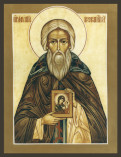 Making copies of the
faces of the saints on wood, he copied their virtues in his own soul. He healed a man of
leprosy, saw an angel of God and died peacefully in the Lord in old age, in 1114. Making copies of the
faces of the saints on wood, he copied their virtues in his own soul. He healed a man of
leprosy, saw an angel of God and died peacefully in the Lord in old age, in 1114.
|
FOR CONSIDERATION
The Lord does not let His faithful servants be put to shame. It often happens that Christ’s martyrs, mocked and sneered at by their judges, suddenly work some wonder that brings terror to the godless. Idols have fallen, thunderbolts have destroyed pagan temples, unexpected downpours have put out fires prepared for their burning, stones and staves have turned back on the torturers themselves, and other similar things have happened. Thus Antipater, the torturer of St. Myron, during the torturing of this man of God, suddenly went out of his mind.
St. Alypy (Alypius) the Iconographer was already near the end of his life when he received an order to paint an icon of the dormition of the most holy Mother of God. As the feast drew near, the man returned several times, to see if the icon was finished. But it was not even begun on the Eve of the Dormition itself, when it should have been placed in the church. When this man had gone home in despair, a young man suddenly appeared in Alypy’s cell, sat down and began to work on the icon. He worked very quickly and with great skill. When the icon was ready, it shone like the sun. Showing it to the amazed Alypy, the young man took the icon and went to the church for which it had been ordered. On the following day, the man who had ordered it came to the church, and in sheer astonishment, saw the icon in its place. The man then went to the monastery, and together with the abbot, went into Alypy’s cell. ‘How was this icon painted, and by whom?’ asked the abbot. The sick Alypy replied: ‘It was painted by an angel, and he is standing here, waiting to take me.’ Thus saying, he breathed his last.
Daily Scripture Readings taken from The Orthodox New Testament, translated and published by Holy Apostles Convent, Buena Vista, Colorado, copyright © 2000, used with permission, all rights reserved.
Daily Prologue Readings taken from The Prologue of Ochrid, by Bishop Nikolai Velimirovic, translated by Mother Maria, published by Lazarica Press, Birmingham, England, copyright © 1985, all rights reserved. Edited by Dormition Skete.