

Daily Devotional
Monday, August 14, 2028 (NS), August 1, 2028 (OS)
Fast Day. No Meat, Fish, Dairy, Eggs, Alcohol or Olive Oil Allowed.
Dormition Fast Begins
Monday of the Eleventh Week
| The commemoration of the Procession of the precious Wood of the life-giving Cross of the Lord, and the holy Seven Children of the Maccabees, and their mother Solomone, and their teacher Eleazar. |
Scripture Readings
Paschalion — Movable Calendar
Monday of the Eleventh Week
Epistle
The Reading is from the Second Epistle of Saint Paul to the Corinthians [§ 171]. Brethren:
2 3My joy is the joy of you all. 4For out of much affliction and anguish of heart I wrote to you through many tears, not that ye should be grieved, but that ye might know the love which I have more abundantly toward you.
5But if anyone hath caused grief, he hath not grieved me, but in part—that I may not weigh him down—you all. 6Sufficient to such a one is this punishment which was by the majority; 7so that, on the contrary, ye ought rather to graciously forgive and comfort him, lest such a one should be swallowed up by excessive grief. 8Wherefore I beseech you to confirm your love toward him. 9For in regard to this also did I write, that I might know the proof of you, if ye are obedient in all things. 10But to whom ye graciously forgive anything, I also; for if I also have graciously forgiven anything, what I have graciously forgiven, it hath been for your sakes in the person of Christ, 11lest Satan should get the advantage over us, for we are not ignorant of his designs.
12Now, after I came to Troas for the Gospel of the Christ, and a door was opened to me in the Lord, 13I had no rest in my spirit at my not having found Titus my brother; but having bid farewell to them, I went forth to Macedonia. 14But thanks be to God Who always causeth us to triumph in the Christ, and maketh manifest the fragrance of the knowledge of Him by us in every place. 15For we are to God a sweet smelling fragrance of Christ in those being saved and in those perishing.
Gospel
The Reading is from the Holy Gospel according to Saint Matthew [§ 94]. The Lord said to those Jews who had come to Him:
23 13“Woe to you, scribes and Pharisees, hypocrites! For ye devour the houses of widows, and for a pretense are offering long prayers; on this account ye shall receive greater condemnation. 14“Woe to you, scribes and Pharisees, hypocrites! For ye shut the kingdom of the heavens before men; for ye do not enter, neither do ye permit to enter those who are trying to enter. 15“Woe to you, scribes and Pharisees, hypocrites! For ye go about the sea and the dry land to make one proselyte, and whenever he should become one, ye make him twofold more a son of Gehenna than yourselves. 16“Woe to you, blind guides, who are saying, ‘Whosoever shall swear by the temple, it is nothing; but whosoever shall swear by the gold of the temple, he is bound.’ 17“Fools and blind! For which is greater, the gold or the temple that sanctifieth the gold? 18“And, ‘Whosoever shall swear by the altar, it is nothing; but whosoever shall swear by the gift that is upon it, he is bound.’ 19“Fools and blind! For which is greater, the gift or the altar that sanctifieth the gift? 20“Therefore the one who sweareth by the altar, sweareth by it, and by all things that are upon it. 21“And the one who sweareth by the temple, sweareth by it and by the One Who dwelleth in it. 22“And the one who sweareth by the heaven, sweareth by the throne of God, and by the One Who sitteth upon it.”
Menaion — Fixed Calendar
The commemoration of the Procession of the precious Wood of the life-giving Cross of the Lord, and the holy Seven Children of the Maccabees, and their mother Solomone, and their teacher Eleazar.
Epistle
For the Cross:
The Reading is from the First Epistle of Saint Paul to the Corinthians [§ 125]. Brethren:
1 18The word, that of the Cross, on the one hand, to those who are perishing is foolishness, but on the other hand, to us who are being saved, it is the power of God. 19For it hath been written: “I will destroy the wisdom of the wise, and will set at nought the comprehension of the intelligent [cf. Is. 29:14].” 20Where is the wise? Where is the scribe? Where is the disputer of this age? Did not God make foolish the wisdom of this world? 21For since, in the wisdom of God, the world knew not God through its wisdom, it pleased God through the foolishness of the preaching to save those who believe. 22For indeed, Jews ask for a sign, and Greeks seek wisdom; 23but we proclaim Christ Who hath been crucified, to Jews, on the one hand, a stumbling block, and to Greeks, on the other hand, foolishness, 24but to those who are called, both Jews and Greeks, Christ, God’s power and God’s wisdom.
For the Maccabees:
The Reading is from the Epistle of Saint Paul to the Hebrews [§§ 330, 331]. Brethren:
11 33All the saints through faith struggled against kingdoms, wrought righteousness, attained to promises, stopped mouths of lions, 34quenched the power of fire, escaped the edges of the sword, were empowered out of weakness, became strong in battle, turned back encampments of aliens. 35Women received their dead by resurrection. And others were tortured, not accepting release, that they might attain a better resurrection. 36And others received trial of mockings and of scourgings, and, moreover, of bonds and of imprisonment. 37They were stoned, they were sawn asunder, were tempted; they died, murdered by the sword. They went about in sheepskins, in goatskins, being in need, afflicted, ill-treated— 38of whom the world was not worthy. They were made to wander in deserts, and in mountains, and in caves, and in the holes of the earth. 39And these all, having been approved by testimony through faith, received not for themselves the promise, 40God having foreseen some better thing concerning us, that they should not be made perfect without us.
12 1Therefore we also, having so great a cloud of witnesses which is set around us, and having laid aside every weight and sin that is easily circumvented, let us by means of patience be running the course which is set before us, 2looking to Jesus, the originator and accomplisher of our faith, Who, in exchange for the joy set before Him, endured a cross, having despised the shame, and hath sat down on the right of the throne of God.
for Sl. usage, see [Heb. 11:33-40].
Gospel
For the Cross:
The Reading is from the Holy Gospel according to Saint John [§§ 60, 61]. At that time:
19 6When the chief priests and the officers saw Jesus, they cried out, saying, “Crucify, crucify Him.” Pilate saith to them, “Ye take Him and crucify Him, for I find no cause for accusation in Him.” 7The Jews answered him, “We have a law, and according to our law He ought to die, because He made Himself Son of God.” 8Therefore, when Pilate heard this saying, he was the more afraid. 9And he entered into the Prætorium again, and saith to Jesus, “From what place art Thou?” But Jesus did not give him an answer. 10Then Pilate saith to Him, “Speakest Thou not to me? Knowest Thou not that I have authority to crucify Thee, and authority to release Thee?” 11Jesus answered, “Thou wouldest have no authority at all against Me, except it were given to thee from above.”... 13Therefore Pilate, having heard this saying, brought out Jesus, and took his seat upon the tribunal in a place which is called Lithostrotos, but in Hebrew, Gabbatha. 14Now it was the preparation of the passover, and about the sixth hour. And he saith to the Jews, “Behold your King!” 15But they cried out, “Take Him away, take Him away, crucify Him.” Pilate saith to them, “Your King shall I crucify?” The chief priests answered, “We have no king except Cæsar.” 16Therefore he then delivered Him up to them, in order that He might be crucified.
And they took Jesus and led Him away. 17And bearing His Cross, He went out to the place called Place of a Skull, which is called in Hebrew, Golgotha, 18where they crucified Him, and two others with Him, on the one side and the other, and Jesus in the middle. 19And Pilate also wrote a title, and put it on the Cross. And it was written: “Jesus the Nazaræan, the King of the Jews.” 20Therefore many of the Jews read this title, for the place where Jesus was crucified was near the city; and it was written in Hebrew, in Greek, and in Latin. 21Then the chief priests of the Jews were saying to Pilate, “Write not, ‘The King of the Jews,’ but that ‘He said, “I am King of the Jews.”’” 22Pilate answered, “What I have written, I have written.”
23Then the soldiers, when they crucified Jesus, took His garments and made four parts, to each soldier a part, and also the tunic; but the tunic was seamless, woven from the top throughout. 24They said therefore to one another, “Let us not tear it, but let us obtain it by lot for whom it shall be,” that the Scripture might be fulfilled, which saith, “They parted My garments among themselves, and upon My clothing they cast a lot [Ps. 21(22):18].” These things therefore the soldiers did. 25Now there had stood by the Cross of Jesus His Mother, and His Mother’s sister, Mary the wife of Cleopas, and Mary Magdalene. 26Then Jesus, having seen His Mother and the disciple whom He loved standing by, saith to His Mother, “Woman, behold thy son.” 27Then He saith to the disciple, “Behold, thy Mother.” And from that hour the disciple took her into his own home. 28After this, Jesus, knowing that all things now have been accomplished, that the Scripture might be fulfilled, saith, “I thirst.”... 30Then, when Jesus took the vinegar, He said, “It hath been finished.” And having bowed His head, He delivered up the spirit.
31The Jews therefore, since it was the preparation, in order that the bodies should not remain upon the cross on the sabbath—for great was the day of that sabbath—asked Pilate that their legs might be broken, and that they might be taken away. 32Then the soldiers came and indeed broke the legs of the first and of the other who was crucified with Him. 33But when they came to Jesus and saw that He was already dead, they did not break His legs. 34But one of the soldiers pierced His side with a spear, and straightway blood and water came out. 35And the one who hath seen it hath borne witness, and his testimony is true; and that one knoweth that he speaketh true things, that also ye might believe.
For the Maccabees:
The Reading is from the Holy Gospel according to Saint Matthew [§ 36]. The Lord said to His disciples:
10 16“Behold, I send you forth as sheep in the midst of wolves. Become therefore wise as the serpents and guileless as the doves. 17“But continue being on guard against men; for they will deliver you up to councils, and they will scourge you in their synagogues. 18“And also ye shall be brought before governors and kings on account of Me, for a testimony to them and to the nations. 19“But whenever they deliver you up, do not become anxious about how or what ye should speak; for it shall be given to you in that hour what ye shall speak. 20“For ye are not the ones who are speaking, but the Spirit of your Father Who is speaking in you. 21“Now a brother shall deliver up a brother to death, and a father a child; and children shall rise up against parents and shall put them to death. 22“And ye shall be hated by all for My name’s sake; but the one who endureth to the end, this one shall be saved.”
for Sl. usage, see [Mt. 10:32, 33, 37, 38; 19:27-30].
Lives of the Saints (Prologue)
August 14th – Civil Calendar
August 1st – Church Calendar
1. The Seven Maccabees, their Mother Solomonia and Eleazar the Priest.
They all suffered for the purity of the Israelite faith under King Antiochus, called by some ‘Epiphanes’— God manifest—and by others, ‘Epimanes’—mad. For the great sins of Jerusalem, and especially for the wresting-away of the high-priestly power and the wickedness that ensued, the Lord let loose great calamity on the holy city. Antiochus desired after that to bring the Jews to idolatry in place of their faith in the one, living God, and did all he could to this end. He was helped in his intention by several disaffected high priests and elders of Jerusalem. The king once came himself to Jerusalem and commanded that all Jews eat pork, which was against the law of Moses and was therefore a recognizable sign of apostasy from the Jewish faith. The elder Eleazar, a priest and one of the seventy translators of the Old Testament into Greek, refused to eat pork. He was therefore tortured and burned. Returning to Antioch, the king took the seven young men, the Maccabees, and their mother Solomonia (II Macc. 6:18-7:41). The seven Maccabean brothers were called: Avim, Antonius, Eleazar, Gurius, Evsebon, Achim and Marcellus. Before their mother’s eyes, the wicked king tortured her sons one after the other, flaying the skin from their faces and then throwing them into the flames. They all endured torture and death with courage, remaining steadfast in their faith. Finally their mother, when she saw her three-year-old son in the fire, threw herself into the flames and perished, giving her soul into God’s hands. They all suffered with honor for their faith in the one, living God in about 167 B.C.
2. The Procession of the Precious Cross.
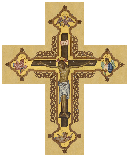 This feast was established jointly by the Greeks and
Russians in the time of the Greek Emperor Manuel and the Russian Prince Andrei, as a memorial of
the simultaneous victories of the Russians over the Bulgars and the Greeks over the Saracens. In
both battles, the soldiers carried crosses, from which a heavenly radiance shone forth, with the
army. It was therefore instituted that, on August 1st, the Cross be carried from the Church of
Hagia Sophia, first around the interior of the church and then through the streets, to give the
people the chance to venerate it, as a memorial of the miraculous help given by the Cross in
earlier wars. This was not just any cross, but the true Precious Cross itself, which was kept in
the church of the imperial court. On July 31st, the Precious Cross was taken from the imperial
court to Hagia Sophia, and thence carried through the streets, to consecrate the earth and the
air. Finally, on August 14th, it was taken back to the church in the imperial palace.
This feast was established jointly by the Greeks and
Russians in the time of the Greek Emperor Manuel and the Russian Prince Andrei, as a memorial of
the simultaneous victories of the Russians over the Bulgars and the Greeks over the Saracens. In
both battles, the soldiers carried crosses, from which a heavenly radiance shone forth, with the
army. It was therefore instituted that, on August 1st, the Cross be carried from the Church of
Hagia Sophia, first around the interior of the church and then through the streets, to give the
people the chance to venerate it, as a memorial of the miraculous help given by the Cross in
earlier wars. This was not just any cross, but the true Precious Cross itself, which was kept in
the church of the imperial court. On July 31st, the Precious Cross was taken from the imperial
court to Hagia Sophia, and thence carried through the streets, to consecrate the earth and the
air. Finally, on August 14th, it was taken back to the church in the imperial palace.
3. The Nine Holy Martyrs: Leontius, Attus, Alexander, Cindeus, Mnesitheus, Cyriacus, Menaeus, Catunus and Eucieus.
The first was a carpenter and the others workers of the land. For their bold confession of the Christian Faith and for their destruction of the temple of Artemis, they were harshly tortured and beheaded in Perga of Pamphylia in the time of Diocletian, in about 300, and became inheritors of the kingdom of Christ.
FOR CONSIDERATION
A weak man habitually defends himself by hypocrisy and a strong man by tyranny, but no man can protect his life before God either by hypocrisy or tyranny. This is clearly shown to us by the example of the holy elder Eleazar and King Antiochus. When the tyrannical king brought Eleazar out for trial and urged him to eat pork, desiring to preserve his life, Eleazar firmly refused. Then some of Eleazar’s friends handed him a piece of some other meat, not pork, begging him to eat that in front of the king and thus save his life and salve his conscience. The elder rejected this suggestion, saying to his friends: ‘It would not be fitting for me, an old man, to be a stumbling-block to the young by hypocrisy,’ and the elder perished in the flesh, but saved his soul. God’s punishment came upon the tyrannical king even in this life. A terrible internal illness fell on him; his body was infested with worms and the stench spread far. In his despair, he called to mind the shedding of the innocent blood of the thousands of human beings who had, on his orders, been inexcusably slaughtered. Fear of God came upon him, and he began to confess the one God, Whom he had formerly persecuted in persecuting His faithful ones. But there was no sign from heaven towards him.
Daily Scripture Readings taken from The Orthodox New Testament, translated and published by Holy Apostles Convent, Buena Vista, Colorado, copyright © 2000, used with permission, all rights reserved.
Daily Prologue Readings taken from The Prologue of Ochrid, by Bishop Nikolai Velimirovic, translated by Mother Maria, published by Lazarica Press, Birmingham, England, copyright © 1985, all rights reserved. Edited by Dormition Skete.