

Daily Devotional
Thursday, August 22, 2024 (NS), August 9, 2024 (OS)
Fast Day. No Meat, Fish, Dairy, Eggs, Alcohol or Olive Oil Allowed.
Thursday of the Ninth Week
The commemoration of the Afterfeast of the Transfiguration, and the holy Apostle Matthias.
Scripture Readings
Paschalion — Movable Calendar
Thursday of the Ninth Week
Epistle
The Reading is from the First Epistle of Saint Paul to the Corinthians [§ 155].
14 6Brethren, if I should come to you speaking with tongues, what shall I profit you, unless I speak to you either in revelation, or in knowledge, or in prophecy, or in teaching? 7Likewise, when lifeless things give a sound, whether flute or harp, if a distinction is never given in the sounds, how shall it be known what is being piped or being harped? 8For also if a trumpet should give an uncertain sound, who shall prepare himself for war? 9Thus also, unless by the tongue ye should give an easily understood speech, how shall it be known what is being spoken? For ye shall speak into the air. 10There are, if it should happen, so many kinds of speech in the world, and none of them is without its distinctive sound. 11Therefore, if I do not know the force of the speech, I shall be a barbarian to the one who speaketh, and the one who speaketh shall be a barbarian to me. 12Even so ye, since ye are zealots of spiritual gifts, keep on seeking that ye may abound to the building up of the Church. 13Wherefore let the one who speaketh in a tongue pray that he may interpret. 14For if I should pray in a tongue, my spirit prayeth, but my understanding is unfruitful. 15What is it then? I will pray with the spirit, and I will pray also with the understanding. I will chant with the spirit, and I will chant also with the understanding. 16Else if thou bless with the spirit, how shall the one who filleth the place of the unlearned say the “Amen” at thy giving of thanks, since what thou sayest he knoweth not? 17For thou indeed givest thanks well, but the other is not being edified. 18I thank my God I speak with tongues more than all of you; 19but in the church I wish to speak five words with my understanding, in order that I might instruct others also, than myriads of words in a tongue.
Gospel
The Reading is from the Holy Gospel according to Saint Matthew [§ 81]. At that time:
20 17When Jesus went up to Jerusalem, He took the twelve disciples apart in the way and said to them, 18“Behold, we are going up to Jerusalem, and the Son of Man shall be delivered up to the chief priests and scribes; and they shall condemn Him to death, 19“and shall deliver Him up to the Gentiles to mock and to scourge and to crucify. And the third day He shall raise Himself.” 20Then the mother of the sons of Zebedee came to Him with her sons, making obeisance and asking something from Him. 21And He said to her, “What dost thou wish?” She saith to Him, “Command that these two sons of mine might sit, one on Thy right and one on Thy left, in Thy kingdom.” 22But Jesus answered and said, “Ye know not what ye ask for yourselves. Are ye able to drink the cup which I am about to drink, and to be baptized with the baptism with which I am baptized?” They say to Him, “We are able.” 23And He saith to them, “Ye shall indeed drink My cup, and be baptized with the baptism with which I am baptized; but to sit on My right and on My left is not Mine to give, but it shall be given to those for whom it hath been prepared by My Father.” 24And after the ten heard it, they were indignant on account of the two brothers. 25But Jesus called them to Himself and said, “Ye know that the rulers of the nations exercise lordship over them, and the great ones exercise authority over them. 26“But it shall not be so among you. But whosoever doth wish to become great among you shall be your servant; 27“and whosoever doth wish to be first among you shall be your slave— 28“even as the Son of Man came not to be served, but to serve, and to give His life a ransom for many.”
Menaion — Fixed Calendar
The commemoration of the Afterfeast of the Transfiguration, and the holy Apostle Matthias.
Epistle
The Reading is from the Acts of the Apostles [§ 2]. In those days:
1 12The apostles returned to Jerusalem from the mount which is called the Mount of Olives, which is near Jerusalem, being a sabbath’s day journey. 13And when they entered, they went up into the upper chamber where they were staying, both Peter and Iakovos, and John and Andrew, Philip and Thomas, Bartholomew and Matthew, Iakovos the son of Alphæos and Simon the Zealot, and Judas the brother of Iakovos. 14These all were persevering with one accord in prayer and in entreaty, with the women and Mary the Mother of Jesus, and with His brethren.
15And in those days Peter stood up in the midst of the disciples—there was a multitude of persons in the same place, about a hundred and twenty—and said, 16“Men, brethren, it was needful for this Scripture to have been fulfilled, which the Holy Spirit spoke before by the mouth of David concerning Judas, who became a guide to those who arrested Jesus; 17“for he was numbered with us and obtained as his portion the lot of this ministry.... 21“It is needful, therefore, of those men who were in company with us during all the time in which the Lord Jesus went in and went out among us, 22“beginning from the baptism of John until the day in which He was taken up from us, for one of these to become a witness of His resurrection with us.” 23And they set forth two: Joseph called Barsavas, who was surnamed Justos, and Matthias. 24And they prayed and said, “Thou, Lord, O Knower of the hearts of all, show which one of these two Thou didst choose for Thyself, 25“to receive the lot of this ministry and apostleship, from which Judas transgressed, to go to his own place.” 26And they gave their lots, and the lot fell upon Matthias; and he was reckoned along with the eleven apostles.
Gospel
The Reading is from the Holy Gospel according to Saint Luke [§ 51]. The Lord said to His disciples:
10 16“The one who heareth you heareth Me, and the one who rejecteth you rejecteth Me, and the one who rejecteth Me rejecteth the One Who sent Me forth.”
17And the seventy returned with joy, saying, “Lord, even the demons are being made subject to us in Thy name.” 18And He said to them, “I was beholding Satan as lightning having fallen out of the heaven. 19“Behold, I give you the authority to tread upon serpents and scorpions, and upon all the power of the enemy; and nothing in anywise shall injure you. 20“However cease rejoicing in this, that the spirits are being made subject to you; but be rejoicing that your names were written in the heavens.” 21In the same hour Jesus rejoiced in the Spirit, and said, “I give thanks to Thee, O Father, Lord of the heaven and of the earth, that Thou didst hide these things from the wise and intelligent, and didst reveal them to babes. Yea, Father, for thus it was well-pleasing before Thee.”
for Sl. usage, see [Lk. 9:1-6].
Lives of the Saints (Prologue)
August 22nd – Civil Calendar
August 9th – Church Calendar
1. The Holy Apostle Matthias.
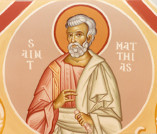 Born in Bethlehem of the tribe of Judah, he was a pupil of St.
Simeon the God-Receiver in Jerusalem. When the Lord began preaching the kingdom of God, Matthias
was among those who loved the Lord with all their hearts, heard His words and saw His works with
delight. Matthias was at first included among the seventy, lesser apostles of Christ, but after
the Lord’s Resurrection, because the place of Judas the betrayer fell vacant, the apostles
chose this Matthias by lot in Judas’ place as one of the twelve great apostles (Acts 1:23).
Receiving the Holy Spirit at Pentecost, Matthias began to preach the Gospel, first in Judea then
in Ethiopia, where he suffered greatly for the sake of Christ. It is held that he preached also
in Macedonia, where they tried to bind him, but he became invisible to his tormentors and thus
escaped danger. When he was imprisoned, the Lord appeared to him, gave him courage and set him
free. He finally returned to work in Judea. There he was arrested and taken for trial before
Ananias the high priest, before whom he fearlessly witnessed to Christ. Ananias (the same who had
earlier killed the Apostle Iakovos) condemned Matthias to death. They took Matthias out and
stoned him to death, then cut off his head with an axe (the Roman way of executing those
condemned to death. The hypocritical Jews used this method on the dead man, to prove to the
Romans that he had opposed Rome). So died this great apostle of Christ, and went to the eternal
joy of his Lord.
Born in Bethlehem of the tribe of Judah, he was a pupil of St.
Simeon the God-Receiver in Jerusalem. When the Lord began preaching the kingdom of God, Matthias
was among those who loved the Lord with all their hearts, heard His words and saw His works with
delight. Matthias was at first included among the seventy, lesser apostles of Christ, but after
the Lord’s Resurrection, because the place of Judas the betrayer fell vacant, the apostles
chose this Matthias by lot in Judas’ place as one of the twelve great apostles (Acts 1:23).
Receiving the Holy Spirit at Pentecost, Matthias began to preach the Gospel, first in Judea then
in Ethiopia, where he suffered greatly for the sake of Christ. It is held that he preached also
in Macedonia, where they tried to bind him, but he became invisible to his tormentors and thus
escaped danger. When he was imprisoned, the Lord appeared to him, gave him courage and set him
free. He finally returned to work in Judea. There he was arrested and taken for trial before
Ananias the high priest, before whom he fearlessly witnessed to Christ. Ananias (the same who had
earlier killed the Apostle Iakovos) condemned Matthias to death. They took Matthias out and
stoned him to death, then cut off his head with an axe (the Roman way of executing those
condemned to death. The hypocritical Jews used this method on the dead man, to prove to the
Romans that he had opposed Rome). So died this great apostle of Christ, and went to the eternal
joy of his Lord.
2. The Holy Martyr Anthony.
He was a citizen of Alexandria. Brought before the pagan governor, he freely declared his faith and was tortured—whipped and flogged—but would not deny Christ. He was finally cast into the flames, from the midst of which he said to the people: ‘My beloved brethren, do not be enslaved by your bodies, but give thought to your souls, given to you by God and kin to God and to the heavenly powers.’ He thus instructed the people, and being burned in the fire, gave his holy soul to God.
3. The Holy Martyrs Julian and Marcian, and others with them.
They suffered at the hands of the iconoclasts under the wicked Emperor Leo the Isaurian, in 726, and were crowned with unfading glory.
FOR CONSIDERATION
To take another’s sin on oneself is a form of martyrdom, and a sign of very great love for one’s neighbor. As the wages of sin is death (cf. James 1:15), to take another’s sin on oneself is to add a second death to one’s own. But God rewards with resurrection those who, from love, take another’s sin on themselves. There are many examples among the saints of this taking of a neighbor’s sin on oneself. Thus, it is said of St. Ammon: a brother fell into sin, then came to Ammon and told him that, because of his sin, he must leave the monastery and return to the world. Ammon told him that he would take the sin on himself, and urged the brother to remain in the monastery. The brother stayed, and the elder Ammon stood offering repentance and prayer to God. After a short time, the elder received a revelation from God that the sin was forgiven because of his love for the brother. When St. Makarios, St. Simeon the Fool for Christ, St. Theodore and others were accused of immorality, they did not defend themselves, but taking the sin of others on themselves, took also the harsh punishment for sin and patiently endured until God revealed their innocence to men.
Daily Scripture Readings taken from The Orthodox New Testament, translated and published by Holy Apostles Convent, Buena Vista, Colorado, copyright © 2000, used with permission, all rights reserved.
Daily Prologue Readings taken from The Prologue of Ochrid, by Bishop Nikolai Velimirovic, translated by Mother Maria, published by Lazarica Press, Birmingham, England, copyright © 1985, all rights reserved. Edited by Dormition Skete.