

Daily Devotional
Friday, August 9, 2024 (NS), July 27, 2024 (OS)
Fast Day, but Wine and Olive Oil Allowed.
Friday of the Seventh Week
The commemoration of the holy Great-martyr Panteleimon, the unmercenary healer.
Scripture Readings
Paschalion — Movable Calendar
Friday of the Seventh Week
Epistle
The Reading is from the First Epistle of Saint Paul to the Corinthians [§ 139]. Brethren:
7 35This I say for your own profit, not that I might cast a noose upon you, but for that which is seemly, and for constant waiting on the Lord without distraction. 36But if anyone think that he behaveth himself unseemly toward his virgin daughter, if she is past her prime, and so it ought to take place, let him do what he doth wish, he sinneth not; let them marry. 37But he who standeth steadfast in the heart, not having necessity, but hath authority concerning his own will, and hath judged this in his heart to keep his own virgin daughter, doeth well. 38So that also he who giveth her in marriage doeth well; but he who giveth her not in marriage doeth better. 39A wife hath been bound by law for as long a time as her husband liveth; but if her husband should repose, she is free to be married to whom she doth wish, only in the Lord. 40But she is happier if she should so remain, according to mine own opinion; and I think I also have the Spirit of God.
8 1Now concerning the sacrifices to idols, we know that we all have knowledge. Knowledge puffeth up, but love buildeth up. 2And if anyone think he hath come to know anything, he hath known nothing yet as he ought to know. 3But if anyone love God, the same is known by Him. 4Concerning then the eating of things sacrificed to idols, we know that an idol is nothing in the world, and that there is no other God except one. 5For even if indeed there are those called gods, whether in heaven or on the earth—just as there are many gods and many lords— 6but to us there is one God the Father, of Whom are all things, and we to Him, and one Lord Jesus Christ, through Whom are all things, and we through Him. 7But knowledge is not in all; but some, with consciousness of the idol, until now eat it as a sacrifice to an idol, and their conscience, being weak, is defiled.
Gospel
The Reading is from the Holy Gospel according to Saint Matthew [§ 63]. At that time:
15 29Jesus came near to the Sea of Galilee; and He went up into the mountain and was sitting there. 30And many crowds came to Him, having with them the lame, blind, mute, crippled, and many others; and they cast them at the feet of Jesus, and He healed them; 31insomuch that the crowds wondered when they saw the deaf hearing, the mute talking, the crippled healthy, the lame walking, and the blind seeing; and they glorified the God of Israel.
Menaion — Fixed Calendar
The commemoration of the holy Great-martyr Panteleimon, the unmercenary healer.
Epistle
The Reading is from the Second Epistle of Saint Paul to Saint Timothy [§ 292]. Child Timothy:
2 1Be thou empowered in the grace that is in Christ Jesus; 2and the things which thou heardest from me in the midst of many witnesses, commit thou these things to faithful men who shall be competent also to teach others. 3Thou therefore suffer hardship as a good soldier of Jesus Christ. 4No one serving as a soldier is entangled with the affairs of life, in order that he might please the one who enlisted him. 5And if anyone also contend as an athlete in the games, he is not crowned unless he contend lawfully. 6The farmer who laboreth must be first to partake of the fruits. 7Be considering what I say; O may the Lord give thee understanding in all things! 8Be remembering Jesus Christ, of the seed of David, Who hath been raised from the dead, according to my Gospel, 9in which I suffer hardship even to bonds as a malefactor, but the word of God hath not been bound. 10On this account I endure all things for the sake of the elect, that they might also attain salvation that is in Christ Jesus with eternal glory.
Gospel
The Reading is from the Holy Gospel according to Saint Luke [§ 106]. The Lord said to His disciples, “Be taking heed of men:
21 12“For they shall lay their hands upon you and persecute you, delivering you up to synagogues and prisons, bringing you before kings and governors on account of My name; 13“but it shall prove to be a testimony for you. 14“Therefore settle it for yourselves in your hearts not to premeditate to make a defense; 15“for I will give you a mouth and wisdom, which all those who oppose you shall not be able to contradict nor withstand. 16“And ye shall be delivered up also by parents, and kinfolk, and friends, and brethren; and they shall put some of you to death. 17“And ye shall be hated by all for My name’s sake. 18“But a hair of your head in no wise shall perish. 19“In your patience win your souls.”
for Sl. usage, see [Jn. 15:17-16:2].
Lives of the Saints (Prologue)
August 9th – Civil Calendar
July 27th – Church Calendar
1. The Holy and Great Martyr Panteleimon.
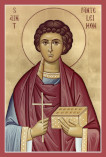 Born in Nikomedia of a Christian mother, Evoula,
and a pagan father, Efstorgios, he studied medicine as a young man. The priest Hermolaus
befriended him, instructed him in the Christian Faith and baptized him. Panteleimon miraculously
healed a blind man whom other doctors had treated in vain: he healed him by the name of Christ
and baptized him. From jealousy, the doctors denounced Panteleimon as a Christian, and he went
before the Emperor Maximian for judgement. ‘He stood before the earthly ruler in the body,
but in his mind he stood before the heavenly King.’ He freely declared himself to be a
Christian before the emperor, and in front of his eyes, healed a paralytic of a long infirmity.
This miracle brought many of the pagans to the Christian Faith. The emperor put him to torture,
but the Lord appeared to him on several occasions and delivered him whole and uninjured. Then St.
Hermolaus suffered, along with Hermippus and Hermocrates. Condemned to death, St. Panteleimon
knelt in prayer. At that, the executioner gave him a blow on the neck with his sword, and the
sword broke as if made of wax. The executioner could not kill him until he had finished his
prayer and had himself given the word to behead him. Panteleimon was beheaded under an olive
tree, which after that became laden with fruit. ‘Panteleimon’ means
‘all-merciful’. God the all-merciful received his righteous soul, and glorified him
among His greatest saints, his relics remaining incorrupt. This wonderful martyr suffered with
honor as a youth for Christ on July 27th, 304. St. Panteleimon is invoked in the prayers at the
blessing of water and the blessing of oil, together with St. Hermolaus and the other
unmercenaries and wonder-workers. The loveliest church and monastery dedicated to him are to be
found on the Holy Mountain.
Born in Nikomedia of a Christian mother, Evoula,
and a pagan father, Efstorgios, he studied medicine as a young man. The priest Hermolaus
befriended him, instructed him in the Christian Faith and baptized him. Panteleimon miraculously
healed a blind man whom other doctors had treated in vain: he healed him by the name of Christ
and baptized him. From jealousy, the doctors denounced Panteleimon as a Christian, and he went
before the Emperor Maximian for judgement. ‘He stood before the earthly ruler in the body,
but in his mind he stood before the heavenly King.’ He freely declared himself to be a
Christian before the emperor, and in front of his eyes, healed a paralytic of a long infirmity.
This miracle brought many of the pagans to the Christian Faith. The emperor put him to torture,
but the Lord appeared to him on several occasions and delivered him whole and uninjured. Then St.
Hermolaus suffered, along with Hermippus and Hermocrates. Condemned to death, St. Panteleimon
knelt in prayer. At that, the executioner gave him a blow on the neck with his sword, and the
sword broke as if made of wax. The executioner could not kill him until he had finished his
prayer and had himself given the word to behead him. Panteleimon was beheaded under an olive
tree, which after that became laden with fruit. ‘Panteleimon’ means
‘all-merciful’. God the all-merciful received his righteous soul, and glorified him
among His greatest saints, his relics remaining incorrupt. This wonderful martyr suffered with
honor as a youth for Christ on July 27th, 304. St. Panteleimon is invoked in the prayers at the
blessing of water and the blessing of oil, together with St. Hermolaus and the other
unmercenaries and wonder-workers. The loveliest church and monastery dedicated to him are to be
found on the Holy Mountain.
2. St. Clement, Archbishop of Ochrid.
He was a disciple of Saints Methodius and Kyril. After St. Methodius’ death, Clement, under pressure from the Germans, left Moravia for the south. With Gorazd, Naum, Sava and Angelarius—together called the Five Companions—he crossed the Danube, stayed with King Boris Michael and then went to the Ochrid region. He first founded a monastery at Belica, which he made his first episcopal seat, and later moved to Ochrid, from which center he covered a large area with his episcopal and teaching labors. In Ochrid, St. Clement built a church to St. Panteleimon. He had many followers, who copied books in Slavonic script for the use of the Slav people, being especially helped in this work by St. Naum. He performed miracles both during his lifetime and through his relics, which have healing power down to the present day. They lie in the church formerly dedicated to the Mother of God, which was later re-dedicated to St. Clement. After great labors and faithful service of God, he entered peacefully into rest in 916.
3. Blessed Nicholas.
A fool for Christ of Novgorod, he was the son of wealthy parents. He left his riches, and ran as a fool through the streets, teaching the people through his madness. His companion in the same ascesis was Blessed Theodore. Running at one time in the sight of the people, they both crossed a river on the surface of the water. Blessed Nicholas entered into rest in the Lord in 1392.
4. Our Holy Mother Anthusa.
After long asceticism in solitude, she founded a monastery of ninety nuns. During the iconoclast persecution under Constantine Kopronymos, all ninety nuns were murdered, and after that, St. Anthusa herself died, in 759.
5. The Hundred and Fifty Three Martyrs.
They were drowned in the sea in Thrace.
FOR CONSIDERATION
If you give alms to the poor, know that, insofar as you do good to your neighbor, you do it, and more, to yourself. St. Anthony says: ‘Life and death come to us through our neighbor,’ and St. Peter of Damascus writes: ‘As the poor are bounden to thank God and love the rich, who do good to them, so still more must the rich thank God and love the poor, because they are saved, in the providence of God, both now and in the world to come, by their alms. For, without the poor, not only do they not receive the salvation of their souls, but are unable to flee the temptations of their riches.’ Alms that are given from vanity, or with scorn, are worthless. In former days, the rich took gold to the hermits and begged them to accept it. It rarely happened that the hermits received alms gladly, and when they received it, they did so out of compassion for the rich. The poorest of men received alms out of compassion!
Daily Scripture Readings taken from The Orthodox New Testament, translated and published by Holy Apostles Convent, Buena Vista, Colorado, copyright © 2000, used with permission, all rights reserved.
Daily Prologue Readings taken from The Prologue of Ochrid, by Bishop Nikolai Velimirovic, translated by Mother Maria, published by Lazarica Press, Birmingham, England, copyright © 1985, all rights reserved. Edited by Dormition Skete.