

Daily Devotional
Sunday, July 28, 2024 (NS), July 15, 2024 (OS)
No Fasting.
13-19. The Sunday of the Holy Fathers.
According to the Typikon of the Great Church, if the 13th is a Sunday, we commemorate the holy and God-bearing Fathers of the Fourth Œcumenical Synod at Chalcedon. If the 13th is not a Sunday, the service is celebrated on the first Sunday following the 13th, but not later than the 19th of July.
According to the Typikon of St. Savvas, when it is the 16th of July, if it should fall on Wednesday or earlier, we celebrate the service to the holy and God-bearing Fathers of the first Six Œcumenical Synods on the preceding Sunday. If the 16th falls on a Thursday or later, the service is commemorated on the following Sunday.
Sunday of the Fifth Week
Mode Four — Fifth Eothinon
The commemoration of the Martyrs Julitta and her child Kyrikos.
According to Gk. usage, this service is commemorated on the 15th of July. For Gk. usage, see [Mt. 17:24-18:4].
According to Sl. usage, this service has been transferred from the 15th to the 14th of July, due to the commemoration of St. Vladimir on the 15th. For Sl. usage, see [Lk. 10:19-21].
Scripture Readings
Special Commemorations
13-19. The Sunday of the Holy Fathers.
According to the Typikon of the Great Church, if the 13th is a Sunday, we commemorate the holy and God-bearing Fathers of the Fourth Œcumenical Synod at Chalcedon. If the 13th is not a Sunday, the service is celebrated on the first Sunday following the 13th, but not later than the 19th of July.
According to the Typikon of St. Savvas, when it is the 16th of July, if it should fall on Wednesday or earlier, we celebrate the service to the holy and God-bearing Fathers of the first Six Œcumenical Synods on the preceding Sunday. If the 16th falls on a Thursday or later, the service is commemorated on the following Sunday.
Epistle
The Reading is from the Epistle of Saint Paul to Saint Titus [§ mid 302 A]: Child Titus:
3 8Faithful is the word. And concerning these things I desire thee to be affirming, in order that they who have believed God may give heed to set before themselves good works. These things are good and profitable to men. 9But be shunning foolish inquiries, and genealogies, and strifes, and contentions relating to points of the law; for they are unprofitable and vain. 10A heretical man, after a first and second admonition, be rejecting, 11knowing that such a one hath been perverted, and sinneth, being self-condemned.
12Whenever I should send Artemas to thee, or Tychikos, hasten to come to me in Nicopolis, for I have decided to winter there. 13Send forth with haste Zenas the lawyer and Apollos, in order that nothing may be lacking to them. 14And let ours also be learning to set before themselves good works for necessary uses, that they may not be unfruitful.
15All those with me salute thee. Greet those who love us in faith.
Grace be with you all. Amen.
for Sl. usage, see [Heb. 13:7-16].
Gospel
The Reading is from the Holy Gospel according to Saint Matthew [§ 11]. The Lord said to His disciples:
5 14“Ye are the light of the world. A city situated on the top of a mountain cannot be hid. 15“Nor do they light a lamp and put it under the bushel, but upon the lampstand, and it giveth light to all those in the house. 16“Thus, let your light shine before men, that they might see your good works, and might glorify your Father Who is in the heavens.
17“Do not begin to think that I came to abolish the law or the prophets; I came not to abolish, but to fulfill. 18“For verily I say to you, until the heaven and the earth shall have passed away, one iota or one tittle in no wise shall pass away from the law, until all shall have taken place. 19“Whosoever then shall break one of the least of these commandments, and shall teach men so, he shall be called least in the kingdom of the heavens; but whosoever shall do and teach them, this one shall be called great in the kingdom of the heavens.”
for Sl. usage, see [Jn. 17:1-13].
Paschalion — Movable Calendar
Sunday of the Fifth Week
Mode Four — Fifth Eothinon
Epistle
The Reading is from the Epistle of Saint Paul to the Romans [§ 103].
10 1Brethren, indeed the good pleasure of my heart and entreaty to God on behalf of Israel is for their salvation. 2For I bear witness to them that they have a zeal for God, but not according to full knowledge. 3For they being ignorant of the righteousness of God, and seeking to establish their own righteousness, submitted not to the righteousness of God. 4For Christ is the end of the law in regard to righteousness for everyone who believeth. 5For Moses writeth of the righteousness which is of the law, that “the man who doeth those things shall live in them [cf. Lev. 18:5].” 6But the righteousness which is of faith speaketh thus, “Say not in thy heart, ‘Who shall ascend into the heavens [cf. Deut. 30:12]?’” (that is, to bring down Christ) 7or, “‘Who shall descend into the abyss [cf. Ps. 106(107):26]?’” (that is, to bring up Christ from the dead). 8But what saith it? “The word is near to thee, in thy mouth and in thy heart [Deut. 30:14]” (that is, the word of faith which we proclaim): 9That if thou confess with thy mouth Jesus as Lord and believe in thy heart that God raised Him from the dead, thou shalt be saved. 10For with the heart one believeth unto righteousness, and with the mouth one confesseth unto salvation.
Gospel
The Reading is from the Holy Gospel according to Saint Matthew [§ 28]. At that time:
8 28After Jesus came into the country of the Gergesenes, there met Him two possessed by demons coming out of the sepulchers, exceedingly fierce, so that no one was able to pass by that way. 29And behold they cried out, saying, “What have we to do with Thee, Jesus, Son of God? Art Thou come here to torment us before the time?” 30Now there was far off from them a herd of many swine feeding. 31And the demons besought Him, saying, “If Thou cast us out, permit us to go away into the herd of swine.” 32And He said to them, “Go.” And they came out and went away into the herd of swine. And behold all the herd of swine rushed down the cliff into the sea, and died in the waters. 33And they who fed them fled, and went away into the city and related everything, and the matter of those possessed by demons. 34And behold, the whole city went out to meet Jesus. And after they saw Him, they besought Him that He would depart from their borders.
9 1And He embarked into the ship, and went across, and came into His own city.
Menaion — Fixed Calendar
The commemoration of the Martyrs Julitta and her child Kyrikos.
According to Gk. usage, this service is commemorated on the 15th of July. For Gk. usage, see [Mt. 17:24-18:4].
According to Sl. usage, this service has been transferred from the 15th to the 14th of July, due to the commemoration of St. Vladimir on the 15th. For Sl. usage, see [Lk. 10:19-21].
Epistle
14, 15. The commemoration of the Martyrs Julitta and her child Kyrikos.
According to Gk. usage, this service is commemorated on the 15th of July.
According to Sl. usage, the service to these saints has been transferred from the 15th to the 14th of July, due to the commemoration of St. Vladimir on the 15th of July.
The Reading is from the First Epistle of Saint Paul to the Corinthians [§ mid 154]. Brethren:
13 11When I was an infant, as an infant I used to talk, as an infant I used to understand, as an infant I used to reason; but when I became a man, I did away with the things of the infant. 12For now we see by means of a mirror, darkly, but then face to face. Now I know in part, but then I shall fully know even as I also was fully known. 13And there now abideth faith, hope, love, these three things; but the greatest of these is love.
14 1Keep on pursuing love and emulously desiring spiritual gifts, but much more that ye may prophesy. 2For the one who speaketh in a tongue, speaketh not to men, but to God; for no one heareth, but in spirit he speaketh mysteries. 3But the one who prophesieth to men speaketh for edification, and exhortation, and consolation. 4The one who speaketh in a tongue edifieth himself; but the one who prophesieth edifieth a church. 5Now I wish for you all to speak in tongues, but much more that ye may prophesy; for greater is the one who prophesieth than the one who speaketh in tongues, unless he be interpreting in order that the Church might receive edification.
15. The commemoration of Prince Vladimir the Great, Equal-to-the-apostles.
The Reading is from the Epistle of Saint Paul to the Galatians [§ 200].
1 11Brethren, I make known to you the Gospel which was preached as good tidings by me, that it is not according to man; 12for I neither received it from man, nor was I taught it, but by a revelation of Jesus Christ. 13For ye heard of my manner of life at one time in Judaism, that according to excess, I used to persecute the Church of God, and was ravaging her. 14And I kept on advancing in Judaism beyond many contemporaries in mine own race, being more exceedingly a zealot of the traditions of my fathers. 15But when it pleased God, Who separated me from my mother’s womb and called me by His grace, 16to reveal His Son in me, that I be preaching Him as good tidings among the nations, immediately I conferred not with flesh and blood, 17neither did I go up to Jerusalem to those who were apostles before me, but I went away into Arabia, and again returned to Damascus. 18Then after three years I went up to Jerusalem to visit Peter, and remained with him fifteen days; 19but of the other apostles I saw none, except Iakovos the brother of the Lord.
Gospel
14, 15. The commemoration of the Martyrs Julitta and her child Kyrikos.
According to Gk. usage, this service is commemorated on the 15thof July. For Gk. usage, see [Mt. 17:24-18:4], hereunder:
According to Sl. usage, this service has been transferred from the 15thto the 14thof July. For Sl. usage, see [Lk. 10:19-21].
15. The commemoration of Prince Vladimir the Great, Equal-to-the-apostles.
The Reading is from the Holy Gospel according to Saint John [§ mid 35]. The Lord said to those Jews who had come to Him:
10 1“Verily, verily, I say to you, the one who entereth not by the door into the fold of the sheep, but goeth up from another place, that one is a thief and a robber. 2“But the one who entereth by the door is a shepherd of the sheep. 3“To this one the doorkeeper openeth, and the sheep hear his voice; and he calleth his own sheep by name and leadeth them out. 4“And whenever he should put forth his own sheep, he goeth before them; and the sheep follow him, because they know his voice. 5“But a stranger in no wise will they follow, but will flee from him, because they know not the voice of strangers.” 6This parable Jesus spoke to them; but they understood not what it was which He spoke to them. 7Then said Jesus to them again, “Verily, verily, I say to you that I am the door of the sheep. 8“All, as many as came before Me, are thieves and robbers; but the sheep heard them not. 9“I am the door; by Me if anyone should enter, he shall be saved, and shall go in and go out and find pasture.”
Lives of the Saints (Prologue)
Special Commemorations
13-19. The Sunday of the Holy Fathers.
According to the Typikon of the Great Church, if the 13th is a Sunday, we commemorate the holy and God-bearing Fathers of the Fourth Œcumenical Synod at Chalcedon. If the 13th is not a Sunday, the service is celebrated on the first Sunday following the 13th, but not later than the 19th of July.
According to the Typikon of St. Savvas, when it is the 16th of July, if it should fall on Wednesday or earlier, we celebrate the service to the holy and God-bearing Fathers of the first Six Œcumenical Synods on the preceding Sunday. If the 16th falls on a Thursday or later, the service is commemorated on the following Sunday.
Commemoration of the First Six Ecumenical Councils.
The ecumenical councils (synods) are the greatest duels between Orthodoxy and the heretics. Today, the Church commemorates the first six councils together:
The First Ecumenical Council in Nicaea in 325, at which 318 fathers were present. It is commemorated on May 29th and on the 7th Sunday after Pascha. This council refuted the Arian heresy against God the Son.
The Second Council in Constantinople in 381, was attended by 150 fathers. It is commemorated on May 22nd. This council refuted the heresy of Macedonius against God the Holy Spirit.
The Third Council was in Ephesus in 431, with 200 fathers. It is commemorated on September 9th. This council refuted the Nestorian heresy against the Mother of God.
The Fourth Council was in Chalcedon in 451, with 630 fathers present. It is commemorated on July 16th. This council refuted the Monophysite heresy.
The Fifth Council was in Constantinople in 553, with 160 fathers, and is commemorated on July 25th. This council refuted the heresy of Origen.
The Sixth Council was in Constantinople in 691, with 170 fathers. It is commemorated on January 23rd. This council refuted the Monothelite heresy.
The Seventh Ecumenical Council, held in 787 with 367 fathers present, is not commemorated on this occasion, but on its own on October 11th. This council refuted the iconoclast heresy.
At these councils, by the guidance of the Holy Spirit, all heresies were condemned and the Orthodox Faith defined and confirmed for all time.
Menaion — Fixed Calendar
July 28th – Civil Calendar
July 15th – Church Calendar
1. The Holy Martyrs Kyrikos and Julitta.
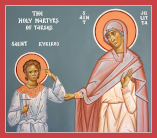 Holy Julitta was of noble
birth. She was widowed young, and left with a newborn child, Kyrikos (Cerycus). She lived in
Iconium, a city of Lykaonia, and was a very devout Christian. She had her son baptized
immediately after his birth, and when he was three years old, instructed him in the Faith and
taught him to pray insofar as a child of that age is capable of learning. When Diocletian
launched a persecution of Christians, much innocent blood was shed in the city of Iconium.
Julitta took her son and hid from the wrath of the pagans in the town of Seleucid, but things
were no better there. Julitta was arrested as a Christian and brought to trial. Seeing Julitta so
courageously proclaim her faith in the Lord Jesus, the judge, to distress her and make her waver,
took the child in his arms and began to kiss it. But Kyrikos shouted: ‘I am a Christian;
let me go to my mother!’ and he began to scratch the judge, turning his face away from him.
The judge was furious, threw the child to the ground and kicked it, and the child rolled down the
stone steps and gave his holy and innocent soul to God. Seeing how Kyrikos suffered before her,
Julitta was filled with joy and gave thanks to God that her son had been counted worthy of the
wreath of martyrdom. After harsh torture, Julitta was beheaded, in the year 304. The relics of
Ss. Kyrikos and Julitta have wonder-working power to this day. A part of the relics of these
saints is to be found in Ochrid, in the Church of the Holy Mother of God, the Healer.
Holy Julitta was of noble
birth. She was widowed young, and left with a newborn child, Kyrikos (Cerycus). She lived in
Iconium, a city of Lykaonia, and was a very devout Christian. She had her son baptized
immediately after his birth, and when he was three years old, instructed him in the Faith and
taught him to pray insofar as a child of that age is capable of learning. When Diocletian
launched a persecution of Christians, much innocent blood was shed in the city of Iconium.
Julitta took her son and hid from the wrath of the pagans in the town of Seleucid, but things
were no better there. Julitta was arrested as a Christian and brought to trial. Seeing Julitta so
courageously proclaim her faith in the Lord Jesus, the judge, to distress her and make her waver,
took the child in his arms and began to kiss it. But Kyrikos shouted: ‘I am a Christian;
let me go to my mother!’ and he began to scratch the judge, turning his face away from him.
The judge was furious, threw the child to the ground and kicked it, and the child rolled down the
stone steps and gave his holy and innocent soul to God. Seeing how Kyrikos suffered before her,
Julitta was filled with joy and gave thanks to God that her son had been counted worthy of the
wreath of martyrdom. After harsh torture, Julitta was beheaded, in the year 304. The relics of
Ss. Kyrikos and Julitta have wonder-working power to this day. A part of the relics of these
saints is to be found in Ochrid, in the Church of the Holy Mother of God, the Healer.
2. St. Vladimir, Great Prince of Russia.
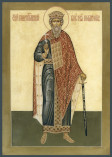 Vladimir was the son of Prince Svyatoslav, and
grandson of Igor and Olga, and was at first completely pagan in faith and life. Learning of the
existence of various faiths, he began to examine them, to decide which was best. He sent envoys
throughout the world to examine all of the major religions, and to report back to him what they
had found. The envoys who examined the Indian, Moslem, Jewish, and Latin faiths were not
impressed; but the envoys who visited the Orthodox in Constantinople, told the prince that they
had been at a service in the Orthodox Church of Hagia Sophia, and that they had been ‘out
of ourselves, not knowing if we were on earth or in heaven’. This inspired Vladimir to be
baptized, receiving the name Vasily (Basil), and to baptize his people. The chief idol, Perun,
was dragged off the hill of Kiev and thrown into the Dnieper. Embracing the Christian Faith,
Vladimir utterly changed his way of life and devoted all his labor to the perfect fulfilling of
the demands of his faith. He decreed that churches be built throughout the land on the places
where the idols had been pulled down, and himself built a beautiful church in Kiev to the most
holy Mother of God. This church was built on the same spot where St. Theodore and his son John
suffered martyrdom for Christ (see July 12th). With the same irresistible force with which
Vladimir earlier upheld idolatry, he now spread Christianity. He entered into rest in the Lord in
1015.
Vladimir was the son of Prince Svyatoslav, and
grandson of Igor and Olga, and was at first completely pagan in faith and life. Learning of the
existence of various faiths, he began to examine them, to decide which was best. He sent envoys
throughout the world to examine all of the major religions, and to report back to him what they
had found. The envoys who examined the Indian, Moslem, Jewish, and Latin faiths were not
impressed; but the envoys who visited the Orthodox in Constantinople, told the prince that they
had been at a service in the Orthodox Church of Hagia Sophia, and that they had been ‘out
of ourselves, not knowing if we were on earth or in heaven’. This inspired Vladimir to be
baptized, receiving the name Vasily (Basil), and to baptize his people. The chief idol, Perun,
was dragged off the hill of Kiev and thrown into the Dnieper. Embracing the Christian Faith,
Vladimir utterly changed his way of life and devoted all his labor to the perfect fulfilling of
the demands of his faith. He decreed that churches be built throughout the land on the places
where the idols had been pulled down, and himself built a beautiful church in Kiev to the most
holy Mother of God. This church was built on the same spot where St. Theodore and his son John
suffered martyrdom for Christ (see July 12th). With the same irresistible force with which
Vladimir earlier upheld idolatry, he now spread Christianity. He entered into rest in the Lord in
1015.
FOR CONSIDERATION
Hospitality exists among other faiths, but Christianity has stressed hospitality as a duty and an obligation. Gratitude for hospitality is no less a duty and an obligation for the Christian. He who learns to be grateful for hospitality will also be grateful to God for His hospitality, for what are we here on earth but God’s guests? What else are the angels in heaven? The following is told of King Philip of Macedon, who harshly punished one of his courtiers for ingratitude: The king sent this courtier overseas to carry out a certain piece of work. The courtier completed it and set off home by ship. A storm destroyed the ship, and the courtier found himself among the waves. Fortunately, this was not far from land, and a fisherman saw the man drowning and brought him to land. When he had recovered and rested, the courtier returned to the king, and told him of his calamity in the storm at sea. The king, desiring to reward him, asked him what he desired. The courtier mentioned the fisherman, and told the king that his greatest desire was that the king should give him the farm of that fisherman by the sea. The king immediately did as he asked. When the courtier had taken possession of the farm of his greatest benefactor, the latter went to the king and related the whole story with great lamentation. He told how he had saved the courtier’s life and how he had driven the fisherman from his home. Hearing this, the king was furious with the ungrateful courtier, and ordered that he be branded on the forehead with the words: ‘An ungrateful guest’.
Daily Scripture Readings taken from The Orthodox New Testament, translated and published by Holy Apostles Convent, Buena Vista, Colorado, copyright © 2000, used with permission, all rights reserved.
Daily Prologue Readings taken from The Prologue of Ochrid, by Bishop Nikolai Velimirovic, translated by Mother Maria, published by Lazarica Press, Birmingham, England, copyright © 1985, all rights reserved. Edited by Dormition Skete.