

Daily Devotional
Saturday, July 20, 2024 (NS), July 7, 2024 (OS)
No Fasting.
Saturday of the Fourth Week
The commemoration of the holy Great-martyr Kyriake (Gk. calendar only), and our venerable Father Thomas of Mount Maleon, and our venerable Father Akakios of Sinai (commemorated on Gk. calendar on the 26th of November).
Scripture Readings
Paschalion — Movable Calendar
Saturday of the Fourth Week
Epistle
The Reading is from the Epistle of Saint Paul to the Romans [§ 92]. Brethren:
6 11Thus reckon ye also yourselves to be dead indeed to sin, but alive to God in Christ Jesus our Lord. 12Therefore let not sin be reigning in your mortal body, so that ye obey it in its desires. 13Cease presenting your members as weapons of unrighteousness to sin, but present yourselves to God, as those alive from the dead, and your members as weapons of righteousness to God. 14For sin shall not have dominion over you; for ye are not under the law, but under grace.
15What then? Shall we sin, because we are not under the law, but under grace? May it not be! 16Ye know, do ye not, that to whom ye present yourselves slaves in regard to obedience, his slaves ye are to whom ye obey, whether of sin to death, or of obedience to righteousness? 17But thanks be to God, that ye were slaves of sin, but ye obeyed from the heart, to which form of teaching ye were delivered.
Gospel
The Reading is from the Holy Gospel according to Saint Matthew [§ 26]. At that time:
8 14After Jesus came into the house of Peter, He saw his mother-in-law bedridden and ill with a fever. 15And He touched her hand, and the fever left her. And she arose and began to minister to Him. 16And evening having come to pass, they brought to Him many possessed by demons. And He cast out the spirits with a word, and cured all those who were ill, 17that it might be fulfilled that which was spoken by Esaias the prophet, saying, “He Himself took our weaknesses and bore our diseases [cf. Is. 53:4].”
18Now after Jesus saw great crowds around Him, He gave orders to go away to the other side. 19And a scribe came and said to Him, “Teacher, I will follow Thee wheresoever Thou goest.” 20And Jesus saith to him, “The foxes have holes, and the birds of the heaven have nests, but the Son of Man hath nowhere that He may lay His head.” 21And another of His disciples said to Him, “Lord, permit me first to go away and bury my father.” 22But Jesus said to him, “Follow thou Me, and leave the dead to bury their own dead.”
23And after He embarked into the ship, His disciples followed Him.
Menaion — Fixed Calendar
The commemoration of the holy Great-martyr Kyriake (Gk. calendar only), and our venerable Father Thomas of Mount Maleon, and our venerable Father Akakios of Sinai (commemorated on Gk. calendar on the 26th of November).
No readings given.
Lives of the Saints (Prologue)
July 20th – Civil Calendar
July 7th – Church Calendar
1. The Holy and Great Martyr Kyriake (Dominica).
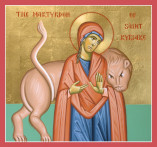 In the time of the Emperors
Diocletian and his son-in-law Maximian, both adversaries of Christ, there lived in Anatolia two
elderly, devout souls, Dorotheos and Evsevia. They were devoted Christians, rich but childless.
With unceasing prayer, they besought God for a child, and their prayers were answered in this
holy Kyriake. She consecrated herself to God from her childhood, holding herself apart from the
activities of carefree children. When she had grown up, beautiful in body and soul, she had many
suitors but refused them all, saying that she had betrothed herself to Christ the Lord and
desired nothing other than to die a virgin. One of these rejected suitors denounced Kyriake and
her parents to the Emperor Diocletian as Christians. The emperor ordered that her parents be
tortured, and after torture had them exiled to the town of Melitene, where they died under
further torture. Diocletian sent Kyriake to Maximian for trial. When she affirmed her faith in
Christ the Lord before Maximian, he ordered that she be thrown to the ground and flogged with
bull-whips. Then the emperor handed her over to the generals—firstly to Hilarion and then, after
his death, to Apollonius. They tortured her bestially in all possible ways, but in vain. While
holy Kyriake lay in prison wounded all over, Christ the Lord appeared to her, healed her and said
to her: ‘Don’t be afraid of the torture, Kyriake; My grace is with thee.’ And
indeed Christ’s grace saved this martyr from fire and from wild beasts, which the godless
torturers were certain would bring about her death. Seeing the miraculous saving of Kyriake from
such a death, many of the pagans came to belief in Christ. All were beheaded. Kyriake said to
Apollonius: ‘There is no way that you can turn me from my faith. Throw me into the fire—I
have the example of the Three Children; throw me to the wild beasts—I have the example of Daniel;
throw me into the sea—I have the example of Jonah the prophet; put me to the sword—I shall
remember the honored Forerunner. For me, to die is life in Christ.’ Then Apollonius ordered
that she be beheaded. Kyriake knelt and raised her hands to heaven in prayer to God, that He
would have mercy on and save all those who would celebrate her memory, and that He would give
rest to her soul and those of her parents. Finishing her prayer, she gave her soul to God before
the sword descended on her head. She suffered with honor in Nikomedia and went to eternal joy in
the year 289.
In the time of the Emperors
Diocletian and his son-in-law Maximian, both adversaries of Christ, there lived in Anatolia two
elderly, devout souls, Dorotheos and Evsevia. They were devoted Christians, rich but childless.
With unceasing prayer, they besought God for a child, and their prayers were answered in this
holy Kyriake. She consecrated herself to God from her childhood, holding herself apart from the
activities of carefree children. When she had grown up, beautiful in body and soul, she had many
suitors but refused them all, saying that she had betrothed herself to Christ the Lord and
desired nothing other than to die a virgin. One of these rejected suitors denounced Kyriake and
her parents to the Emperor Diocletian as Christians. The emperor ordered that her parents be
tortured, and after torture had them exiled to the town of Melitene, where they died under
further torture. Diocletian sent Kyriake to Maximian for trial. When she affirmed her faith in
Christ the Lord before Maximian, he ordered that she be thrown to the ground and flogged with
bull-whips. Then the emperor handed her over to the generals—firstly to Hilarion and then, after
his death, to Apollonius. They tortured her bestially in all possible ways, but in vain. While
holy Kyriake lay in prison wounded all over, Christ the Lord appeared to her, healed her and said
to her: ‘Don’t be afraid of the torture, Kyriake; My grace is with thee.’ And
indeed Christ’s grace saved this martyr from fire and from wild beasts, which the godless
torturers were certain would bring about her death. Seeing the miraculous saving of Kyriake from
such a death, many of the pagans came to belief in Christ. All were beheaded. Kyriake said to
Apollonius: ‘There is no way that you can turn me from my faith. Throw me into the fire—I
have the example of the Three Children; throw me to the wild beasts—I have the example of Daniel;
throw me into the sea—I have the example of Jonah the prophet; put me to the sword—I shall
remember the honored Forerunner. For me, to die is life in Christ.’ Then Apollonius ordered
that she be beheaded. Kyriake knelt and raised her hands to heaven in prayer to God, that He
would have mercy on and save all those who would celebrate her memory, and that He would give
rest to her soul and those of her parents. Finishing her prayer, she gave her soul to God before
the sword descended on her head. She suffered with honor in Nikomedia and went to eternal joy in
the year 289.
2. Our Holy Father Thomas of Malea.
This Thomas was a general, famed for his courage and wealth. He was massive of body and a source of fear to his enemies. But, when he came to love Christ more than the world or anything in the world, he left everything and retired to the desert, where he became a monk and gave himself to asceticism. The Prophet Elias appeared to him and led him to the mountain called Malea, near the Holy Mountain. There he lived in solitude, alone with God, in unceasing prayer day and night. Although he hid from the world, he could not succeed in concealing himself. Learning of the holiness of his life, people began to go to him, bringing their sick. St. Thomas healed them of all ills and weaknesses. When he went to God (in the tenth century), his relics continued to give aid to all who drew near to them in faith.
3. Our Holy Fathers, the Martyrs Epictetus and Astius.
Epictetus, a priest, brought Astius, the only son of his parents, to the Christian Faith, baptized him and made him a monk. They then went off eastwards, to the region of Scythia, and settled in the Scythian town of Almirida (now Ramzina), at the mouth of the Danube on the Black Sea. They were tortured and killed for the Christian Faith in about 290. They both appeared after their deaths in great light to St. Astius’ parents, Alexander and Marcellina, who turned to Christ and were baptized by Bishop Evangelus, who was himself then executed for Christ; ‘Evangelus, another angel,’ as is sung of him.
FOR CONSIDERATION
The example of St. Kyriake, a beautiful maiden, and of St. Astius, a rich young man, who both gave themselves over to torture and death for the sake of Christ the Lord, leads us to the thought that there is no equal in history to the power of Christ, by Whose aid young people conquer themselves, and through that conquest, conquer all else. Victory over oneself is the greatest victory. The Church counts such victors in their thousands, in their many thousands. St. Cyprian, writing on virginity, says: ‘To be victorious over pleasure is the greatest pleasure, and there is no greater victory than victory over one’s desires. He who has overcome an enemy shows himself stronger than the other, but he who has overcome his desires shows himself stronger than himself. Every other evil is easier to overcome than pleasure, for all other evils are repulsive, while pleasure is an attractive evil. Those who free themselves from their desires are freed also from fear, for desire is the root of fear.’
Daily Scripture Readings taken from The Orthodox New Testament, translated and published by Holy Apostles Convent, Buena Vista, Colorado, copyright © 2000, used with permission, all rights reserved.
Daily Prologue Readings taken from The Prologue of Ochrid, by Bishop Nikolai Velimirovic, translated by Mother Maria, published by Lazarica Press, Birmingham, England, copyright © 1985, all rights reserved. Edited by Dormition Skete.