

Daily Devotional
Wednesday, July 3, 2024 (NS), June 20, 2024 (OS)
Fast Day. No Meat, Fish, Dairy, Eggs, Alcohol or Olive Oil Allowed.
Wednesday of the Second Week
The commemoration of Hieromartyr Methodios, Bishop of Patara.
Scripture Readings
Paschalion — Movable Calendar
Wednesday of the Second Week
Epistle
The Reading is from the Epistle of Saint Paul to the Romans [§ 87]. Brethren:
4 13The promise that he should be the heir of the world was not to Abraham or to his seed through the law, but through the righteousness of faith. 14For if the heirs be of the law, faith is made void, and the promise made of no effect, 15for the law worketh out wrath; for where there is no law, neither is there transgression. 16On this account it is of faith, in order that it be according to grace, to the end that the promise be made sure to all the seed, not to that of the law only, but to that also of the faith of Abraham, who is the father of us all 17(even as it hath been written: “I have made thee a father of many nations [Gen. 17:5]”) before Him Whom he believed—God, Who giveth life to the dead, and calleth the things not existing as existing; 18who against hope believed upon hope, in order for him to become the father of many nations, according to that which was spoken, “So shall thy seed be [Gen. 15:5].” 19And not becoming weak in faith, he considered not his own body, already dead, when he was about a hundred years old, neither yet the deadness of Sarah’s womb. 20And in regard to the promise of God he was not made to doubt by unbelief, but was empowered in faith, giving glory to God, 21and was fully persuaded that what He had promised, He was able also to do. 22And wherefore it was reckoned to him for righteousness. 23Now it was not written on account of him only, that it was reckoned to him, 24but on account of us also, to whom it is about to be reckoned, to those who believe on Him Who raised Jesus our Lord from the dead, 25Who was delivered up for our offenses, and was raised for our justification.
Gospel
The Reading is from the Holy Gospel according to Saint Matthew [§ 23]. The Lord said:
7 21“Not everyone who saith to Me, ‘Lord, Lord,’ shall enter into the kingdom of the heavens, but the one who doeth the will of My Father in the heavens. 22“Many will say to Me in that day, ‘Lord, Lord, we prophesied in Thy name, and cast out demons in Thy name, and did many works of power in Thy name, did we not?’ 23“And then will I profess to them, ‘I never knew you; depart from Me, ye who work lawlessness.’”
Menaion — Fixed Calendar
The commemoration of Hieromartyr Methodios, Bishop of Patara.
No readings given.
Lives of the Saints (Prologue)
July 3rd – Civil Calendar
June 20th – Church Calendar
1. The Hieromartyr Methodius, Bishop of Patara,
He devoted himself from his youth to the ascetic life, and like a city set on a hill, was seen and called to the episcopate in the city of Patara in Lycia. Methodius was a learned and eloquent hierarch and wrote against the heresy of Origen. His words, ‘inspired by God, illumine the whole world like lightning’. The pagans rose up against him, tortured him and beheaded him in 311, in Chalkis in Syria.
2. The Holy Martyrs Aristokles, Dimitrianus and Athanasius.
Aristokles was a priest at the cathedral church in the town of Tamasus on Cyprus, and lived a life pleasing to God. Through his great zeal for the Faith, he was made worthy to hear a voice from heaven telling him to go to Salamis to receive the crown of martyrdom. The deacon Dimitrianus and the reader Athanasius joined him. On their arrival in Salamis, these men of God began to preach Christ. The pagans seized them, and after trial by torture, beheaded Aristokles with a sword, but Dimitrianus and Athanasius were cast into the flames. This was in the year 306.
3. Our Holy Father Naum of Ochrid.
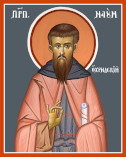 His chief festival is on December 23rd,
where his life is recorded, but June 20th is his summer feast. A great crowd gathers at the
monastery of St. Naum for this summer festival. Many of the sick come or are carried there
to receive healing through faith and prayer over the relics of this holy man. Not merely
Orthodox, but people of other faiths come seeking help from St. Naum. In 1926, a Moslem
from Resna (Resen) went there and donated a bell to the monastery in gratitude to the saint
for healing his brother and raising him from his deathbed. The donor was Jemail Zizo, and
his brother who was healed was called Suleiman Zizo. Both were eminent citizens of Resna. His chief festival is on December 23rd,
where his life is recorded, but June 20th is his summer feast. A great crowd gathers at the
monastery of St. Naum for this summer festival. Many of the sick come or are carried there
to receive healing through faith and prayer over the relics of this holy man. Not merely
Orthodox, but people of other faiths come seeking help from St. Naum. In 1926, a Moslem
from Resna (Resen) went there and donated a bell to the monastery in gratitude to the saint
for healing his brother and raising him from his deathbed. The donor was Jemail Zizo, and
his brother who was healed was called Suleiman Zizo. Both were eminent citizens of Resna.
|
4. St. Kallistos I, Patriarch of Constantinople.
He lived the ascetic life for twenty-eight years as a disciple of Gregory the Sinaite on Mount Athos, in the skete of Magoula attached to the monastery of Philotheou. He later founded the community of St. Mamas there. He was elected Patriarch of Constantinople in 1350. After four years, he left the patriarchal throne to return to Athos, but in the reign of John Palaiologos, he was again called to the throne, where he remained until his death. He died in 1363 on the way to Serres to meet the Serbian Queen Helena, who was seeking help against the Turks. He wrote the Lives of St. Gregory the Sinaite and St. Theodosius of Trnovo, as well as numerous homilies. It is interesting to note how St. Maximus of Kapsokalyvia foretold the death of Patriarch Kallistos. On his way to Serbia, Kallistos called in at the Holy Mountain. St. Maximus saw him and said: ‘This elder will not see his flock again, because I hear behind him the hymn over the grave: “Happy are the blameless in the way...”.’
5. St. Leucius, Bishop of Brindisi.
Born in Alexandria, he entered a monastery young. He was worthy of great revelations and powerful grace, sufficient to raise the dead and drive demons from men. He was at first Bishop of Alexandria, and went to Italy in response to a command from heaven. He baptized the entire pagan city of Brindisi and built a church there to the Mother of God. After intensive and successful work for the Faith, he entered into eternity in the fifth century, in the reign of the Emperor Theodosios II.
6. Blessed Studios.
A famous nobleman and consul in Constantinople, he founded in 463 the Church of St. John the Forerunner near the Golden Gates, and a monastery, named the Studion after him. This monastery became famed for its many great men, spiritual teachers, ascetics and martyrs for the Faith, among whom St. Theodore the Studite is the best-known. The Latin Crusaders destroyed this monastery in 1204, but it was restored in 1293 by the Paleologue Emperor Andronikos II. The church, for some centuries a mosque, is now in ruins.
7. Feast of the Odegetria (Directress) Icon of the Mother of God.
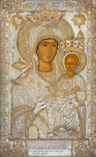 Luke the Evangelist painted this icon on
wood himself. When the most holy Mother of God saw it, she was pleased with it and blessed it.
St. Luke presented the icon to Theophilus, a state official for whom he wrote the Acts of the
Apostles. The icon was later taken from Antioch to Jerusalem, and sent from there by the Empress
Evdokia to Constantinople as a gift for Pulcheria, the emperor’s devout sister. Pulcheria
placed it in the Church of Vlachernai, which was her own foundation. The most holy Mother of God
once appeared to two blind men and led them into the church to her icon and restored the sight of
them both. For this reason, the icon has become known as ‘Odegetria’—
‘She who shows the way’. When the armies of the Persian king, Chozroes, and of Kagan,
leader of the Scythians, attacked Constantinople, Patriarch Sergios carried the icon around the
city ramparts, and the most holy Mother of God saved the Christians from the unbelievers. The
forces of the enemy became confused, the sea began to heave about, and the boats began to sink.
The enemy soldiers who remained alive saved themselves by fleeing. Ever since then, a
commemoration of this miracle wrought by the most holy Mother of God has been held on the
Saturday of the Fifth Week of the Great Fast, with the reading of the Akathist. During the
iconoclast period, this icon was taken to the monastery of the Pantocrator and sealed up in a
wall with a burning lamp hanging before it. It was found later, unharmed by its immuring.
Luke the Evangelist painted this icon on
wood himself. When the most holy Mother of God saw it, she was pleased with it and blessed it.
St. Luke presented the icon to Theophilus, a state official for whom he wrote the Acts of the
Apostles. The icon was later taken from Antioch to Jerusalem, and sent from there by the Empress
Evdokia to Constantinople as a gift for Pulcheria, the emperor’s devout sister. Pulcheria
placed it in the Church of Vlachernai, which was her own foundation. The most holy Mother of God
once appeared to two blind men and led them into the church to her icon and restored the sight of
them both. For this reason, the icon has become known as ‘Odegetria’—
‘She who shows the way’. When the armies of the Persian king, Chozroes, and of Kagan,
leader of the Scythians, attacked Constantinople, Patriarch Sergios carried the icon around the
city ramparts, and the most holy Mother of God saved the Christians from the unbelievers. The
forces of the enemy became confused, the sea began to heave about, and the boats began to sink.
The enemy soldiers who remained alive saved themselves by fleeing. Ever since then, a
commemoration of this miracle wrought by the most holy Mother of God has been held on the
Saturday of the Fifth Week of the Great Fast, with the reading of the Akathist. During the
iconoclast period, this icon was taken to the monastery of the Pantocrator and sealed up in a
wall with a burning lamp hanging before it. It was found later, unharmed by its immuring.
FOR CONSIDERATION
St. Cyprian writes on immortality: ‘Whenever any famous person promises you something, you trust in his promise and do not think that he will deceive you, since he is always true to his word. But lo, O distrustful man, God Himself speaks to you and you vacillate in doubt! God has promised you immortality when you leave this world, and do you impudently doubt this promise? This means that you do not recognize God at all, it means that you insult Christ our Lord and Teacher with your lack of faith.’ What a strong faith is held by God’s saints! How clear and rational and well-attested it is by simple yet powerful examples! It is not because the unholy are rational that they doubt, but because they are unholy. The holier a man, the more rational, since he sees the truth in the undistorted mirror of his heart.
Daily Scripture Readings taken from The Orthodox New Testament, translated and published by Holy Apostles Convent, Buena Vista, Colorado, copyright © 2000, used with permission, all rights reserved.
Daily Prologue Readings taken from The Prologue of Ochrid, by Bishop Nikolai Velimirovic, translated by Mother Maria, published by Lazarica Press, Birmingham, England, copyright © 1985, all rights reserved. Edited by Dormition Skete.