

Daily Devotional
Saturday, June 15, 2024 (NS), June 2, 2024 (OS)
No Fasting.
Saturday of the Sixth Week
The commemoration of our father among the saints, Nikephoros the Confessor, Patriarch of Constantinople, and the Great-martyr John the New of Sochi, who suffered at Belgrade.
Scripture Readings
Paschalion — Movable Calendar
Saturday of the Sixth Week
Epistle
The Reading is from the Acts of the Apostles [§ 43]. In those days:
20 7On the first day of the week, after the disciples gathered together to break bread, Paul, who was about to depart on the morrow, kept on discoursing to them; and he was extending the discourse until midnight. 8And there were a considerable number of lamps in the upper room where they were assembled. 9And a certain young man, by name Eftychos, who sat on the window sill, was borne down by deep sleep. As Paul discoursed yet longer, because he was borne down by sleep, he fell down from the third story, and was taken up dead. 10And Paul went down, and fell upon him, and having embraced him, said, “Cease being clamorous; for his life is in him.” 11And after he went up, and broke bread and tasted food, he conversed for a considerable time until dawn, and so he went forth. 12And they brought the boy alive, and were not a little comforted.
Gospel
The Reading is from the Holy Gospel according to Saint John [§ 48]. The Lord said to His disciples:
14 10“The words which I speak to you I speak not from Myself; but the Father Who abideth in Me, He doeth the works. 11“Keep on believing Me that I am in the Father and the Father in Me; otherwise keep on believing Me on account of the works themselves. 12“Verily, verily, I say to you, the one who believeth in Me, the works which I do shall that one do also; and greater works than these shall he do, because I go to My Father. 13“And whatsoever ye shall ask in My name, this will I do, that the Father might be glorified in the Son. 14“If ye should ask anything in My name, I will do it.
15“If ye love Me, keep My commandments. 16“And I will ask the Father, and He shall give you another Paraclete, that He may abide with you forever— 17“the Spirit of the truth, Whom the world is not able to receive, because it seeth Him not, nor knoweth Him; but ye know Him, for He abideth by you, and shall be in you. 18“I will not leave you orphans; I am coming to you. 19“Yet a little while, and the world seeth Me no longer, but ye see Me; because I live, ye shall live also. 20“In that day ye shall know that I am in the Father, and ye in Me, and I in you. 21“The one who hath My commandments and keepeth them, that one is the one who loveth Me. And the one who loveth Me shall be loved by My Father, and I will love him and will manifest Myself to him.”
Menaion — Fixed Calendar
The commemoration of our father among the saints, Nikephoros the Confessor, Patriarch of Constantinople, and the Great-martyr John the New of Sochi, who suffered at Belgrade.
Epistle
For the Hierarch:
The Reading is from the Epistle of Saint Paul to the Hebrews [§ mid 318]. Brethren:
For Gk. usage, see Heb. 8:1-6; for Sl. usage, see Heb. 8:3-6.
8 1Now in reference to the things being spoken of, the chief point is: We have such a High Priest, Who sat down on the right of the throne of the majesty in the heavens, 2a Liturgist of the holies and of the tabernacle, the true one, which the Lord pitched, and not man. 3For every high priest is appointed to offer both gifts and sacrifices; wherefore it is necessary for this One to have something also which He might offer. 4For if, indeed, He were on earth, He would not even be a priest, since there are priests who offer the gifts according to the law, 5who worship a copy and a shadow of the heavenly things, even as Moses had been divinely warned when he was about to execute the tabernacle; for, “See,” saith He, “that thou make all things according to the pattern which was shown to thee in the mount [cf. Ex. 25:40].” 6But now He hath attained a more excellent liturgy, inasmuch as He is also Mediator of a better covenant, which hath been enacted upon better promises.
For the Great-Martyr:
The Reading is from the Epistle of Saint Paul to the Ephesians [§ 233].
6 10Brethren, keep on being empowered in the Lord and in the strength of His might. 11Put on the full armor of God, for you to be able to stand against the wiles of the devil; 12because for us the wrestling is not against blood and flesh, but against the principalities, against the powers, against the cosmic rulers of the darkness of this age, against spiritual hosts of evil on account of the heavenly things. 13For this cause take up the full armor of God, in order that ye might be able to withstand in the evil day, and having counteracted all things, to stand. 14Stand therefore, having girt your loins with truth, and having put on for yourselves the breastplate of righteousness, 15and having shod your feet in readiness of the Gospel of peace; 16on the whole, take up the shield of faith, with which ye shall be able to quench all the fiery darts of the evil one. 17And take the helmet of salvation, and the sword of the Spirit, which is the word of God.
Gospel
For the Hierarch:
The Reading is from the Holy Gospel according to Saint Luke [§ 64]. The Lord said to His disciples:
12 8“Everyone who shall confess in Me before men, the Son of Man also shall confess in him before the angels of God. 9“But the one who denieth Me before the face of men shall be denied before the face of the angels of God. 10“And everyone who shall speak a word against the Son of Man, it shall be forgiven him; but to the one who blasphemeth against the Holy Spirit it shall not be forgiven. 11“And whenever they bring you in before the synagogues and the rulers and the authorities, cease being anxious how or what ye should speak in defense, or what ye should say; 12“for the Holy Spirit shall teach you in the same hour what things it is needful to say.”
Lives of the Saints (Prologue)
June 15th – Civil Calendar
June 2nd – Church Calendar
1. St. Nikephoros the Confessor, Patriarch of Constantinople.
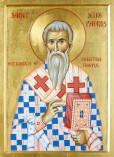 He was
a nobleman of Constantinople. His father Theodore, a wealthy and devout man, was a highranking
official at the emperor’s court. Nikephoros served several years at court in the same
capacity as his father, but then, seeing all the vanity of the world, he withdrew to the shore of
the Bosphorus and built a monastery there. This monastery rapidly became filled with monks and he
administered it; not, however, himself becoming a monk from a conviction of his unworthiness. He
was, in this, an example to all. He had earlier, as a layman, taken part in the Seventh
Ecumenical Council, at the request of the emperor and the patriarch, and was of great assistance
there with his intimate knowledge of holy Scripture. When Patriarch Tarasios died, Nikephoros,
much against his will, was chosen to succeed him. He was immediately professed a monk and
received the priestly orders in succession, being enthroned as patriarch in Hagia Sophia in 806.
This was in the time of the Emperor Nikephoros, who went off to war against the Bulgars very
shortly after this and was killed in battle there. His son Stavrakios reigned for only two months
before he died. After this, the good Emperor Michael, called Rangabe, came to the throne, but he
reigned only two years before Leo the Armenian attacked him and drove him into exile. When this
emperor began his reign, the patriarch sent him a book on the Confession of the Orthodox Faith
for him to sign (this being according to the custom obtaining for all Byzantine emperors,
who were regarded as sworn to uphold and defend the true Faith). The emperor did not sign it, but
set it aside until his coronation. When the patriarch crowned him, he still refused to sign the
book, and revealed himself to be an iconoclast heretic. The patriarch attempted to remonstrate
with him and bring him back to the true Faith, but in vain. The emperor exiled him by force to
the island of Prokonnesos, where he spent several years in want and privation before going to
eternity in the year 829. He governed the Church as patriarch for nine years.
He was
a nobleman of Constantinople. His father Theodore, a wealthy and devout man, was a highranking
official at the emperor’s court. Nikephoros served several years at court in the same
capacity as his father, but then, seeing all the vanity of the world, he withdrew to the shore of
the Bosphorus and built a monastery there. This monastery rapidly became filled with monks and he
administered it; not, however, himself becoming a monk from a conviction of his unworthiness. He
was, in this, an example to all. He had earlier, as a layman, taken part in the Seventh
Ecumenical Council, at the request of the emperor and the patriarch, and was of great assistance
there with his intimate knowledge of holy Scripture. When Patriarch Tarasios died, Nikephoros,
much against his will, was chosen to succeed him. He was immediately professed a monk and
received the priestly orders in succession, being enthroned as patriarch in Hagia Sophia in 806.
This was in the time of the Emperor Nikephoros, who went off to war against the Bulgars very
shortly after this and was killed in battle there. His son Stavrakios reigned for only two months
before he died. After this, the good Emperor Michael, called Rangabe, came to the throne, but he
reigned only two years before Leo the Armenian attacked him and drove him into exile. When this
emperor began his reign, the patriarch sent him a book on the Confession of the Orthodox Faith
for him to sign (this being according to the custom obtaining for all Byzantine emperors,
who were regarded as sworn to uphold and defend the true Faith). The emperor did not sign it, but
set it aside until his coronation. When the patriarch crowned him, he still refused to sign the
book, and revealed himself to be an iconoclast heretic. The patriarch attempted to remonstrate
with him and bring him back to the true Faith, but in vain. The emperor exiled him by force to
the island of Prokonnesos, where he spent several years in want and privation before going to
eternity in the year 829. He governed the Church as patriarch for nine years.
2. The Holy New-Martyr Constantine.
Born a Moslem on the island of Mytilene, he was healed of a grave illness by the aid of holy water in the church, and seeing other marvels of the Christian Faith, was baptized on the Holy Mountain in the skete of Kapsokalyvia. He later fell into the hands of the Turks, who, after inflicting terrible torture on him, hanged him in Constantinople on June 2nd, 1819.
3. The Holy Martyr John the New of Sochava.
A nobleman of Trebizond, he was denounced by some envious Latin and suffered for Christ in the town of Akerman. After being tortured for not accepting the Islamic religion (for the governor of the town was of that faith), St. John was tied to a horse’s legs and dragged round the town. Some wicked Jews, seeing him thus, ran up and butchered him. That night, a burning column was seen by many people above his body, and three men bathed in light standing around it. Later the Moldavian commander, Joalexander, took his honored body and buried it in the metropolitical church, where it remains to this day and miraculously saves men from various pains and sicknesses. He suffered with honor and was glorified on June 2nd, 1492.
4. The Hieromartyr Erazmo of Ochrid.
This saint was born in Antioch and lived in the reigns of Diocletian and Maximian. He lived in strict asceticism on Mount Lebanon, and was endowed by God with great wonder-working gifts. As a bishop, he set out to preach the Gospel. Arriving at the city of Ochrid, he restored the son of a man called Anastasius to life by his prayers, and baptized him. At this time, Erazmo baptized many other pagans and tore down the idolatrous altar in Ochrid. For this he was denounced to the Emperor Maximian, who was at that time staying in Illyria. The emperor brought him before the copper image of Zeus, and ordered him to bring sacrifices and worship the idol. St. Erazmo, by his power, caused a terrible dragon to come out of the statue, which terrified all the people. The saint then worked another wonder, and the dragon died. Then the saint preached Christ and baptized 20,000 souls. The furious emperor commanded that all 20,000 be beheaded, and put Erazmo to harsh torture, before throwing him into prison. But an angel of God appeared to him, as once to the Apostle Peter, and led him out of the prison. After that, this servant of God went to Campania, where he preached the Gospel to the people, then returned again to the town of Hermelia, where he withdrew to a cave and lived in asceticism for the rest of his days. At the time of his death, he prostrated three times towards the East, and with upraised hands, prayed to God to forgive and give eternal life to all those who would, with faith, call upon his name. At the end of his prayer, a voice was heard from heaven: ‘Let it be as thou hast asked, My little healer Erazmo!’ The saint looked up once more to heaven with great joy and saw a wreath of glory descending upon him, and a choir of angels, prophets, apostles and martyrs waiting to receive his holy soul. He finally cried: ‘Lord, receive my spirit!’ and breathed his last, in about the year 303. The cave and chapel of St. Erazmo stand to this day not far from Ochrid, and from there is proclaimed to this day the great power of the man of God, Erazmo the hieromartyr.
(In the Slavonic Prologue and Menaion, St. Erazmo is commemorated on May 4th; but in the Greek on June 2nd. This latter is more correct, as the feast of this saint has been celebrated in Ochrid on June 2nd from time immemorial.)
FOR CONSIDERATION
The veneration of icons is an integral part of Orthodoxy, and cannot be divorced from it. ‘An icon is a divine thing, but it is not God,’ said St. Nikephoros to the iconoclast Emperor Leo the Armenian. He then explained that Moses had made a bronze serpent and lifted it up in the wilderness, although it had previously been commanded: ‘Thou shalt not make to thyself any graven image.’ The latter was commanded so that the chosen people should be saved from the idol-worship of Egypt, and the former so that He, the one most high God, might show His power through a visible thing. Thus He allows His power to be shown forth through icons. It is His holy will and our aid to salvation. If icons were things of little meaning, why did many of the holiest men and women suffer unto death throughout history for the holy icons?
Daily Scripture Readings taken from The Orthodox New Testament, translated and published by Holy Apostles Convent, Buena Vista, Colorado, copyright © 2000, used with permission, all rights reserved.
Daily Prologue Readings taken from The Prologue of Ochrid, by Bishop Nikolai Velimirovic, translated by Mother Maria, published by Lazarica Press, Birmingham, England, copyright © 1985, all rights reserved. Edited by Dormition Skete.