

Daily Devotional
Thursday, June 13, 2024 (NS), May 31, 2024 (OS)
No Fasting.
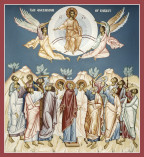
| The Thursday of the Ascension |
The commemoration of the holy Martyr Hermeas at Comana.
Scripture Readings
Paschalion — Movable Calendar
The Thursday of the Ascension
Epistle
The Reading is from the Acts of the Apostles [§ 1].
1 1The first account indeed I made for myself concerning all which, O Theophilos, Jesus began both to do and teach, 2until the day in which He was taken up, after He gave command to the apostles whom He chose for Himself through the Holy Spirit, 3to whom also He presented Himself alive after He had suffered by many proofs, being seen by them during forty days and speaking the things concerning the kingdom of God. 4And being assembled together with them, He ordered them not to depart from Jerusalem, but to wait for the promise of the Father, “which,” He said, “ye heard of Me; 5“for John indeed baptized with water, but ye shall be baptized in the Holy Spirit not many days after these.” 6Indeed therefore, after they came together, they kept on questioning, saying, “Lord, dost Thou at this time restore the kingdom to Israel?” 7And He said to them, “It is not yours to know times or seasons which the Father Himself put in His own authority. 8“But ye shall receive power, after the Holy Spirit is come upon you; and ye shall be witnesses to Me both in Jerusalem, and in all Judæa and Samaria, and unto the ends of the earth.” 9And having said these things, while they looked, He was taken up; and from before their eyes, a cloud took Him up from under. 10And while they were gazing intently into the heaven as He went, then behold, two men stood by them in white raiment, 11who also said, “Men, Galilæans, why do ye stand looking into the heaven? This Jesus, the One Who was taken up from you into the heaven, so shall He come in the manner ye beheld Him going into the heaven.” 12Then they returned to Jerusalem from the mount which is called the Mount of Olives, which is near Jerusalem, being a sabbath’s day journey.
Gospel
In the Orthros
The Reading is from the Holy Gospel According to Saint Mark. [§ 71]. At that time:
16 9After Jesus rose early the first day of the week, He appeared first to Mary Magdalene, from whom He had cast out seven demons. 10She went and brought tidings to those who had been with Him, who were mourning and weeping. 11And they, having heard that He liveth and was seen by her, disbelieved. 12And after these things He was made manifest in a different form to two of them as they were walking and went into the country. 13And they went and brought tidings to the rest; neither did they believe them. 14Afterwards He was made manifest to the eleven themselves as they reclined at table; and He reproached their unbelief and hardness of heart, because they believed not those who saw Him after He was raised. 15And He said to them, “Go into all the world and proclaim the Gospel to the whole creation. 16“The one who believeth and is baptized shall be saved; but the one who believeth not shall be condemned. 17“And these signs shall accompany those who believe: In My name they shall cast out demons; they shall speak in new tongues; 18“they shall take up serpents; and if they should drink anything deadly, in no wise shall it harm them; they shall lay hands on the sick, and they shall be well.”
19Then indeed, after speaking to them, the Lord was taken up into the heaven, and sat on the right of God. 20And they went forth and preached everywhere, the Lord working with them, and confirming the word by the accompanying signs. Amen.
In the Liturgy
The Reading is from the Holy Gospel according to Saint Luke [§ 114]. At that time:
24 36After Jesus rose from the dead, He stood in the midst of His disciples, and saith to them, “Peace be to you.” 37But they were terrified and affrighted, and kept on thinking that they saw a spirit. 38And He said to them, “Why are ye troubled? And why do reasonings come up in your hearts? 39“Behold My hands and My feet, that I am He. Touch Me and see, for a spirit hath not flesh and bones, even as ye see Me having.” 40And having said this, He showed them His hands and His feet. 41And while they yet disbelieved from the joy, and wondered, He said to them, “Have ye anything to eat here?” 42And they gave Him a portion of a broiled fish and of a honeycomb. 43And He took these and ate in their presence. 44And He said to them, “These are the words which I spoke to you while I was yet with you, that it is needful for all the things to be fulfilled, which were written in the law of Moses, and in the prophets, and in the psalms concerning Me.” 45Then He thoroughly opened their mind to understand the Scriptures, 46and said to them, “Thus it hath been written, and thus it was needful for the Christ to have suffered, and to have risen from the dead the third day, 47“and repentance and forgiveness of sins to have been preached in His name to all the nations, beginning from Jerusalem. 48“And ye are witnesses of these things. 49“And behold, I send forth the promise of My Father upon you; but sojourn in the city of Jerusalem, until ye are clothed with power from on high.”
50And He led them out as far as to Bethany. And having lifted up His hands, He blessed them. 51And it came to pass, as He was blessing them, He stood apart from them and was carried up into the heaven. 52And they made obeisance to Him, and returned to Jerusalem with great joy. 53And they were continually in the temple, praising and blessing God. Amen.
Menaion — Fixed Calendar
The commemoration of the holy Martyr Hermeas at Comana.
No readings given.
Lives of the Saints (Prologue)
June 13th – Civil Calendar
May 31st – Church Calendar
1. The Holy Apostle Hermas.
One of the Seventy, he is mentioned in the Epistle of St. Paul to the Romans (16:14). A Greek by birth, he spent a long time in Rome. He was bishop in Philippoupolis, and finished his life a martyr. He compiled the very instructive book ‘The Shepherd’ through revelations from the angels of God. Hermas was a rich man, but fell into extreme poverty through his own sins and those of his sons. A man appeared to him, clad in white and with a staff in his hand, and told him that he was the angel of repentance, sent to him before the end of his life. The angel gave him twelve commandments:
1. To believe in God.
2. To live in simplicity and innocence.
3. To love truth and flee from falsehood.
4. To guard his thoughts in chastity.
5. To learn patience and magnanimity of soul.
6. To know that a good and an evil spirit attend every man.
7. To fear God, but not the devil
8. To perform every good deed and to restrain himself from every evil one.
9. To pray to God in faith from the depths of his heart, so that his prayer might be heard.
10. To preserve himself from melancholy, the daughter of doubt, and from anger.
11. To try true and false prophecies.
12. To preserve himself from every evil desire.
2. The Holy Martyr Hermias.
He was a soldier in the imperial army till old age, when he suffered for another Emperor: Christ. The wicked judge tried in vain to make him renounce the Christian Faith and offer sacrifice to idols, then he ordered that Hermias’ teeth be broken with a stone and the skin stripped from his face with a knife. After that, he was thrown into a flaming furnace, but he remained unharmed, protected by the grace of God. He was then made to drink the strongest poison, which was given to him by a magician on the judge’s orders, but the poison did him no harm at all. When the magician saw this, he was so amazed that he confessed Christ himself, and was immediately slain with the sword. They then poked out both of Hermias’ eyes, and he said mildly to the judge: ‘Take the eyes of flesh which used to gaze upon the vanity of the world; I have other eyes in my heart with which I clearly see the true light.’ He was then hung upside down by the feet, and those who were torturing him became blind and staggered around him. St. Hermias called them to himself, laid his hands upon them and restored their sight by his prayers. Seeing all this, the judge became as furious as a lion, and drawing out his sword, cut off the head of the man of God. Christians came and took Hermias’ body in secret, and gave it burial. His relics gave healing to all the sick and wretched. St. Hermias suffered in the reign of the Emperor Antoninus, in the year 160.
3. The Holy Martyr Philosophos.
This martyr of Christ’s was born near Alexandria. During a persecution of Christians, Philosophos refused to renounce Christ the Lord before the pagan princes and judges, and they therefore inflicted terrible tortures on him. After he had been tortured in various ways, they finally placed him on a soft bed, bound hand and foot, and put a harlot in with him to entice him into sin. When Philosophos felt passion awakening in himself through the touch of the woman’s hands, he took the tongue between his teeth, bit it through and spat it out in the harlot’s face. His passion was extinguished, and the harlot was so aghast that she fled from him at once. He was afterwards beheaded with the sword, in about 252, whilst still young in years, and entered into the kingdom of eternal youth. (In the Greek Prologue, St. Philosophos is commemorated on May 1st.).
FOR CONSIDERATION
This life is a spiritual battle: to conquer or be conquered. If we conquer, we shall enjoy the fruits of victory through all eternity; but if we are conquered, we shall suffer the horrors of defeat through all eternity. This life is a duel between man and everything that sets itself against God. God is the almighty Ally of every man who whole-heartedly calls upon Him for aid. Saint John of Kronstadt says: ‘This life is neither a joke nor a plaything, although men may turn it into either. They fritter away the time given to us to prepare for eternity, disporting themselves with empty words. They go about visiting, sitting and gossiping, playing this or that game. They get together in the theaters and amuse themselves there. Life is, for them, amusement. But woe to those who do nothing but amuse themselves!’
Daily Scripture Readings taken from The Orthodox New Testament, translated and published by Holy Apostles Convent, Buena Vista, Colorado, copyright © 2000, used with permission, all rights reserved.
Daily Prologue Readings taken from The Prologue of Ochrid, by Bishop Nikolai Velimirovic, translated by Mother Maria, published by Lazarica Press, Birmingham, England, copyright © 1985, all rights reserved. Edited by Dormition Skete.