

Daily Devotional
Sunday, May 26, 2024 (NS), May 13, 2024 (OS)
No Fasting.
| The Fourth Sunday of Pascha, or the Sunday of the Paralytic Mode Three — Fifth Eothinon |
The commemoration of the Virgin-martyr Glykeria at Heraclea.
Scripture Readings
Paschalion — Movable Calendar
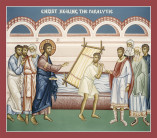
The Fourth Sunday of Pascha, or the Sunday of the Paralytic
Mode Three — Fifth Eothinon
Epistle
The Reading is from the Acts of the Apostles [§ 23]. In those days:
9 32It came to pass, as Peter passed through all quarters, he went down also to the saints that dwelt at Lydda. 33And there he found a certain man, by name Æneas, who kept his bed for eight years, and was paralyzed. 34And Peter said to him, “Æneas, Jesus the Christ healeth thee; rise up and make up thy bed for thyself.” And straightway he rose up. 35And all those inhabiting Lydda and the Sharon Plain, who saw him, turned to the Lord. 36Now there was in Joppa a certain disciple, by name Tabitha, which, being interpreted, is called Dorcas. She was full of good works and of alms which she used to do. 37And it came to pass in those days she fell sick and died. And after they washed her, they laid her in an upper room. 38And since Lydda was near to Joppa, and the disciples heard that Peter was in it, they sent forth two men to him, beseeching him not to delay to come over to them. 39And Peter, having risen up, went with them, whom after he came, they brought him into the upper room. And all the widows stood by him weeping, and showing howsoever many tunics and garments Dorcas used to make while she was with them. 40But Peter put them all forth, and kneeled down, and prayed. And turning to the body, he said, “Tabitha, rise up.” And she opened her eyes; and after she saw Peter she sat up. 41And he gave her his hand and raised her up; and after he called the saints and the widows, he presented her alive. 42And it became known throughout all of Joppa; and many believed on the Lord.
Gospel
The Reading is from the Holy Gospel according to Saint John [§ 14]. At that time:
5 1Jesus went up to Jerusalem. 2Now there is in Jerusalem by the gate a sheep pool, which is surnamed in Hebrew, Bethesda, having five porches. 3In these was lying a great multitude of the infirm, blind, lame, withered, awaiting the moving of the water. 4For an angel used to come down from time to time into the pool and trouble the water; then after the troubling of the water, the one who first entered became well of whatsoever disease he was held by. 5And a certain man was there, who had been thirty and eight years in his infirmity. 6Jesus saw this one lying there, and knew that he had already been much time in that condition, and He said to him, “Dost thou wish to become well?” 7The sick man answered Him, “Sir, I have no man in order that whenever the water is troubled he may put me into the pool; but while I am coming, another goeth down before me.” 8Jesus saith to him, “Rise, take up thy bed and be walking.” 9And straightway the man became well, and took up his bed, and went on walking. And on that day it was a sabbath. 10The Jews therefore were saying to him who had been healed, “It is a sabbath; it is not lawful for thee to take up the bed.” 11He answered them, “The One Who made me well, the same said to me, ‘Take up thy bed and be walking.’” 12Then they asked him, “Who is the Man Who said to thee, ‘Take up thy bed and be walking?’” 13But the one who was healed knew not Who it was, for Jesus turned aside, because a crowd was in the place. 14After these things Jesus findeth him in the temple, and said to him, “Behold, thou hast become well; no longer go on sinning, lest a worse thing should befall thee.” 15The man went away, and told the Jews that Jesus was the One Who made him well.
Menaion — Fixed Calendar
The commemoration of the Virgin-martyr Glykeria at Heraclea.
No readings given.
Lives of the Saints (Prologue)
May 26th – Civil Calendar
May 13th – Church Calendar
1. The Holy Martyr Glykeria.
The daughter of a governor of Rome, she became poor after her father’s death and went to live in Trajanopolis in Thrace. In the time of the wicked Emperor Antoninus, Glykeria was brought to offer sacrifice to the idol of Zeus. She traced the Cross on her forehead, and when the governor asked her where was her lamp (for they all carried lamps in their hands), Glykeria indicated the Cross on her forehead and said: ‘This is my lamp!’ At her prayers, the idol was struck by lightning and broken into pieces. The governor was furious with her and commanded that she be thrown into prison. He sealed the door of the prison, intending to starve the maiden to death, but an angel of God appeared to Glykeria and gave her heavenly food. After a certain time, when the governor reckoned that the maiden must have died of hunger, he opened the prison and was astounded to see her in good health, bright and merry. The warder, Laodicius, seeing this marvel, himself confessed Christ the Lord and was at once beheaded. After that, Glykeria was thrown into a burning furnace, but she remained untouched by the flames. Standing in the midst of the fire, she praised the Lord, commemorating the wonder with the Three Children in the burning fiery furnace in Babylon. Finally, she was thrown to the lions, and praying to God, this holy maiden gave her soul into the hands of the Lord for Whom she had heroically suffered much torture. She suffered with honor in the year 141. A healing myrrh flowed from her relics, which healed the sick of the gravest illnesses.
2. The Holy Martyr Alexander.
He was a Slav, an eighteen-year-old soldier in the army of the Emperor Maximian. He refused to obey the imperial order to offer sacrifice to the Roman idols, because of which it fell to Captain Tiberian to tell him either to deny Christ or be tortured and killed. As all this advice was in vain, Tiberian arrested him and took him through Macedonia to Constantinople, whither he himself had an errand. In every place, the young Alexander was harshly tortured, but in every place also, Christians came out to him, begging his blessing and encouraging him in his sufferings. His mother, Pimenia, followed him. In the course of this journey, Alexander was many times visited by an angel of God, who eased his pains and encouraged him. In one place called Carasura, the martyr worked a miracle by his prayers: when the soldiers who were escorting him were tormented by thirst, he made a spring of cold water come out of a dry place. On the bank of the River Ergina, Tiberian ordered that the executioner behead Alexander and throw his body into the river. When the executioner swung his axe above Alexander’s head, he saw angels of God around him, resplendent with light, and was afraid and stayed his hand. Alexander asked him why he had done this, and he said that he had seen some young men in a nimbus of light surrounding him. Desiring to die and so be united with the Lord, Alexander prayed to God to take the angels away, so that the executioner would not be afraid. And so the executioner completed his work, in 298. Pimenia retrieved the body of her son and gave it burial. There were many healings at the martyr’s grave. After his death, he appeared to his mother and gave her tidings of her own imminent departure to the other world.
3. Our Holy Fathers John, Evthymius, George and Gabriel of Iviron.
They were the founders of the famous Iviron (Georgian) Monastery on the Holy Mountain. St. John (Ioane) lived in asceticism first in the Lavra of Athanasius, and then founded his own monastery, Iviron. He entered into rest in 998. Evthymius (Ekvtime) and George (Giorgi) translated the holy Scriptures into Georgian. Evthymius died in 1028 and George in 1066. Gabriel was found worthy to receive the wonder-working Portaïtissa icon of the Mother of God which was brought to the monastery by the sea.
FOR CONSIDERATION
St. Athanasius writes thus on the power of the death of Christ and His Cross: ‘Whose death has ever driven away demons? And whose death has ever been the cause of fear to demons, as was the death of Christ? Wherever the name of the Savior is invoked, there the demons are driven out. What has tamed man’s spiritual passions to such an extent that prodigals become chaste and murderers are no longer servants of the sword, and the fearful become brave? Has not the Christian Faith? Has not the sign of the Cross? And what else has so convinced man of immortality as the Cross of Christ and His bodily Resurrection?’ The death of the Sinless One and the Cross of the Lover of mankind have brought a greater and more enduring victory than all the kings of the earth with their milliard soldiers. For when has an army ever overcome one single demon? Only the invocation of the name of the Crucified puts the armies of demons to flight. Oh, when will all Christians know what riches they have in the name of Christ, and what a weapon in His Cross?
Daily Scripture Readings taken from The Orthodox New Testament, translated and published by Holy Apostles Convent, Buena Vista, Colorado, copyright © 2000, used with permission, all rights reserved.
Daily Prologue Readings taken from The Prologue of Ochrid, by Bishop Nikolai Velimirovic, translated by Mother Maria, published by Lazarica Press, Birmingham, England, copyright © 1985, all rights reserved. Edited by Dormition Skete.