

Daily Devotional
Wednesday, May 8, 2024 (NS), April 25, 2024 (OS)
No Fasting.
Bright Week - No Fasting All Week
Wednesday of the Renewal Week
The commemoration of the holy Apostle and Evangelist Mark.
Scripture Readings
Paschalion — Movable Calendar
Wednesday of the Renewal Week
Epistle
The Reading is from the Acts of the Apostles [§ 5]. In those days:
Gk. usage, Acts 2:22-38; Sl. usage, Acts 2:22-36.
2 22Peter spoke to the people. “Men, Israelites, hear these words: Jesus the Nazaræan, a Man from God, Who hath been shown forth to you by works of power and wonders and signs, which God did by Him in your midst, even as ye yourselves know— 23“this One, given up by the determinate counsel and foreknowledge of God—ye took and affixed to the Cross by lawless hands and did slay, 24“Whom God raised up, having loosed the throes of death, inasmuch as it was not possible for Him to be held by it. 25“For David saith in regard to Him, ‘I was foreseeing the Lord before my face continually, because He is on my right, that I should not be shaken [Ps. 15(16):8]. 26“‘Therefore my heart was gladdened, and my tongue exulted; moreover my flesh also shall rest upon hope [Ps. 15(16):9], 27“‘for Thou wilt not leave behind my soul in Hades, nor wilt Thou give Thy Holy One to see corruption [Ps. 15(16):10]. 28“‘Thou madest known to me the paths of life; Thou shalt fill me full with good cheer with Thy countenance [Ps. 15(16):11].’ 29“Men, brethren, it is allowed to speak with freedom of speech to you concerning the Patriarch David, that he both died and was buried, and his sepulcher is among us until this day. 30“Therefore being a prophet—and knowing that God swore with an oath to him that from the fruit of his loins, according to his flesh, He would raise up the Christ to sit upon his throne— 31“he foresaw and spoke concerning the resurrection of the Christ, that His soul was not left behind in Hades, nor did His flesh see corruption. 32“This Jesus did God raise up, of Whom we are all witnesses. 33“Therefore having been exalted to the right of God, and having received from the Father the promise of the Holy Spirit, He poured out this which ye now see and hear. 34“For David did not ascend into the heavens, but he saith himself, ‘The Lord said to my Lord, “Sit Thou on My right, 35“‘“until I should place Thine enemies as a footstool of Thy feet [Ps. 109(110):1].”’ 36“Assuredly therefore, let all the house of Israel know that God made Him, this same Jesus Whom ye crucified, both Lord and Christ.”
Gospel
The Reading is from the Holy Gospel according to Saint John [§ 4]. At that time:
1 35John was standing, and two of his disciples. 36And having looked at Jesus walking, he saith, “Behold, the Lamb of God!” 37And the two disciples heard Him speaking, and they followed Jesus. 38And Jesus turned, and beheld them following, and saith to them, “What seek ye?” And they said to Him, “Rabbi” (which is to say, being interpreted, Teacher), “where art Thou staying?” 39He said to them, “Come and see.” Then they went and saw where He was staying. And they stayed with Him that day; and it was about the tenth hour. 40Andrew, the brother of Simon Peter, was one of the two who heard this from John, and followed Him. 41This same one first findeth his own brother Simon, and saith to him, “We have found the Messiah” (which is, being interpreted, the Christ), 42and he led him to Jesus. And having looked at him, Jesus said, “Thou art Simon, the son of Jonas. Thou shalt be called Kephas” (which is interpreted, a stone).
43On the morrow Jesus intended to go forth into Galilee; and He findeth Philip, and saith to him, “Follow thou Me.” 44Now Philip was from Bethsaida, of the city of Andrew and Peter. 45Philip findeth Nathanael, and saith to him, “We have found the One of Whom Moses in the law, and the prophets, wrote—Jesus the son of Joseph, Who is from Nazareth.” 46And Nathanael said to him, “Out of Nazareth can there be any good thing?” Philip saith to him, “Come and see.” 47Jesus saw Nathanael coming toward Him, and saith concerning him, “Behold, truly an Israelite in whom is no guile.” 48Nathanael saith to Him, “From what place knowest Thou me?” Jesus answered and said to him, “Before Philip called thee, when thou wast under the fig tree, I saw thee.” 49Nathanael answered, and saith to Him, “Rabbi, Thou art the Son of God; Thou art the King of Israel.” 50Jesus answered and said to him, “Because I said to thee, ‘I saw thee underneath the fig tree,’ believest thou? Thou shalt see greater things than these.” 51And He saith to him, “Verily, verily, I say to thee, henceforth ye shall see the heaven having been opened, and the angels of God ascending and descending upon the Son of Man.”
Menaion — Fixed Calendar
The commemoration of the holy Apostle and Evangelist Mark.
Epistle
The Reading is from the First General Epistle of Saint Peter [§ 63]. Brethren:
5 6Humble yourselves under the mighty hand of God, in order that He might exalt you in due time, 7casting all of your care upon Him, for with Him there is a care for you. 8Be sober, watch; because your adversary, the devil, as a roaring lion, walketh about, seeking whom he might devour— 9whom withstand, firm in the faith, knowing the same incidents of suffering are being accomplished in your brotherhood which is in the world.
10But the God of all grace, the One Who called you to His eternal glory in Christ Jesus, after ye suffered a little while, shall Himself perfect, set fast, strengthen, and found you. 11To Him be the glory and the might to the ages of the ages. Amen.
12By Silouanos, the faithful brother, as I reckon, I am writing briefly to you, exhorting and testifying that this is the true grace of God in which ye stand. 13She that is in Babylon, elect together with you, greeteth you, and Mark my son. 14Greet one another with a kiss of love.
Peace be with you all who are in Christ Jesus. Amen.
Gospel
The Reading is from the Holy Gospel according to Saint Luke [§ 51]. The Lord said to His disciples:
10 16“The one who heareth you heareth Me, and the one who rejecteth you rejecteth Me, and the one who rejecteth Me rejecteth the One Who sent Me forth.”
17And the seventy returned with joy, saying, “Lord, even the demons are being made subject to us in Thy name.” 18And He said to them, “I was beholding Satan as lightning having fallen out of the heaven. 19“Behold, I give you the authority to tread upon serpents and scorpions, and upon all the power of the enemy; and nothing in anywise shall injure you. 20“However cease rejoicing in this, that the spirits are being made subject to you; but be rejoicing that your names were written in the heavens.” 21In the same hour Jesus rejoiced in the Spirit, and said, “I give thanks to Thee, O Father, Lord of the heaven and of the earth, that Thou didst hide these things from the wise and intelligent, and didst reveal them to babes. Yea, Father, for thus it was well-pleasing before Thee.”
for Sl. usage, see [Mk. 6:7-13].
Lives of the Saints (Prologue)
May 8th – Civil Calendar
April 25th – Church Calendar
1. The Holy Apostle and Evangelist Mark.
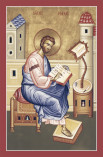 St. Mark was a companion and helper of the Apostle
Peter in his journeys. Peter, in his first Epistle, calls him his son, not after the flesh but
after the spirit (I Pet. 5:13). When Mark was with Peter in Rome, the faithful begged him to
write down for them the saving knowledge of the Lord Jesus, His miracles and His life. So Mark
wrote his Gospel, which the Apostle Peter himself saw and testified to as true. Mark was chosen
by the Apostle Peter to be bishop, and sent to Egypt to preach. And so Mark was the first
preacher of the Gospel and the first bishop in Egypt. Egypt was oppressed by a thick darkness of
paganism, idolatry, divination and malice. But, with the help of God, St. Mark succeeded in
sowing the seed of the knowledge of God in Libya, Ammonicia and Pentapolis. From Pentapolis, he
went to Alexandria, whither the Spirit of God led him. In Alexandria, he succeeded in
establishing the Church of God, in giving her bishops, priests and deacons and in rooting
everything firmly in faithfulness and devotion. Mark confirmed his preaching with many great
miracles. When the pagans brought accusations against Mark as a destroyer of their idolatrous
faith, and when the governor of the city began to search for Mark, he fled again to Pentapolis,
where he continued his earlier work. After two years, Mark again returned to Alexandria, to the
great joy of his faithful, whose number had already increased very greatly. The pagans took the
opportunity to seize Mark, and they bound him firmly and began to drag him over the cobblestones,
crying: ‘We’re taking the ox to the stall!’ They threw him into prison all
injured and bloodstained, where there appeared to him first an angel from heaven, who encouraged
and strengthened him, and then the Lord Himself. Jesus said to him: ‘Peace to thee, Mark My
Evangelist!’ to which Mark replied: ‘And peace to Thee, my Lord Jesus Christ!’
On the next day, the wicked people hauled Mark from prison and again dragged him through the
streets with the same cry: ‘We’re taking the ox to the stall!’ Utterly spent
and enfeebled, Mark said: ‘Into Thy hands, O Lord, I commend my spirit,’ and thus
breathed his last and went to the better world. His holy relics were given burial by Christians,
and through the ages they gave healing to people from every pain and ill.
St. Mark was a companion and helper of the Apostle
Peter in his journeys. Peter, in his first Epistle, calls him his son, not after the flesh but
after the spirit (I Pet. 5:13). When Mark was with Peter in Rome, the faithful begged him to
write down for them the saving knowledge of the Lord Jesus, His miracles and His life. So Mark
wrote his Gospel, which the Apostle Peter himself saw and testified to as true. Mark was chosen
by the Apostle Peter to be bishop, and sent to Egypt to preach. And so Mark was the first
preacher of the Gospel and the first bishop in Egypt. Egypt was oppressed by a thick darkness of
paganism, idolatry, divination and malice. But, with the help of God, St. Mark succeeded in
sowing the seed of the knowledge of God in Libya, Ammonicia and Pentapolis. From Pentapolis, he
went to Alexandria, whither the Spirit of God led him. In Alexandria, he succeeded in
establishing the Church of God, in giving her bishops, priests and deacons and in rooting
everything firmly in faithfulness and devotion. Mark confirmed his preaching with many great
miracles. When the pagans brought accusations against Mark as a destroyer of their idolatrous
faith, and when the governor of the city began to search for Mark, he fled again to Pentapolis,
where he continued his earlier work. After two years, Mark again returned to Alexandria, to the
great joy of his faithful, whose number had already increased very greatly. The pagans took the
opportunity to seize Mark, and they bound him firmly and began to drag him over the cobblestones,
crying: ‘We’re taking the ox to the stall!’ They threw him into prison all
injured and bloodstained, where there appeared to him first an angel from heaven, who encouraged
and strengthened him, and then the Lord Himself. Jesus said to him: ‘Peace to thee, Mark My
Evangelist!’ to which Mark replied: ‘And peace to Thee, my Lord Jesus Christ!’
On the next day, the wicked people hauled Mark from prison and again dragged him through the
streets with the same cry: ‘We’re taking the ox to the stall!’ Utterly spent
and enfeebled, Mark said: ‘Into Thy hands, O Lord, I commend my spirit,’ and thus
breathed his last and went to the better world. His holy relics were given burial by Christians,
and through the ages they gave healing to people from every pain and ill.
2. St. Anianus, Second Bishop of Alexandria.
When St. Mark stepped from the boat onto dry land in Alexandria, one of his shoes was torn, and he took it to a cobbler. While the cobbler was sewing it, he drove the awl through his left hand and the blood began to flow, the man screaming with the pain. Then the apostle of God mixed dust with his spittle and anointed the injured hand, and it at once became whole and healthy. The cobbler marvelled at this miracle, and invited Mark to his house. Hearing Mark’s preaching, Anianus, for that was his name, was baptized, he and his whole household. Anianus showed such devotion and zeal for the work of God that St. Mark consecrated him bishop, and this holy man was the second Bishop of Alexandria.
FOR CONSIDERATION
The devil quickly finds work for idle hands, but an angel for diligent ones. In this world of constant movement and incessant change, a man, whether he likes it or not, must be busy, either with good works or with evil ones. An idle man is not, in fact, unoccupied: he is a diligent worker for the devil. A lazy body and a lazy soul are the most suitable ground for devilish sowing and reaping. St. Anthony the Great says: ‘The body must be subdued and exhausted by long labor,’ and St. Ephraim the Syrian teaches: ‘Learn to work, so that you don’t have to learn to beg!’ And all the other holy fathers, without exception, speak of the indispensability of labor for the salvation of the soul of man. The apostles and all the saints give us an example of hard and unceasing labor, both spiritual and physical. That the lazy man, by idleness, does not prolong his life on earth, is clearly attested by the longevity of many of the saints, the greatest laborers of all upon earth.
Daily Scripture Readings taken from The Orthodox New Testament, translated and published by Holy Apostles Convent, Buena Vista, Colorado, copyright © 2000, used with permission, all rights reserved.
Daily Prologue Readings taken from The Prologue of Ochrid, by Bishop Nikolai Velimirovic, translated by Mother Maria, published by Lazarica Press, Birmingham, England, copyright © 1985, all rights reserved. Edited by Dormition Skete.