

Daily Devotional
Sunday, April 28, 2024 (NS), April 15, 2024 (OS)
Fast Day, but Fish, Wine and Olive Oil Allowed.
Holy Week
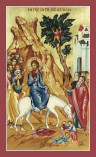
| Palm Sunday |
The commemoration of the holy Martyr Crescens in Myra of Lycia, and the holy Apostles Aristarchos, Pudens, and Trophimos of the Seventy (commemorated on Gk. calendar on the 14th of April), and the Martyrs Vasilissa and Anastasia of Rome, disciples of the Apostles Peter and Paul.
Scripture Readings
Paschalion — Movable Calendar
Palm Sunday
Epistle
The Reading is from the Epistle of Saint Paul to the Philippians [§ 247]. Brethren:
4 4Be rejoicing in the Lord always; again I will say, be rejoicing. 5Let your reasonableness be known to all men. The Lord is near: 6Cease being anxious about anything, but in everything by prayer and by entreaty, with giving of thanks, let your requests be made known to God. 7And the peace of God, which surpasseth all understanding, shall guard your hearts and your minds in Christ Jesus.
8For the rest, brethren, whatsoever things are true, whatsoever things are worthy of respect, whatsoever things are just, whatsoever things are pure, whatsoever things are pleasing, whatsoever things are of good report, if there is any virtue and if there is any praise, be considering these things. 9And what ye learned and received and heard and saw in me, these things be practising; and the God of peace shall be with you.
Gospel
In the Orthros
The Reading is from the Holy Gospel according to Saint Matthew [§ 83]. At that time:
21 1When Jesus drew near to Jerusalem, and came to Bethphage, toward the Mount of Olives, then Jesus sent forth two disciples, 2saying to them, “Go into the village, the one opposite you; and straightway ye shall find an ass which hath been tied, and a colt with her. Loose them and bring them to Me. 3“And if anyone should say anything to you, ye shall say, ‘The Lord hath need of them’; and straightway he will send them.” 4Now all this came to pass in order that it might be fulfilled that which was spoken by the prophet, saying, 5“Say to the daughter of Sion [Is. 62:11], ‘Behold thy King cometh to thee, meek, and mounted on an ass, and a colt, the foal of a beast of burden [cf. Zach. 9:9].’” 6And the disciples went and did even as Jesus commanded them, 7and brought the ass and the colt, and put their garments upon them, and He sat down upon them. 8And the greater part of the crowd spread their garments in the way; and others were cutting branches from the trees and were strewing them in the way. 9And the crowds, those going before and those following, were crying out, saying, “Hosanna, to the Son of David; blessed is He Who cometh in the name of the Lord [cf. Ps. 117(118):25(26)]; hosanna in the highest.” 10And after He entered into Jerusalem, all the city was shaken, saying, “Who is this?” 11And the crowds were saying, “This is Jesus the Prophet, the One from Nazareth of Galilee.”...
15But after the chief priests and the scribes saw the wonders which He did, and the children crying out in the temple and saying, “Hosanna, to the Son of David,” they were indignant, 16and said to Him, “Hearest Thou what these say?” And Jesus saith to them, “Yes; did ye never read, ‘Out of the mouth of babes and sucklings Thou hast perfected praise for Thyself [Ps. 8:2]’?” 17And He left them behind and went out of the city to Bethany, and He lodged there.
In the Liturgy
The Reading is from the Holy Gospel according to Saint John [§ 41].
12 1Six days before the passover, Jesus came to Bethany, where Lazarus was who had died, whom He raised from the dead. 2So they made a supper for Him there, and Martha was serving; but Lazarus was one of those reclining at table with Him. 3Then Mary, having taken a pound of very precious perfumed ointment of pure spikenard, anointed the feet of Jesus, and wiped His feet with her hair. And the house was filled with the odor of the perfumed ointment. 4Then one of His disciples, Judas Iscariote, Simon’s son, who was about to deliver Him up, saith, 5“Why was this perfumed ointment not sold for three hundred denarii and given to the poor?” 6But he said this, not that he was caring for the poor, but because he was a thief, and had the money box, and was taking away what was put in it. 7Then Jesus said, “Let her alone, for the day of My laying out for burial hath she kept it. 8“For ye have the poor among yourselves always, but Me ye have not always.” 9A great crowd of the Jews therefore knew that He was there, and they came not because of Jesus only, but also in order that they might see Lazarus, whom He raised from the dead. 10But the chief priests took counsel that they might put to death Lazarus also, 11because by reason of him many of the Jews were going away and were believing in Jesus.
12On the morrow a great crowd which came to the feast, after they heard that Jesus was coming into Jerusalem, 13took the palm branches of the palm trees, and went out to meet Him, and were crying, “Hosanna, blessed is He Who cometh in the name of the Lord, the King of Israel [cf. Ps. 117(118):25(26)].” 14And Jesus, having found a young ass, sat upon it, even as it is written: 15“Cease fearing, O daughter of Sion, behold, thy King cometh, sitting on a colt of an ass [cf. Zach. 9:9].” 16But the disciples knew not these things at the first; but when Jesus was glorified, then they remembered that these things were written in reference to Him, and that these things they did to Him. 17Then the crowd that was with Him when He called Lazarus out of the grave and raised him from the dead bore witness. 18On this account the crowd also went to meet Him, because it heard that He had done this sign.
Menaion — Fixed Calendar
The commemoration of the holy Martyr Crescens in Myra of Lycia, and the holy Apostles Aristarchos, Pudens, and Trophimos of the Seventy (commemorated on Gk. calendar on the 14th of April), and the Martyrs Vasilissa and Anastasia of Rome, disciples of the Apostles Peter and Paul.
No readings given.
Lives of the Saints (Prologue)
April 28th – Civil Calendar
April 15th – Church Calendar
1. The Holy Apostles Aristarchus, Pudens and Trophimus.
These were all numbered among the Seventy. Aristarchus was Bishop of Apameia in Syria. The Apostle Paul mentions him several times (Acts 19:29; Col. 4:10; Philem. v.24). He was seized in Ephesus, together with Gaius, by a mob that had risen up against Paul. The apostle wrote to the Colossians: ‘Aristarchus my fellow-prisoner saluteth you,’ and in the Epistle to Philemon, Paul calls Aristarchus ‘my fellow-laborer,’ together with Mark, Demas and Luke. Pudens was an eminent Roman citizen. The Apostle Paul mentions him once (II Tim. 4:21). Pudens’ house was first the refuge of the chief apostles and was then turned into a church dedicated to the Good Shepherd. Trophimus was an Asian (Acts 20:4), and accompanied St. Paul on his journeys. In one place, Paul writes: ‘Trophimus have I left at Miletum sick’ (II Tim. 4:21). During Nero’s persecution, when the Apostle Paul was beheaded, these glorious martyrs were also beheaded.
2. The Holy Martyr Savvas the Goth.
There was a brutal persecution of Christians on the part of the Goths. A Gothic prince came to the village where this devout Savvas lived, and asked the villagers if there were any Christians there. They answered him on their honor that there were none. Then Savvas stood before the prince and the people, and said: ‘Let no one swear an oath on my behalf. I am a Christian.’ The prince, seeing this poor wretch, let him go in peace, saying: ‘This one can do neither harm nor good.’ The next year, just at Pascha, a priest, Sansal, came to the village and celebrated Pascha with Savvas. The pagans, coming to hear of this, descended suddenly on Savvas’ house and began to belabor the men of God without mercy, then, having dragged Savvas naked through thorns, bound them both to trees and tried to force them to eat meat offered to idols. But the men of God, remembering the apostle’s words, would not touch the unclean, diabolical sacrifices. The prince finally sentenced Savvas to death and handed him over to the soldiers. Savvas went to the place of execution full of joy, praising God. Recognising in him a good man, the soldiers sought to set him free on the way, but Savvas was greatly distressed by this and told the soldiers that they were in duty bound to carry out the prince’s command. Then the soldiers brought him to a river, tied a rock round his neck and threw him into the water. His body was cast up onto the bank. Later the Greek commander Ionnios Soranos, in the time of the Emperor Valens, found Savvas’ body during a war with the Goths and took it to Cappadocia. St. Savvas suffered in 372, at the age of 31.
3. The Holy Martyrs Vasilissa and Anastasia.
Two devout Roman women, they gathered the bodies of the apostles’ disciples for burial during Nero’s persecutions. They were arrested for this and imprisoned, and after prolonged torture in which their breasts were cut off and their tongues cut out, they were beheaded.
FOR CONSIDERATION
St. Gregory of Sinai writes on meditation: ‘We reckon that there are eight main subjects for meditation: first, God, unseen and invisible, without beginning and uncreated, the first Cause of all that is, threefold and one in His divine being; second, the order and state of the angelic powers; third, the structure of visible things; fourth, the incarnation of the Logos; fifth, the general resurrection; sixth, the dreadful Second Coming of the Lord; seventh, eternal torment; eighth, the kingdom of heaven. The first four have already been revealed and belong to the past. The last four have not yet been revealed and belong to the future, although these four are able to be considered by those who, with the help of the grace they have received, acquire a truly pure mind. He who approaches this labor (meditation) without the light of grace, let him know that he is building fantasies, not meditation.’ So writes the great and discerning Gregory of Sinai, whose knowledge came from experience.
Daily Scripture Readings taken from The Orthodox New Testament, translated and published by Holy Apostles Convent, Buena Vista, Colorado, copyright © 2000, used with permission, all rights reserved.
Daily Prologue Readings taken from The Prologue of Ochrid, by Bishop Nikolai Velimirovic, translated by Mother Maria, published by Lazarica Press, Birmingham, England, copyright © 1985, all rights reserved. Edited by Dormition Skete.