

Daily Devotional
Sunday, March 31, 2024 (NS), March 18, 2024 (OS)
Fast Day, but Shellfish, Wine and Olive Oil Allowed.
Holy & Great Fast
| The Sunday of the Second Week of the Great Fast, in which we Commemorate St. Gregory Palamas. Mode Two — Tenth Eothinon |
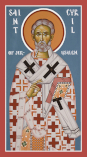
The commemoration of our holy father among the saints, Kyril, Archbishop of Jerusalem.
Scripture Readings
Paschalion — Movable Calendar
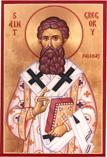
The Sunday of the Second Week of the Great Fast, in which we Commemorate St. Gregory Palamas.
Mode Two — Tenth Eothinon
Epistle
The Reading is from the Epistle of Saint Paul to the Hebrews [§ 304].
1 10“Thou, O Lord, in the beginning founded the earth, and the heavens are the works of Thy hands [Ps. 101(102):25]. 11“They shall perish, but Thou remainest; and they shall all become old as an outer garment [Ps. 101(102):26], 12“and as a covering Thou shalt roll them up, and they shall be changed. But Thou art the same, and Thy years shall not fail [Ps. 101(102):26, 27].” 13But to which of the angels hath He said at any time, “Sit Thou on My right, until I should place Thine enemies as a footstool of Thy feet [Ps. 109(110):1]”? 14They are all ministering spirits being sent forth to minister for the sake of those who are about to inherit salvation, are they not?
2 1On this account, it is necessary for us to give heed more abundantly to the things which were heard, lest ever we should slip away. 2For if the word spoken by angels was confirmed, and every transgression and disobedience received a just recompense, 3how shall we escape, if we neglect so great a salvation, which received a beginning to be spoken of by the Lord, and was confirmed to us by those who heard?
COMMEMORATION OF SAINT GREGORY PALAMAS
The Reading is from the Epistle of Saint Paul to the Hebrews [§ mid 318]. Brethren:
8 3Every high priest is appointed to offer both gifts and sacrifices; wherefore it is necessary for this One to have something also which He might offer. 4For if, indeed, He were on earth, He would not even be a priest, since there are priests who offer the gifts according to the law, 5who worship a copy and a shadow of the heavenly things, even as Moses had been divinely warned when he was about to execute the tabernacle; for, “See,” saith He, “that thou make all things according to the pattern which was shown to thee in the mount [cf. Ex. 25:40].” 6But now He hath attained a more excellent liturgy, inasmuch as He is also Mediator of a better covenant, which hath been enacted upon better promises.
Gospel
The Reading is from the Holy Gospel according to Saint Mark [§ 7]. At that time:
2 1Jesus entered into Capernaum after some days; and it was heard that “He is in the house.” 2And straightway many were gathered together, insomuch that there was no longer room, not even at the door. And He was speaking the word to them. 3And they come to Him, bearing a paralytic who was borne by four. 4And not being able to come near to Him on account of the crowd, they uncovered the roof where He was. And after they dug it out, they let down the bed on which the paralytic was lying. 5And Jesus, having seen their faith, saith to the paralytic, “Child, thy sins have been forgiven thee.” 6But some of the scribes were sitting there and reasoning in their hearts, 7“Why doth this One thus speak blasphemies? Who is able to forgive sins except One, God?” 8And straightway, Jesus, having fully known in His spirit that they were reasoning thus within themselves, said to them, “Why are ye reasoning these things in your hearts? 9“Which is easier, to say to the paralytic, ‘Thy sins have been forgiven thee,’ or to say, ‘Arise, and take up thy bed and be walking’? 10“But in order that ye may know that the Son of Man hath authority to forgive sins on the earth”—He saith to the paralytic, 11“I say to thee, ‘Arise, and take up thy bed, and go thy way to thy house.’” 12And straightway he arose; and having taken up the bed, he went forth before all, so that all were amazed and glorified God, saying, “We never saw it thus.”
Commemoration of Saint Gregory Palamas
The Reading is from the Holy Gospel according to Saint John [§ 36]. The Lord said to the Jews who had come to Him:
10 9“I am the door; by Me if anyone should enter, he shall be saved, and shall go in and go out and find pasture. 10“The thief cometh not, except that he might steal, and slay, and destroy. I came that they may have life, and may have it abundantly. 11“I am the good shepherd. The good shepherd layeth down his life for the sheep. 12“But the hireling, who indeed is not a shepherd, whose own the sheep are not, seeth the wolf coming, and leaveth the sheep and fleeth; and the wolf seizeth them and scattereth the sheep. 13“Now the hireling fleeth, because he is a hireling and careth not about the sheep. 14“I am the good shepherd; and I know those that are Mine, and am known of those that are Mine. 15“Even as the Father knoweth Me, I also know the Father; and I lay down My life for the sheep. 16“And I have other sheep which are not of this fold; them also it is needful for Me to bring, and they shall hear My voice; and there shall be one flock and one Shepherd.”
Menaion — Fixed Calendar
The commemoration of our holy father among the saints, Kyril, Archbishop of Jerusalem.
Epistle
The Reading is from the Epistle of Saint Paul to the Hebrews [§ 334]. Brethren:
13 7Be remembering those who lead you, who spoke to you the word of God, whose faith keep on imitating, observing attentively the end of their conduct: 8Jesus Christ, the same yesterday and today and to the ages. 9Cease being carried about by various and strange teachings. For it is good for the heart to be confirmed by grace, not by foods, in which those walking therein were not profited. 10We have an altar from which those serving the tabernacle have no authority to eat; 11for the bodies of those animals, “whose blood is being brought into the holies for sins” by the high priest, “are being burned outside of the encampment [cf. Lev. 16:27].” 12Wherefore Jesus also, that He might sanctify the people by His own blood, suffered outside of the gate. 13Let us be going forth therefore to Him outside of the encampment, bearing His reproach; 14for we have no abiding city here, but we seek the coming one. 15Through Him, then, let us be offering up a “sacrifice of praise [Lev. 7:2(12)]” continually to God, that is, “the fruit of the lips [cf. Hos. 14:3(2); Is. 57:19],” giving thanks to His name. 16But cease being forgetful of doing good and of contributing; for God is well pleased with such sacrifices.
Gospel
The Reading is from the Holy Gospel according to Saint Matthew [§ 11]. The Lord said to His disciples:
5 14“Ye are the light of the world. A city situated on the top of a mountain cannot be hid. 15“Nor do they light a lamp and put it under the bushel, but upon the lampstand, and it giveth light to all those in the house. 16“Thus, let your light shine before men, that they might see your good works, and might glorify your Father Who is in the heavens.
17“Do not begin to think that I came to abolish the law or the prophets; I came not to abolish, but to fulfill. 18“For verily I say to you, until the heaven and the earth shall have passed away, one iota or one tittle in no wise shall pass away from the law, until all shall have taken place. 19“Whosoever then shall break one of the least of these commandments, and shall teach men so, he shall be called least in the kingdom of the heavens; but whosoever shall do and teach them, this one shall be called great in the kingdom of the heavens.”
Synaxarion Readings
Sunday of St. Gregory Palamas
Now is the truly great preacher of the radiant light led by the Source of Light to the never-setting Light.
This son of the divine and never-setting Light was a true man of God indeed, and a wondrous servant and minister of the divine mysteries, having been born in the imperial city (Constantinople) of most radiant and glorious parents. Through his virtue and instruction he desired to adorn not only the outer man according to the senses, but also much more the unseen inner being. When he was yet quite young, his father died. His mother, brothers, and sisters raised him and instructed him in morals, catechism, and sacred Scripture, and sent him to teachers of worldly wisdom, from whom he learned well. Cleverly combining his learning with a natural zeal, he soon became skilled in verbal arts. At the age of twenty, regarding all earthly things as inferior and passing dreams, he sought recourse to God the Author and Giver of all wisdom, to consecrate his entire self to God through a perfect life. Hence he disclosed his great love for God, his pious intentions and burning desire to his mother, and he found that for a long time she too had been desirous of this and rejoiced at his decision. And straightway gathering her children, his mother said with joy, “Behold, I and the children God has given me!” And she disclosed to them the intent of the great Gregory, asking if it seemed to them to be good. And he with words of instruction soon convinced them all in earnestness to follow him in his love and withdrawal from life. Distributing then his earthly possessions to the poor according to the teachings of the Gospel, and cheerfully abandoning human love, earthly honor, and the approbation of men, he followed after Christ.
Placing his mother and sisters in a convent, he and his brothers went to the sacred Mount Athos, where he convinced his brothers to stay in different monasteries, so that they would have no time to be together, thereby perfecting their life in God. He himself became obedient to a wondrous man named Nikodemos, who had consecrated his life of silence to God alone. Learning from him through actions every precept and every virtue, through a mystical revelation there he received the protection of the all pure Theotokos, an invincible help in all things. After Nikodemos’ parting from this life to God, having lived for several years in the Great Lavra most zealously with perfection of thought and a love of silence, Gregory left the lavra and embraced the wilderness.
Increasing ever in love and always desiring to be with God, he dedicated himself to a life of the utmost severity, strengthening his reasoning with earnest attention, raising his thoughts to God, practicing prayer at all times, meditating on divine things, and leading an excellent life. With the help of God he overcame the attacks of demons, and cleansing his soul with fountains of tears at all night vigils, he became a chosen vessel of the gifts of the Spirit of God, and often had divine visions.
Because of the commencement of attacks of the Ishmaelites on Thessalonica, he retreated to the summit skete and was constrained to speak with several of the citizenry. Having led a diligent life, for he was no longer young, and having cleansed his body and soul entirely, at God’s command, he received the great anointing to the priesthood, and like an angel, he became transcendent in the celebration of the sacred mysteries, so that all who observed him were moved. He was truly great and was recognized as a bearer of the Spirit by those who lived godly lives, revealing himself to those who witnessed the following outward signs: He had authority over demons and was able to release those possessed from their wiles and deceit. He could change barren trees into fruitful ones. He foresaw things to come and was blessed with other gifts and fruits of the Divine Spirit. For when it lies within our power to act upon the virtues, then we are not able to fall into temptation. Without the virtues there can be no perfection or appearance of faith in God, but frequent falls into various temptations. So he was shown to be perfect to all.
What more can be said? First the licentious wiles of the evil contender and then the lies and slanders of the new God-fighters were directed at him. In all, twenty-three years he endured much anger and affliction. For the Italian beast, Barlaam of Calabria, philosophized in a worldly manner, and through the vanity of his philosophy (for he thought to know everything) he mounted a fierce attack against Christ’s Church, against our Faith, and against those who openly professed it. For the grace of the Father, the Son, and the Holy Spirit is one, and this grace is the light of the age to come, inasmuch as the righteous shine like the sun, as Christ Himself demonstrated beforehand in splendor on the mountain. And simply put, Barlaam erroneously taught that all the power and action of the Godhead in three hypostases and all differences there might be in the divine nature were created. But those who piously believed that the divine light was uncreated, and all His power and action as not something new but that which is naturally in God, through his rhetoric and widespread letters, he called bitheists and polytheists, as the Jews, Sabellius, and Arius call us. For the sake of these the divine Gregory, as a defender of piety and most glorious intercessor, fought before everyone and was reviled. He was sent by the Church to Constantinople, and he went. And when the most divine Emperor Andronikos, fourth after the Paleologos, sought to defend the Faith, a sacred council was assembled. And when Barlaam appeared with his previously mentioned impious teachings and his accusations against piety, the great Gregory, filled with the Spirit of God and clothed with invincible power from on high, stopped his mouth from speaking against God and disgraced him utterly. With words of spiritual fire and documents he burned up Barlaam’s heresies like brushwood to ashes. Wherefore unable to endure the shame, the enemy of piety ran back to Italy, whence he came. Immediately after this the council exposed his great harm, and with arguments to the contrary refuted and dispersed his compositions.
But those who had partaken of these ideas did not cease their struggle against God’s Church. For this cause, through the great urging of the sacred council, the emperor himself, and most importantly the command of God, Gregory was persuaded to ascend the bishop’s throne and was appointed the pastor of the sacred Church in Thessalonica. Wherefore he bravely and steadfastly accomplished great deeds in behalf of the Orthodox Faith. But many evil heirs of Akindinos and Barlaam appeared, fierce beasts born of ferociousness, as well as their teachings and compositions, not once, not twice, not three times, but many times, and not during the reign of one emperor or patriarch but during three successive reigns and an equal number of patriarchates and many councils, which through divinely inspired words and writings, countered them in many ways and eventually overcame them completely. Yet some persisted, having no regard for the High Court, shamelessly attacking the saints who triumphed over them. Such were in short Gregory’s victories over the impious.
Then God, in an ineffable manner, sent the great teacher to the East. He was sent as the elder from Thessalonica to Constantinople to make peace between two quarreling emperors. But he was seized by the Muslim Hagarenes and for an entire year was made to travel in suffering from place to place, from city to city, fearlessly preaching the Gospel of Christ. And he strengthened and convinced the Christians in their faith, entreating them to remain steadfast, confirming with divine wisdom those who were wavering in the Faith or could not understand or asked questions about the previous events, and freely granting healing to those who asked it. But to those who did not believe, to wretched apostates, to those who had followed them, and to those who cast aspersions on our teachings about the incarnate providence of our Lord and God or the veneration of the precious Cross and the holy icons he spoke many times without hesitation. He spoke also of Mohammed and answered many other questions which they put to him. Some wondered in themselves, others were angered and put forth their hands and would have made him a martyr if it were not for God’s providence and the promise of money to be gained from his ransom. So he was spared.
Then the great saint was freed by the Serbian lovers of Christ, and this bloodless martyr returned once more in joy to his flock. In addition to the other many and great gifts and preeminent qualities which he had, he was truly crucified to the world, bearing in his body the marks of the Lord Jesus, according to the words of Saint Paul. Let us describe him. These were his characteristics: along with his excellence, he was meek and humble. (We do not speak here of God and divine matters, for he was quite a defender of these.) He did not remember evil and was good-natured, desiring to return good for evil. He never quarreled. He was always patient and magnanimous in the face of adversity. He was above vanity and sensuality. He was always temperate and not extravagant in all personal necessities, and despite his abstinence, he did not become ill. He endured quietly and silently, always graciously, to the limits of what was done to him, so that all would see him as reasonable, attentive and keen witted. And consequently he never allowed his eyes to be void of tears but sympathized with a flow of tears.
And so like a martyr from the beginning to the end he struggled against demons and the passions, driving heretics far from Christ’s Church, defining the Orthodox Faith through his words and writings, and by them as with a seal sealing all divinely inspired writing, for his life and word became a seal of the life and words of the saints. He tended his flock for thirteen years more in the godly manner of the apostles, and having adorned them with his moral teachings, he guided them to the heavenly sheepfold. And having served all the Orthodox, both those who lived during his time and those yet to be born, he was translated to the higher life, having lived sixty-three years in all. And he commended his spirit into the hands of God, leaving his body to his flock as a special portion and a precious treasure, enlightened and glorified at the end.
For every day Christ benefits with wonders those who come near in faith and grants healing of many diseases, many of whom tell of their cures. Through his prayers, O God, have mercy on us. Amen.
Translated from Triodion, siest ‘Tripesnets: Triod’ Postnaya, Moscow, 1904, by Robert Parent.
Lives of the Saints (Prologue)
March 31st – Civil Calendar
March 18th – Church Calendar
1. St. Kyril, Archbishop of Jerusalem.
 Born in Jerusalem in the time of Constantine the
Great, he died in 386, in the time of Theodosios the Great. He was ordained priest in 346, and in
350 succeeded the blessed Patriarch Maximus on the patriarchal throne of Jerusalem. He was three
times deposed from his throne and sent into exile; until in the end, in the time of Theodosios,
he did not return but lived a further eight years in peace and gave his soul to the Lord. He had
two great struggles: one against the Arians, who became strong under Constantius,
Constantine’s son, and the other in the time of Julian the Apostate, with this renegade and
with the Jews. In a time of Arian domination, at Pentecost, the sign of the Cross, brighter than
the sun, appeared stretching over Jerusalem and the Mount of Olives and remained for several
days. A letter was sent to the Emperor Constans about this happening, which was seen by all
living in Jerusalem, and this served for the strengthening of Orthodoxy against the heretics. In
the time of the Apostate, another sign took place. In order to humiliate the Christians, Julian
arranged with the Jews for them to rebuild the Temple of Solomon. Kyril prayed to God that this
should not happen. And there was a terrible earthquake which destroyed all that had been
newly-built. The Jews began again, but again there was an earthquake, which destroyed not only
the new building but also the old stones that were still in place beneath the earth. And so the
words of the Lord came true: ‘Not one stone shall remain on another.’ Of this
saint’s many writings there has been kept his ‘Catecheses,’ a first-class work,
which sets out the Faith and practice of Orthodoxy to the present day. A rare arch-pastor and a
great ascetic, he was meek, humble, worn out by fasting and pale of face. After a life of great
labor and knightly battle for the Orthodox Faith, he entered peacefully into rest and went to the
eternal courts of the Lord.
Born in Jerusalem in the time of Constantine the
Great, he died in 386, in the time of Theodosios the Great. He was ordained priest in 346, and in
350 succeeded the blessed Patriarch Maximus on the patriarchal throne of Jerusalem. He was three
times deposed from his throne and sent into exile; until in the end, in the time of Theodosios,
he did not return but lived a further eight years in peace and gave his soul to the Lord. He had
two great struggles: one against the Arians, who became strong under Constantius,
Constantine’s son, and the other in the time of Julian the Apostate, with this renegade and
with the Jews. In a time of Arian domination, at Pentecost, the sign of the Cross, brighter than
the sun, appeared stretching over Jerusalem and the Mount of Olives and remained for several
days. A letter was sent to the Emperor Constans about this happening, which was seen by all
living in Jerusalem, and this served for the strengthening of Orthodoxy against the heretics. In
the time of the Apostate, another sign took place. In order to humiliate the Christians, Julian
arranged with the Jews for them to rebuild the Temple of Solomon. Kyril prayed to God that this
should not happen. And there was a terrible earthquake which destroyed all that had been
newly-built. The Jews began again, but again there was an earthquake, which destroyed not only
the new building but also the old stones that were still in place beneath the earth. And so the
words of the Lord came true: ‘Not one stone shall remain on another.’ Of this
saint’s many writings there has been kept his ‘Catecheses,’ a first-class work,
which sets out the Faith and practice of Orthodoxy to the present day. A rare arch-pastor and a
great ascetic, he was meek, humble, worn out by fasting and pale of face. After a life of great
labor and knightly battle for the Orthodox Faith, he entered peacefully into rest and went to the
eternal courts of the Lord.
2. St. Aninus the Wonder-worker.
Born in Chalcedon, he was little of stature, like Zaccheus, but great in spirit and faith. He denied himself to the world at the age of fifteen and settled near the River Euphrates in a little hut, where he repented for his sins and prayed to God, at first with his teacher Mayum and then, after Mayum’s death, alone. By the power of his prayers he filled an empty well with water, healed the sick of various pains and tamed wild beasts. There was a tamed lion with him as his servant. He had insight into distant happenings. When robbers attacked a stylite, Pionius, at some distance from him, and beat him up to such an extent that he decided to come down from his pillar and go to complain to the judges, St. Aninus saw his intention in his soul and sent him a letter by means of his lion, telling him to set aside his intention, to forgive his assaulters and to continue in his asceticism. He was inexpressibly generous. The bishop of Neocaesarea made a gift to him of a donkey, to ease his carrying of water from the river, but he gave this donkey to some poor man who had complained to him of his poverty. The bishop gave him a second donkey, but he gave that away, too. Then the bishop gave him a third donkey, not for his own but only to serve as a water-carrier, to be kept and returned. At the time of his death, he saw Moses, Aaron and Or coming to him and calling: ‘Aninus, the Lord is calling you. Get up and come with us.’ This he revealed to his disciples, and gave his spirit to the Lord Whom he had served so faithfully. He was 110 years old when he finished his earthly course.
FOR CONSIDERATION
There are malicious people who think that time has brought Christ glorification, and that in the first ages of Christianity the Lord was not thought of so highly as in later ages. There is nothing easier than to shatter this untruth. Here is how St. Kyril of Jerusalem writes of the Lord Christ: ‘This is He Who is and He Who was, coessential with the Father, only-begotten, only-enthroned, equal in power, almighty, without beginning, uncreated, unchangeable, indescribable, invisible, inexpressible, incomprehensible, immense, unthinkable, uncircumscribed. He is “the brightness of the glory of the Father” (Heb. 1:3). He is the Creator of the substance of all created things. He—the Light of light—shines from the bosom of the Father. He is the God of gods (Ps. 49:1), and God of God, Who gives us the knowledge of Himself. He is the Well of life (Ps. 35:10), flowing forth from the Father’s well of life. He is the River of God (Ps. 45:5; 64:10), which comes forth from the infinity of God but is not separated from Him. He is the treasury of the Father’s good gifts and endless blessings. He is the living Water (Jn. 4:14) that gives life to the world. He is the uncreated Ray that is begotten but not cut off from the primal Sun. He is God the Logos (Jn. 1:1), Who with one word brought all things from non-being into being.... This is He Who created us in the image of God, and has now made Himself man in our image; man, but at the same time God.’ And today, sixteen centuries after this confession of faith was written, the Orthodox Church holds the same faith, word for word and letter for letter.
Daily Scripture Readings taken from The Orthodox New Testament, translated and published by Holy Apostles Convent, Buena Vista, Colorado, copyright © 2000, used with permission, all rights reserved.
Daily Prologue Readings taken from The Prologue of Ochrid, by Bishop Nikolai Velimirovic, translated by Mother Maria, published by Lazarica Press, Birmingham, England, copyright © 1985, all rights reserved. Edited by Dormition Skete.