

Daily Devotional
Friday, March 8, 2024 (NS), February 24, 2024 (OS)
Fast Day, but Wine and Olive Oil Allowed.
Friday of the Thirty-Fifth Week
24. The commemoration of the first and second finding of the honorable head of the Forerunner.
Scripture Readings
Paschalion — Movable Calendar
Friday of the Thirty-Fifth Week
Epistle
The Reading is from the Second General Epistle of Saint John [§ 75].
1 1The elder to the elect lady and her children, whom I love in truth, and not I only, but also those who have come to know the truth, 2for the sake of the truth which abideth in us and shall be with us forever: 3Grace, mercy, peace shall be with you from God the Father and from the Lord Jesus Christ, the Son of the Father, in truth and love.
4I was gladdened greatly that I have found some of thy children walking in truth, even as we received a commandment from the Father. 5And I now request thee, lady, not as though I wrote a new commandment to thee, but that which we had from the beginning, that we be loving one another. 6And this is the love, that we be walking according to His commandments. This is the commandment, even as ye heard from the beginning, that ye be walking in it. 7For many deceivers entered into the world, those not confessing Jesus Christ coming in the flesh; this is the deceiver and the antichrist. 8Keep on looking to yourselves, in order that ye might not lose that which we wrought, but that ye might receive a full reward. 9Everyone who transgresseth and abideth not in the teaching of the Christ hath not God; the one abiding in the teaching of the Christ, this one also hath the Father and the Son. 10If anyone come to you and bring not this teaching, cease receiving him into the house and saying to him fare-thee-well; 11for the one who saith to him fare-thee-well partaketh in his evil works.
12Having many things to write to you, I was not willing by means of paper and ink; but I hope to come to you and to speak face to face that our joy may be full. 13The children of thine elect sister greet thee. Amen.
Gospel
The Reading is from the Holy Gospel according to Saint Mark [§ 68]. At that time:
15 20The soldiers took Jesus; and they lead Him out in order that they might crucify Him....
22And they bring Him to a place, Golgotha, which is, being interpreted, Place of a Skull.... 25And it was the third hour, and they crucified Him.... 33And the sixth hour having come to pass, there came to be a darkness over all the earth until the ninth hour. 34And at the ninth hour Jesus cried with a loud voice, saying, “Eloi, Eloi, lima sabachthani?” which is, being interpreted, “My God, My God, why didst Thou forsake Me [cf. Ps. 21(22):1]?” 35And some of those standing by, having heard that, were saying, “Behold, He calleth Elias.” 36And one of them ran and filled a sponge with vinegar, and put it on a reed, and was attempting to give Him to drink, saying, “Let be; let us see if Elias is coming to take Him down.” 37And Jesus let out a loud cry, and gave up the spirit. 38And the veil of the temple was torn into two from top to bottom. 39Now after the centurion who stood opposite Him saw that He thus cried out and gave up the spirit, he said, “Truly this Man was God’s Son.” 40And there were also women looking on from afar off, among whom was also Mary Magdalene, and Mary the Mother of Iakovos the younger and of Joses, and Salome— 41who also, when He was in Galilee, were following Him and ministering to Him—and many other women who came up with Him to Jerusalem.
Menaion — Fixed Calendar
24. The commemoration of the first and second finding of the honorable head of the Forerunner.
Epistle
For Gk. and some Sl. usages,
The Reading is from the Second Epistle of Saint Paul to the Corinthians [§§ 176, 177]. Brethren:
4 6It is God Who said, “Let there be light [cf. Gen. 1:3]” to shine out of darkness, Who shined in our hearts, for the illumination of the knowledge of the glory of God in the face of Jesus Christ.
7But we have this treasure in earthen vessels, that the preeminence of the power may be of God, and not from us. 8In every way we are afflicted, but not straitened; we are at a loss, but not utterly at a loss; 9persecuted, but not abandoned; cast down, but not destroyed— 10always bearing about in the body the dying of the Lord Jesus, that the life also of Jesus might be made manifest in our body. 11For we, the living, are always being delivered to death on account of Jesus, that also the life of Jesus might be made manifest in our mortal flesh. 12So that indeed death energizeth itself in us, but life in you. 13But having the same spirit of faith, according to that which hath been written: “I believed, wherefore I spoke [Ps. 115(116):1(10)],” we also believe, and therefore speak, 14knowing that the One Who raised up the Lord Jesus shall raise up us also through Jesus, and shall present us with you. 15For all things are for your sakes, that the grace, which abounded through the majority, might cause the giving of thanks to abound more to the glory of God.
for other Sl. usage, see [2 Cor. 4:6-12].
Gospel
The Reading is from the Holy Gospel according to Saint Matthew [§ 40]. At that time:
11 2After John heard in the prison the works of the Christ, he sent two of his disciples, 3and said to Him, “Art Thou the coming One, or do we look for another?” 4And Jesus answered and said to them, “Go and report to John what ye are hearing and seeing: 5“the blind are recovering their sight and the lame are walking; the lepers are being cleansed and the deaf are hearing; the dead are being raised and the poor are being preached the Gospel. 6“And happy is he, whosoever shall not be offended in Me.” 7And as these went their way, Jesus began to say to the crowds concerning John, “What went ye out into the wilderness to behold? A reed being shaken by the wind? 8“But what went ye out to see? A man who hath been clothed in soft garments? Behold, those wearing soft garments are in the houses of kings. 9“But what went ye out to see? A prophet? Yea, I say to you, and much more than a prophet. 10“For this is he about whom it hath been written: ‘Behold, I send forth My messenger before Thy face, who shall prepare Thy way before Thee [cf. Mal. 3:1].’ 11“Verily I say to you, there hath not arisen among those born of women a greater than John the Baptist; but the least in the kingdom of the heavens is greater than he. 12“And from the days of John the Baptist until now the kingdom of the heavens is being taken by force, and the forceful seize it. 13“For all the prophets and the law prophesied until John. 14“And if ye are willing to receive it, he is Elias, who is about to come. 15“The one who hath ears to hear, let him hear.”
Lives of the Saints (Prologue)
March 9th – Civil Calendar: Non-Leap Year
March 8th – Civil Calendar: Leap Year
February 24th – Church Calendar
1. The Finding of the Head of St. John the Baptist.
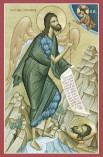 The great and glorious Forerunner was beheaded at the wish and request
of the wicked Herodias, wife of Herod. When John had been beheaded, Herodias ordered that his
head should not be buried with his body, for she feared that the terrible prophet would somehow
rise from the dead. So she took his head and buried it in some hidden and unworthy place, deep in
the earth. Her lady-in-waiting was Joanna the wife of Chuza, a courtier of Herod’s. This
good and God-fearing Joanna could not bear that the head of the godly man should remain in an
unworthy place, so she disinterred it secretly, took it to Jerusalem and buried it on the Mount
of Olives. Not knowing about all this, King Herod, when he heard about Christ and His great
miracles, was afraid and said: ‘It is John, whom I beheaded; he is risen from the
dead!’ (Mk. 6:16). After a considerable time, an eminent government official came to
believe in Christ, left his position in the world and became a monk. Under the name Innocent, he
settled on the Mount of Olives, in precisely the place where the Baptist’s head had been
buried. Deciding to build himself a cell, he dug deep and found an earthen pot containing a head
which, it was revealed to him secretly, was that of the Baptist. He venerated it and re-buried it
in the same place. By God’s providence, that wonder-working head went from hand to hand,
disappearing into the darkness of forgetfulness and then being once more revealed, until it was
finally taken to Constantinople in the middle of the 9th century, in the time of Patriarch
Ignatius and the God-fearing Empress Theodora, mother of Michael and wife of Theophilus. Many
miracles were performed by the head of the Forerunner. It is important and interesting to note
that, while he was alive, John did not work a single miracle (Jn. 10:41), but to his relics was
given the blessed power of working miracles.
The great and glorious Forerunner was beheaded at the wish and request
of the wicked Herodias, wife of Herod. When John had been beheaded, Herodias ordered that his
head should not be buried with his body, for she feared that the terrible prophet would somehow
rise from the dead. So she took his head and buried it in some hidden and unworthy place, deep in
the earth. Her lady-in-waiting was Joanna the wife of Chuza, a courtier of Herod’s. This
good and God-fearing Joanna could not bear that the head of the godly man should remain in an
unworthy place, so she disinterred it secretly, took it to Jerusalem and buried it on the Mount
of Olives. Not knowing about all this, King Herod, when he heard about Christ and His great
miracles, was afraid and said: ‘It is John, whom I beheaded; he is risen from the
dead!’ (Mk. 6:16). After a considerable time, an eminent government official came to
believe in Christ, left his position in the world and became a monk. Under the name Innocent, he
settled on the Mount of Olives, in precisely the place where the Baptist’s head had been
buried. Deciding to build himself a cell, he dug deep and found an earthen pot containing a head
which, it was revealed to him secretly, was that of the Baptist. He venerated it and re-buried it
in the same place. By God’s providence, that wonder-working head went from hand to hand,
disappearing into the darkness of forgetfulness and then being once more revealed, until it was
finally taken to Constantinople in the middle of the 9th century, in the time of Patriarch
Ignatius and the God-fearing Empress Theodora, mother of Michael and wife of Theophilus. Many
miracles were performed by the head of the Forerunner. It is important and interesting to note
that, while he was alive, John did not work a single miracle (Jn. 10:41), but to his relics was
given the blessed power of working miracles.
2. Our Holy Father Erasmus.
A monk of the Caves in Kiev, he inherited great wealth from his parents and spent it all on the beautifying of churches, especially on gold and silver covers for icons. When he had impoverished himself and left himself with nothing, he was despised by everyone. The devil suggested to him that he had squandered his goods in vain in using them for the beautifying of churches instead of giving them to the poor. Erasmus surrendered to this temptation and believed it, as a result of which he came to despise himself, fell into despair and began to live aimlessly and lawlessly. When the time of his death approached, the brothers gathered round him and began to speak of his sins, for he would not consider them for himself. But he suddenly sat up in bed and said: ‘My fathers and brethren, you have spoken thus and so, that I am a sinner and unrepentant, but lo, St. Anthony and St. Theodosius have appeared to me, and the most holy Mother of God, and have told me that the Lord has given me further time for repentance.’ The Mother of God also said these encouraging words to him: ‘The poor you have with you in every place, but my churches you have not.’ And he lived three days longer and repented and fell asleep in the Lord. This teaches us that zeal for the Church and for her beautification is a work pleasing to God. St. Erasmus entered into rest in 1160.
FOR CONSIDERATION
Those who let us do as we like are neither good teachers nor good friends. Blessed John Moschus writes about one eminent woman of senatorial family, who visited the Holy Land: ‘Arriving at Caesarea, she planned to remain there, and applied to the bishop with this request: “Find me a young woman to teach me the fear of God”. The bishop introduced her to a humble girl. After some time, he met this woman and asked her: “How is the girl that I introduced to you?” “She is all right”, replied the woman, “but she has been of little help to my soul because she lets me have my own way. It is because she is humble, but I need her to grumble at me and not let me do as I please”. The bishop found her someone else, a girl with a fairly rough character who grumbled at her, called her an ignorant rich woman and so forth. After some time, the bishop again asked the woman: “And how does this young woman get on with you?” “She is truly helpful to my soul”, replied the woman of senatorial family—and she thus became very humble.’ (‘The Spiritual Meadow’).
Daily Scripture Readings taken from The Orthodox New Testament, translated and published by Holy Apostles Convent, Buena Vista, Colorado, copyright © 2000, used with permission, all rights reserved.
Daily Prologue Readings taken from The Prologue of Ochrid, by Bishop Nikolai Velimirovic, translated by Mother Maria, published by Lazarica Press, Birmingham, England, copyright © 1985, all rights reserved. Edited by Dormition Skete.