

Daily Devotional
Saturday, March 2, 2024 (NS), February 18, 2024 (OS)
No Fasting.
Saturday of the Thirty-Fourth Week
The commemoration of our holy father among the saints, Leo, Pope of Rome.
Scripture Readings
Paschalion — Movable Calendar
Saturday of the Thirty-Fourth Week
Epistle
The Reading is from the First Epistle of Saint Paul to Saint Timothy [§ 288]. Child Timothy:
6 11Be pursuing righteousness, piety, faith, love, patience, meekness. 12Keep on fighting the good fight of the faith. Be laying hold of eternal life, to which thou wast also called, and didst confess the good confession before many witnesses. 13I enjoin thee before God Who maketh alive all things, and Christ Jesus Who witnessed the good confession before Pontius Pilate, 14that thou keep the commandment spotless, irreproachable, until the appearance of our Lord Jesus Christ, 15which in His own times He shall reveal the blessed and only Potentate, the King of those who reign as kings and Lord of those who lord as lords, 16the One Who alone hath immortality, dwelling in light unapproachable, Whom not one of mankind did see, nor is able to see, to Whom be honor and everlasting might. Amen.
For Sl. usage, see [2 Tim. 3:1-9 ].
Gospel
The Reading is from the Holy Gospel according to Saint Luke [§ 103]. The Lord said to His disciples:
20 46“Be on your guard against the scribes, who wish to walk about in full dress, and love salutations in the marketplaces, and chief seats in the synagogues, and chief places at the dinners, 47“who devour the houses of the widows, and for a pretense offer long prayers. They shall receive greater judgment.”
21 1And He looked up and saw the rich casting their gifts into the treasury. 2And He saw also a certain poor widow casting in that place two lepta. 3And He said, “Truly I say to you that this poor widow cast in more than all; 4“for all these did cast into the gifts of God out of that which is superfluous to them, but she, out of her need, cast in her whole means of living which she had.”
Menaion — Fixed Calendar
The commemoration of our holy father among the saints, Leo, Pope of Rome.
No readings given.
Lives of the Saints (Prologue)
March 3rd – Civil Calendar: Non-Leap Year
March 2nd – Civil Calendar: Leap Year
February 18th – Church Calendar
1. St. Leo the Great, Pope of Rome.
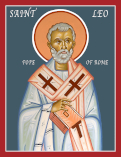 Born in Italy of devout parents, he was
first archdeacon with Pope Sixtus the Third, then elected against his own will to the papal
throne after Sixtus’ death. When Attila drew near to Rome with his Huns and prepared to
ravage and burn the city, Leo went out to him in his episcopal vestments, tamed the wrath of the
Hun leader and averted the fall of Rome. Attila was willing to be guided by Leo both because of
his holiness and because of a vision he had of the Apostles Peter and Paul, standing behind Leo
and threatening Attila with a flaming sword.
Born in Italy of devout parents, he was
first archdeacon with Pope Sixtus the Third, then elected against his own will to the papal
throne after Sixtus’ death. When Attila drew near to Rome with his Huns and prepared to
ravage and burn the city, Leo went out to him in his episcopal vestments, tamed the wrath of the
Hun leader and averted the fall of Rome. Attila was willing to be guided by Leo both because of
his holiness and because of a vision he had of the Apostles Peter and Paul, standing behind Leo
and threatening Attila with a flaming sword.
Leo not only saved Rome; he also contributed greatly to the safeguarding of Orthodoxy against the heresy of Eftyches and Dioscoros. This heresy consisted in the merging of the divine and human natures of Christ into one, and following from this, the denial of the existence of two wills in the Person of our Lord and Savior. This led to the summoning of the Fourth Ecumenical Council at Chalcedon, at which St. Leo’s Epistle was read—a letter which St. Leo, after writing it, had placed on the tomb of St. Peter, and which St. Peter had corrected. As death drew near, he spent forty days in fasting and prayer by the tomb of the Apostle Peter, begging him to tell him if his sins were forgiven. The apostle appeared to him and assured him that they were, except for his sins in the ordaining of priests (from which it is seen how grave a sin it is to ordain an unworthy man). The saint fell to prayer again, until he was told that these also were wiped out. Then he gave his soul to the Lord in peace. St. Leo entered into rest in the year 461.
FOR CONSIDERATION
Grass is the most important thing in a meadow, as are grain in a field and vegetables in a market-garden. No one would boast of the fence of a meadow rather than its hay, or of the hut in a field rather than its crop, or the ditch in a market garden rather than its vegetables. Why do people boast of their country, or of the highways in that country, or its frontier ditches or the towns in it—or about anything else that has just about as much value as the fence of a meadow or the hut in a field or the ditch in a market garden when weighed against the main crop; that is, people? People do not exist for the sake of the country, but the country for their sake. Christ came to save, not the country, but the people. A country is valued by the goodness of its citizens. But of what use is a great country to evil men? They fill the field with brambles.
Daily Scripture Readings taken from The Orthodox New Testament, translated and published by Holy Apostles Convent, Buena Vista, Colorado, copyright © 2000, used with permission, all rights reserved.
Daily Prologue Readings taken from The Prologue of Ochrid, by Bishop Nikolai Velimirovic, translated by Mother Maria, published by Lazarica Press, Birmingham, England, copyright © 1985, all rights reserved. Edited by Dormition Skete.