

Daily Devotional
Wednesday, February 28, 2024 (NS), February 15, 2024 (OS)
No Fasting.
Wednesday of the Thirty-Fourth Week
The commemoration of the holy Apostle Onesimos of the Seventy.
Scripture Readings
Paschalion — Movable Calendar
Wednesday of the Thirty-Fourth Week
Epistle
The Reading is from the Second General Epistle of Saint Peter [§ 68 A].
3 1Beloved, this second epistle, I now write to you, in which I stir up your sincere mind 2to be mindful of the words which were spoken before by the holy prophets, and of the commandment of us, the apostles of the Lord and Savior, 3knowing this first, that during the last days mockers shall come, walking according to their own desires, 4and saying, “Where is the promise of His coming? For since the fathers fell asleep, all things continue thus as they were from the beginning of creation.” 5For this escapeth their notice willingly: that by the word of God were there heavens of old, and an earth having stood together out of water and in water, 6by which the world of that time, having been deluged by water, perished. 7But the present heavens and the earth, which have been laid up in store by the same word, are being kept for fire until a day of judgment and perdition of ungodly men. 8But, beloved, let not this one thing escape you, that one day with the Lord is as a thousand years, and a thousand years as one day. 9The Lord is not slow as to the promise, as some deem slowness, but is long-suffering toward us, not willing to have any perish, but to have all come to repentance. 10But the day of the Lord shall come as a thief in the night, in which the heavens shall pass away with a rushing sound, and the elements, being burned with intense heat, shall be dissolved; and the earth and the works in it shall be burned completely. 11Therefore, because of all these things being dissolved, what manner of persons ought ye to be in holy modes of life and acts of piety, 12expecting and earnestly desiring the coming of the day of the Lord, by reason of which the heavens, being set on fire, shall be dissolved, and the elements, being burned with intense heat, shall be melted! 13But according to His promise, we look for new heavens and a new earth, wherein dwelleth righteousness.
14Wherefore, beloved, looking for these things, earnestly endeavor to be found by Him in peace, spotless and blameless; 15and be deeming that the long-suffering of the Lord is salvation, even as also our beloved brother Paul, according to the wisdom which was given to him, wrote to you, 16as also in all his epistles, speaking in them concerning these things, in which are some things hard to be understood, which the unlearned and unstable twist, as they do also the rest of Scriptures, to their own destruction.
17Ye therefore, beloved, since ye know these things beforehand, be on your guard lest, having been led away by the error of the lawless, ye should fall from your own steadfastness; 18but keep on increasing in grace and in knowledge of our Lord and Savior Jesus Christ. To Him be the glory, both now and to the day of eternity. Amen.
Gospel
The Reading is from the Holy Gospel according to Saint Mark [§ 61]. The Lord said to His disciples:
13 24“In those days, after that affliction, the sun shall be darkened, and the moon shall not give her light; 25“and the stars shall be falling from the heaven, and the powers which are in the heavens shall be shaken. 26“And then shall they see the Son of Man coming in clouds with great power and glory. 27“And then He shall send forth His angels, and shall gather together His elect from the four winds, from the uttermost part of the earth unto the uttermost part of the heaven. 28“Now learn the parable from the fig tree: Whenever its branch at once should become tender and put forth leaves, ye know that the summer is near; 29“thus also ye, whenever ye see these things coming to pass, know ye that it is near, even at the doors. 30“Verily I say to you that in no wise shall this generation pass away until all these things take place. 31“The heaven and the earth shall pass away, but My words in no wise shall pass away.”
Menaion — Fixed Calendar
The commemoration of the holy Apostle Onesimos of the Seventy.
Epistle
The Reading is from the Epistle of Saint Paul to Saint Philemon [§ mid 302 B].
1Paul, a prisoner of Christ Jesus, and Timothy our brother, to Philemon the beloved and our fellow worker, 2and to Apfia the beloved, and to Archippos our fellow soldier, and to the church in thy house. 3Grace to you and peace from God our Father and the Lord Jesus Christ.
4I thank my God, making mention of thee always in the time of my prayers, 5hearing of thy love and the faith which thou hast toward the Lord Jesus and in regard to all the saints, 6that the communion of thy faith might become energized in full knowledge of every good which is in you in regard to Christ Jesus. 7For we have much joy and consolation over thy love, because the hearts of the saints have been refreshed through thee, brother. 8Wherefore, though I have much boldness in Christ to enjoin thee to that which is becoming, 9yet for the sake of love I rather beseech, being such a one as Paul, an elder, and now also a prisoner of Jesus Christ, 10I beseech thee concerning my child, Onesimos, whom I begot in my bonds— 11the one who was once useless to thee, but is now useful to thee and to me—whom I am sending back. 12Now receive thou him, that is, mine own heart, 13whom I was wishing to hold for myself, that he may minister to me in the bonds of the Gospel; 14but without thine opinion I wished to do nothing, that thy good may not be as according to necessity, but according to willingness. 15For perhaps on this account he was separated from thee for a season, in order that thou mayest receive him in full forever, 16no longer as a slave, but above a slave, a brother beloved, especially to me, and how much more to thee, both in the flesh and in the Lord! 17If then thou holdest me a partner, take him to thyself as thou wouldest me. 18But if he wronged thee in anything or oweth thee, be reckoning this to me; 19I, Paul, am writing it with mine own hand, I will repay it; not that I may mention that to me thou owest even thyself. 20Yes, brother, may I benefit from thee in the Lord; refresh thou my heart in the Lord.
21Having trusted to thine obedience, I am writing to thee, knowing that even beyond what I may say thou wilt do. 22And at the same time also, be preparing a lodging for me, for I hope that through your prayers I shall be graciously given to you. 23There greeteth thee Epaphras, my fellow captive in Christ Jesus, 24Mark, Aristarchos, Demas, Luke, my fellow workers.
25The grace of our Lord Jesus Christ be with your spirit. Amen.
Gospel
No reading given.
Lives of the Saints (Prologue)
February 28th – Civil Calendar
February 15th – Church Calendar
1. The Holy Apostle Onesimus.
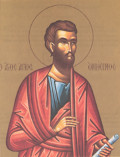 One of the Seventy, he was a slave of Philemon, a rich and
distinguished citizen of Colossae in Phrygia. He offended his master, Philemon, in some way and
fled to Rome, where he heard the Gospel from the Apostle Paul and was baptized. By this time,
Paul had also brought Philemon to the true Faith, and he reconciled the two of them, Philemon and
Onesimus, master and slave, writing a special epistle to Philemon—one of the most moving writings
to be found in the New Testament: ‘I beseech thee for my son Onesimus, whom I have begotten
in my bonds.... Perhaps he departed for a season, that thou shouldest receive him forever, not
now as a servant, but above a servant; a brother beloved.’ Deeply moved by this letter,
Philemon received Onesimus as a brother, indeed, and gave him his freedom. Onesimus was later
made bishop and received the see of Ephesus after the death of the Apostle Timothy. This is
recorded in the epistles of St. Ignatius the God-Bearer. At the time of the persecution under
Trajan, Onesimus, by then an old man, was arrested and taken to Rome. There he testified before
the judge, Tertylus, was imprisoned and finally slain. A wealthy woman took his body, placed it
in a silver coffin and buried it in the year 109.
One of the Seventy, he was a slave of Philemon, a rich and
distinguished citizen of Colossae in Phrygia. He offended his master, Philemon, in some way and
fled to Rome, where he heard the Gospel from the Apostle Paul and was baptized. By this time,
Paul had also brought Philemon to the true Faith, and he reconciled the two of them, Philemon and
Onesimus, master and slave, writing a special epistle to Philemon—one of the most moving writings
to be found in the New Testament: ‘I beseech thee for my son Onesimus, whom I have begotten
in my bonds.... Perhaps he departed for a season, that thou shouldest receive him forever, not
now as a servant, but above a servant; a brother beloved.’ Deeply moved by this letter,
Philemon received Onesimus as a brother, indeed, and gave him his freedom. Onesimus was later
made bishop and received the see of Ephesus after the death of the Apostle Timothy. This is
recorded in the epistles of St. Ignatius the God-Bearer. At the time of the persecution under
Trajan, Onesimus, by then an old man, was arrested and taken to Rome. There he testified before
the judge, Tertylus, was imprisoned and finally slain. A wealthy woman took his body, placed it
in a silver coffin and buried it in the year 109.
2. Our Holy Father Evsevios.
A Syrian hermit, he lived at first under the guidance of holy men, but later went into the solitude of the desert. He fed himself entirely on vegetable foods, never even tasting fruit, and spent all his time in prayer in the open air, enduring all weathers. He lived to the age of 95 and entered into rest in the Lord in 440.
FOR CONSIDERATION
Peace of soul is precious to all men. With those who have acquired peace of soul, the body can be in constant motion, occupation or pain, but their souls, cleaving to God, remain always in unshakable peace. St. Seraphim of Sarov teaches: ‘We must endeavor by every means to keep peace of soul. Do not be troubled by the insults of men. It is necessary at all costs to restrain oneself from anger, and by watchfulness over oneself to keep the mind and heart from vain movement.... For the guarding of peace of soul, it is also necessary to flee from judging others. By non-judgement and silence, peace of soul is preserved. When a man attains to such a state, he receives divine revelation. For a man to be able to keep himself from judging others, he must be vigilant over himself; he must not dare to receive vain thoughts from another, and must be as one dead before all that is of this world. We must tirelessly keep our hearts from vain thoughts and impressions (Prov. 4:23). By constant watchfulness over the heart, a purity of heart is born in which God is seen, according to the words of eternal truth: “Blessed are the pure in heart; for they shall see God” (Matt. 5:8).’
Daily Scripture Readings taken from The Orthodox New Testament, translated and published by Holy Apostles Convent, Buena Vista, Colorado, copyright © 2000, used with permission, all rights reserved.
Daily Prologue Readings taken from The Prologue of Ochrid, by Bishop Nikolai Velimirovic, translated by Mother Maria, published by Lazarica Press, Birmingham, England, copyright © 1985, all rights reserved. Edited by Dormition Skete.