

Daily Devotional
Tuesday, January 30, 2024 (NS), January 17, 2024 (OS)
No Fasting.
Tuesday of the Thirty-Fifth Week
The commemoration of our holy and God-bearing Father Anthony the Great.
Scripture Readings
Paschalion — Movable Calendar
Tuesday of the Thirty-Fifth Week
Epistle
The Reading is from the Epistle of Saint Paul to the Ephesians [§ 230]. Brethren:
For Gk. usage, see Eph. 5:20-25; for Sl. usage, Eph. 5:20-26.
5 20Keep on giving thanks always for all things to the God and Father in the name of our Lord Jesus Christ, 21subordinating yourselves to one another in the fear of Christ.
22Wives, be subordinating yourselves to your own husbands, as to the Lord. 23For the husband is head of the wife, as also the Christ is head of the Church, and is Himself Savior of the body. 24But even as the Church subordinateth herself to the Christ, so also the wives to their own husbands in everything. 25Husbands, be loving your own wives, even as the Christ also loved the Church, and gave Himself up for her, 26in order that He might sanctify her, having cleansed her in the laver of the water with the word.
Gospel
The Reading is from the Holy Gospel according to Saint Luke [§ 18]. At that time:
5 12As Jesus was in one of the cities, behold, a man full of leprosy; and after he saw Jesus, he fell on his face and entreated Him, saying, “Lord, if Thou art willing, Thou art able to cleanse me.” 13And He stretched forth His hand and touched him, saying, “I am willing; be cleansed.” And straightway the leprosy departed from him. 14And He ordered him to tell no one, “But go and show thyself to the priest, and make an offering for thy cleansing, even as Moses commanded, for a testimony to them.” 15But the report concerning Him kept on going abroad much more; and many crowds were coming together to hear, and to be cured from their infirmities by Him. 16But He Himself was withdrawing into the wildernesses and was praying.
Menaion — Fixed Calendar
The commemoration of our holy and God-bearing Father Anthony the Great.
Epistle
The Reading is from the Epistle of Saint Paul to the Hebrews [§ 335]. Brethren:
13 17Be obedient to those who lead you, and keep on submitting, for they are watchful for your souls, as those about to render an account, that they may do this with joy, and not groaning; for this would be unprofitable for you. 18Keep on praying for us; for we trust that we have a good conscience, in all things wishing to conduct ourselves well. 19But I beseech you more abundantly to do this, that I might be restored more quickly to you.
20Now the God of peace Who brought up from the dead our Lord Jesus, the Shepherd of the sheep, the great One, in the blood of an everlasting covenant, 21may He render you perfect in every good work, in order to do His will, doing in you that which is well-pleasing before His face, through Jesus Christ, to Whom be glory to the ages of the ages. Amen.
Gospel
The Reading is from the Holy Gospel according to Saint Luke [§ 24]. At that time:
6 17Jesus stood upon a level place. And there was a crowd of
His disciples, and a great multitude of the people from all of Judæa and Jerusalem and the
seacoast of Tyre and Sidon, who came to hear Him, and to be healed of their diseases—
18even those who were troubled by unclean spirits; and they were cured.
19And all the crowd was seeking to touch Him, for power was coming forth from Him and
healing all. 20And He lifted up His eyes to His disciples, and began to say:
“Blessed are the poor, for yours is the kingdom of God.
21“Blessed are ye who hunger now, for ye shall be
filled.
Blessed are ye who weep now, for ye shall laugh.
22“Blessed are ye whenever men hate you, and whenever they
separate you, and reproach you, and cast out your name as evil, on account of the Son of
Man.
23“Rejoice in that day and leap for joy, for behold, your
reward is great in the heavens.”
Lives of the Saints (Prologue)
January 30th – Civil Calendar
January 17th – Church Calendar
1. Our Holy Father Anthony the Great.
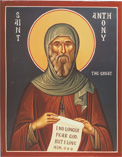 He was an Egyptian, born about 250 in a village called
Quemen-el-Arons near Herakleopolis. After the death of his rich and noble parents, he shared his
inherited possessions with his sister, who was still in her minority, made sure that she was
cared for, gave away his half of the inheritance to the poor, and at the age of twenty,
consecrated himself to the life of asceticism that he had desired from childhood. At first he
lived near his own village but then, in order to escape the disturbance of men, went off into the
desert, on the shores of the Red Sea, where he spent twenty years as a hermit in company with no
one but God, in unceasing prayer, pondering and contemplation, patiently undergoing inexpressible
demonic temptations. His fame spread through the whole world and around him gathered many
disciples whom he, by word and example, placed on the path of salvation. In eighty-five years of
ascetic life, he went only twice to Alexandria: the first time to seek martyrdom during a time of
persecution of the Church, and the second at the invitation of St. Athanasius, to refute the
Arians’ slanderous allegations that he too was a follower of the Arian heresy. He departed
this life at the age of 105, leaving behind a whole army of disciples and followers. And although
Anthony was unlettered, he was as a counselor and teacher one of the most learned men of his age,
as also was St. Athanasius the Great. When some Hellenic philosophers tried to test him with
literary learning, Anthony shamed them with the question: ‘Which is older, the
understanding or the book? And which of these is the source of the other?’ The shamed
philosophers dispersed, for they saw that they had only book-learning without understanding,
while Anthony had understanding. Here was a man who had attained perfection insofar as man is
able on earth. Here was an educator of educators and teacher of teachers, who for a whole
eighty-five years perfected himself, and only thus was able to perfect many others. Full of years
and great works, Anthony entered into rest in the Lord in the year 356.
He was an Egyptian, born about 250 in a village called
Quemen-el-Arons near Herakleopolis. After the death of his rich and noble parents, he shared his
inherited possessions with his sister, who was still in her minority, made sure that she was
cared for, gave away his half of the inheritance to the poor, and at the age of twenty,
consecrated himself to the life of asceticism that he had desired from childhood. At first he
lived near his own village but then, in order to escape the disturbance of men, went off into the
desert, on the shores of the Red Sea, where he spent twenty years as a hermit in company with no
one but God, in unceasing prayer, pondering and contemplation, patiently undergoing inexpressible
demonic temptations. His fame spread through the whole world and around him gathered many
disciples whom he, by word and example, placed on the path of salvation. In eighty-five years of
ascetic life, he went only twice to Alexandria: the first time to seek martyrdom during a time of
persecution of the Church, and the second at the invitation of St. Athanasius, to refute the
Arians’ slanderous allegations that he too was a follower of the Arian heresy. He departed
this life at the age of 105, leaving behind a whole army of disciples and followers. And although
Anthony was unlettered, he was as a counselor and teacher one of the most learned men of his age,
as also was St. Athanasius the Great. When some Hellenic philosophers tried to test him with
literary learning, Anthony shamed them with the question: ‘Which is older, the
understanding or the book? And which of these is the source of the other?’ The shamed
philosophers dispersed, for they saw that they had only book-learning without understanding,
while Anthony had understanding. Here was a man who had attained perfection insofar as man is
able on earth. Here was an educator of educators and teacher of teachers, who for a whole
eighty-five years perfected himself, and only thus was able to perfect many others. Full of years
and great works, Anthony entered into rest in the Lord in the year 356.
2. The Holy Emperor Theodosios the Great.
This famous emperor, a zealot for the Faith, ruled from 379 to 395. Constantine the Great forbade the persecution of Christians. Theodosios the Great went a stage further: he forbade sacrifice to idols in the area under his administration. He played a considerable part in the establishing and spread of the Christian Faith in the world.
3. The Holy Martyr George the New of Ioannina.
He was an Albanian, born in the village of Churkli of very poor parents who were farm-laborers. Made a target by the Turks for conversion to Islam, he remained steadfast in the Christian Faith, for which he was hanged in Ioannina on January 17th, 1838. A great wonder-worker and healer, he is still active today.
FOR CONSIDERATION
St. Anthony teaches: ‘Learn to desire humility, for that will cover all your sins. All sin is hateful to God, but the most hateful of all is pride of heart. Do not consider yourself learned or wise, or all your toil will be lost and your ship will arrive empty at the shore.... If you have great power, threaten no man with death; know that according to nature you also are subject to death and that each soul takes off its body as its final clothing.’
In Byzantium there was a strange and instructive custom at the coronation of the emperor in Hagia Sophia. This was that, when the patriarch placed the crown on the emperor’s head, he at the same time placed in his hand a silk purse filled with grave-dust, that the emperor might be mindful of his death, flee all pride and be humble.
Daily Scripture Readings taken from The Orthodox New Testament, translated and published by Holy Apostles Convent, Buena Vista, Colorado, copyright © 2000, used with permission, all rights reserved.
Daily Prologue Readings taken from The Prologue of Ochrid, by Bishop Nikolai Velimirovic, translated by Mother Maria, published by Lazarica Press, Birmingham, England, copyright © 1985, all rights reserved. Edited by Dormition Skete.