

Daily Devotional
Wednesday, May 18, 2022 (NS), May 5, 2022 (OS)
Fast Day, but Wine and Olive Oil Allowed.
The Wednesday of the Mid-Pentecost
The commemoration of the Great-martyr Irene of Magedon.
Scripture Readings
Paschalion — Movable Calendar
The Wednesday of the Mid-Pentecost
Epistle
The Reading is from the Acts of the Apostles [§ 34]. In those days:
14 6The apostles fled for refuge to the cities of Lycaonia, Lystra, and Derbe, and the country round about; 7and there they were preaching the Gospel.
8And a certain man in Lystra, disabled in his feet, who was lame from his mother’s womb and who never had walked, was sitting. 9This same one heard Paul speaking, who, having looked intently on him and perceiving that he had faith to be made well, 10said with a loud voice, “Stand upright on thy feet.” And he leaped and was walking about. 11And after the crowds saw what Paul did, they lifted up their voice in Lycaonian, saying, “The gods, having become like men, came down to us.” 12And they indeed began calling Barnabas Zeus, and Paul Hermes, since he was the leader of the discourse. 13And the priest of Zeus, whose temple was before their city, brought oxen and garlands to the gateways, and was intending to sacrifice with the crowds. 14But the apostles, Barnabas and Paul, after they heard this, tore their garments and rushed into the crowd, crying out, 15and saying, “Men, why do ye these things? We also are men of like feelings with you, preaching the Gospel to you to turn you from these vanities to the living God, Who made the heaven, and the earth, and the sea, and all the things in them, 16“Who in the generations which have gone by suffered all the nations to walk in their own ways. 17“And yet indeed, He left not Himself without witness, doing good, giving rain from heaven to us and fruit-bearing seasons, filling our hearts with food and good cheer.” 18And saying these things, they scarcely stopped the crowds from sacrificing to them.
Gospel
The Reading is from the Holy Gospel according to Saint John [§ 26].
7 14It now already being the middle of the feast, Jesus went up into the temple and began to teach. 15And the Jews were wondering, saying, “How knoweth this One letters, since He hath not learned?” 16Jesus answered them and said, “My teaching is not Mine, but of the One Who sent Me. 17“If anyone be willing to do His will, he shall know concerning the teaching, whether it is from God or whether I speak from Myself. 18“The one who speaketh from himself seeketh his own glory; but the One Who seeketh the glory of the One Who sent Him, this One is true, and unrighteousness is not in Him. 19“Moses hath given you the law, hath he not? And yet not one of you doeth the law. Why do you seek to kill Me?” 20The crowd answered and said, “Thou hast a demon; who seeketh to kill Thee?” 21Jesus answered and said to them, “I did one work, and ye all wonder on this account. 22“Moses hath given you circumcision—not that it is of Moses, but of the fathers—and on a sabbath ye circumcise a man. 23“If a man receive circumcision on a sabbath, in order that the law of Moses should not be broken, are ye bilious because I made a whole man sound on a sabbath! 24“Cease judging according to appearance, but judge the righteous judgment.” 25Then some of those from Jerusalem were saying, “This is the One Whom they seek to kill, is it not? 26“But behold, He speaketh boldly, and they say nothing to Him. Can it be that the rulers indeed came to know that this is truly the Christ? 27“But we know from what place this One is; but the Christ, whenever He may be coming, no one knoweth where He is from.” 28Then Jesus cried out in the temple, teaching and saying, “Ye both know Me, and ye know from what place I am; and I have not come of Myself, but the One Who sent Me is true, Whom ye know not. 29“But I know Him; for I am from Him, and that One sent Me forth.” 30Then they began seeking to lay hold of Him; but no one laid his hand upon Him, because His hour had not yet come.
Menaion — Fixed Calendar
The commemoration of the Great-martyr Irene of Magedon.
No readings given.
Lives of the Saints (Prologue)
May 18th – Civil Calendar
May 5th – Church Calendar
1. The Holy and Great Martyr Irene.
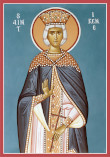 She lived in the Balkans in apostolic times, in the town
of Magedon where her father Licinius was governor of a small region. She was born a pagan of
pagan parents. Penelope—for that was her pagan name—learned the Christian Faith from her teacher,
Appelianus. St. Timothy, the disciple of the Apostle Paul, baptized her and her lady-in-waiting,
and brought her a letter from the Apostle Paul to read. She infuriated her father by her
embracing Christianity, and he intended to have her trampled to death by horses. The horses
turned on him, however, slaying him. She prayed to God on behalf of her father, who had just
tried to kill her, and the Lord resurrected him. He subsequently embraced Christianity. Irene was
tortured in different ways by four kings, other than her father, but God saved her through His
angels. King Sedekias had her cast headlong into a deep pit full of snakes and reptiles. The
saint persevered there for fourteen days, and emerged unscathed. Then the same king attempted to
saw off her feet, but the sword broke against her body as against stone. This same king once
again bound her to the wheel of a water-mill, then let the water in to drown her, but the water
would not flow, but stood still, and the maiden remained whole and alive. After Sedekias was
ousted from his domain, Sapor, his son, marched against those who deposed his father. St. Irene
met Sapor and his army in the city of Magedon. By her prayers, his entire army was stricken
blind. Again, she prayed and their eyesight was restored by divine grace. Nonetheless, the
ungrateful ones shod her with nails, loaded a sack of sand onto her, put a bridle on her and
commanded that she be led like an animal far outside the city. ‘Truly I am as a beast
before Thee, O Lord!’ said the holy martyr as she ran bridled behind her torturers. But an
angel of God caused an earthquake, and the earth opened and swallowed up ten thousand
infidels—but brought thirty thousand to the Faith. Despite this, the king persisted in his
paganism, for which he was smote by an angel of the Lord. Surviving all these tortures, by which
an enormous number of pagans were brought to Christianity, Irene went to the city of Kallinikos,
where she preached the Christian Faith. The local king, Numerian, tried to kill her, throwing her
into three burning metal oxen one after the other. But the maiden was preserved and remained
alive, and many saw and believed. The eparch, Vavdonos, sought to kill her by putting her onto a
burning grid, but this did not harm St. Irene, and brought him to the true Faith. She then went
to the city of Constantina, where Shapur II the Great, King of the Persians, had her head cut
off. But she was resurrected by an angel of God. The king, seeing this, together with many of the
people, believed in Christ and was baptized. And thus St. Irene, by her sufferings and miracles,
brought over 100,000 pagans to faith in Christ. At last she laid herself in a grave and commanded
Appelianus, her former teacher, to close it. After four days, when the grave was opened, her body
was not in it. Thus God glorified forever the maiden and martyr Irene, who had sacrificed all and
endured all, that God should be the more greatly glorified among men.
2. Ss. Martin and Heraclius.
Slavs, they were persecuted by heretical Arians in Illyria. Sent into exile, these knights of Orthodoxy finished their earthly course in the 4th century and went to the Lord.
FOR CONSIDERATION
Prayer with words is of no use if the heart does not participate. God only hears prayer from the heart. Abba Zoilos of the Thebaid, returning once from Mount Sinai, met a monk who complained that in the monastery, they were greatly suffering from drought. Zoilos asked: ‘Why don’t you pray to God, and implore Him?’ The monk replied: ‘We have prayed and implored, but there is no rain!’ To this Zoilos answered: ‘It is obvious that you are not praying from the heart. Do you want to be convinced that this is so?’ And, thus speaking, the elder raised his hands to heaven and began to pray, and abundant rain fell onto the earth. Seeing this, the marveling monk fell to the ground before the elder and did him reverence, but the elder, fearing the praise of men, quickly fled from him. ‘Ask, and it shall be given you,’ said the Lord Himself. But vain are mouthfuls of prayers if the heart is empty. God does not stand and listen to the lips, but to the heart. Let the heart be filled with prayer and the lips be silent. God will hear and receive the prayer, for He only hearkens to heartfelt prayer.
Daily Scripture Readings taken from The Orthodox New Testament, translated and published by Holy Apostles Convent, Buena Vista, Colorado, copyright © 2000, used with permission, all rights reserved.
Daily Prologue Readings taken from The Prologue of Ochrid, by Bishop Nikolai Velimirovic, translated by Mother Maria, published by Lazarica Press, Birmingham, England, copyright © 1985, all rights reserved. Edited by Dormition Skete.