

Daily Devotional
Wednesday, May 11, 2022 (NS), April 28, 2022 (OS)
Fast Day, but Wine and Olive Oil Allowed.
Wednesday of the Third Week
The commemoration of the holy Nine Martyrs of Kyzicus, Theognis, Rufus, Antipater, Theostichos, Artemas, Magnos, Theodotos, Thavmasios, and Philemon (commemorated on Sl. calendar on the 29th of April). The commemoration of the holy Apostles of the Seventy, Jason and Sosipater, and their companions (commemorated on Gk. calendar on the 29th of April). The commemoration of the holy Martyrs Maximos, Quintillian, and Dada at Dorostolum (commemorated on Gk. calendar on the 13th of April).
Scripture Readings
Paschalion — Movable Calendar
Wednesday of the Third Week
Epistle
The Reading is from the Acts of the Apostles [§ 19]. In those days:
8 18After Simon saw that through the laying on of the hands of the apostles the Holy Spirit was given, he offered them money, 19saying, “Give me also this authority, that on whomsoever I lay hands, he may receive the Holy Spirit.” 20But Peter said to him, “May thy silver be with thee for destruction, because thou didst think to acquire the gift of God by means of money. 21“There is neither part nor lot to thee in this matter, for thy heart is not straight before God. 22“Repent therefore of this thy wickedness, and entreat God if perhaps the thought of thy heart be forgiven thee. 23“For I perceive thee to be in the gall of bitterness and in the bond of unrighteousness.” 24And Simon answered and said, “Entreat ye the Lord for me, so that nothing of which ye have spoken might come upon me.” 25They therefore indeed, having testified and spoken the word of the Lord, returned to Jerusalem and preached the Gospel to many villages of the Samaritans.
Gospel
The Reading is from the Holy Gospel according to Saint John [§ 21]. The Lord said to the Jews who had believed Him:
6 35“I am the bread of life; the one who cometh to Me in no wise shall hunger; and the one who believeth in Me in no wise shall thirst at any time. 36“But I said to you that ye also have seen Me, and believe not. 37“All that the Father giveth to Me shall come to Me, and the one who cometh to Me in no wise will I cast out; 38“for I have come down out of the heavens, not in order that I may do Mine own will, but the will of the One Who sent Me. 39“And this is the will of the Father Who sent Me, that all that He hath given Me I should not lose anything of it, but should raise it up in the last day.”
Menaion — Fixed Calendar
The commemoration of the holy Nine Martyrs of Kyzicus, Theognis, Rufus, Antipater, Theostichos, Artemas, Magnos, Theodotos, Thavmasios, and Philemon (commemorated on Sl. calendar on the 29th of April). The commemoration of the holy Apostles of the Seventy, Jason and Sosipater, and their companions (commemorated on Gk. calendar on the 29th of April). The commemoration of the holy Martyrs Maximos, Quintillian, and Dada at Dorostolum (commemorated on Gk. calendar on the 13th of April).
No readings given.
Lives of the Saints (Prologue)
May 11th – Civil Calendar
April 28th – Church Calendar
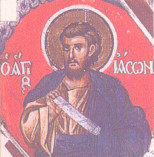
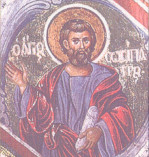
1. The Holy Apostles Jason and Sosipater, and the Virgin Kerkyra.
|
The first two were among the Seventy Apostles, and the last was the daughter of the king of the island of Corfu. The Apostle Paul mentions Jason and Sosipater (Rom. 16:21), and calls them his kinsmen. Jason was born in Tarsus, as was the Apostle Paul himself, and Sosipater in Achaea. The first was nominated by the apostles as Bishop of Tarsus and the second as Bishop of Iconium. Travelling and preaching the Gospel, these two apostles came to the island of Corfu, where they succeeded in building a church dedicated to St. Stephen the Protomartyr and in bringing some unbelievers to the Church. The king of the island threw them into prison, where there were seven robbers already imprisoned: Satorninus, Jakischolus, Faustian, Januarius, Marsalus, Evphrasius and Mamminus. The apostles brought all seven of them to the Christian Faith, making wolves into lambs. The king commanded that these seven be put to death in boiling pitch, and they thus received the wreath of martyrdom. Seeking to disgrace Jason and Sosipater, the king had them dragged through the streets by a horse at a speed calculated to be slow enough to bruise them without killing them. When the king’s daughter, Kerkyra, saw this, she looked upon the wretchedness of her father with disdain, and discovering the reason for it, she visited them in the prison, where she was converted. She gave all her jewels away to the poor and proclaimed herself a Christian to her father. The king was filled with wrath against his daughter and shut her up in a separate prison. Then, failing to turn her from Christ, he ordered that the prison be burned down. The prison burned to the ground, but the maiden remained alive. Seeing this wonder, many of the people were baptized. The furious king ordered that his daughter be bound to a tree and killed with arrows. Those who had come to believe in Christ fled from the terrible king to a nearby island and hid themselves. The king set off in a boat to arrest them, but his boat overturned in the sea and thus the unrighteous perished, as Pharaoh aforetime. The succeeding king, Donatios, continued in the persecution. He ordered Sosipater to be put to death. It was presumed that Jason would follow his comrade in death, but the king decided to question the surviving partner first. A gnawing sense of guilt precipitated the meeting of the two, at which Jason succeeded in converting Donatios to the Christian Faith. Not long after this, the twelve-year-old daughter of Donatios was stricken with a fatal illness, but was cured when Jason knelt in prayer on her behalf. Jason continued to work for our Savior until his death at the age of sixty on April 28th, the day on which Sosipater had died for Christ. |
|
2. The Holy Martyrs Maximus, Dada and Quintillian.
Suffering in the time of Diocletian, they were condemned and tortured by the commander Tarquinius. After imprisonment and torture, they were beheaded.
3. The Holy Martyr Tibald.
A Slav from Pannonia, he was terribly tortured for the Faith in the time of Diocletian, and suffered in Tsibal.
FOR CONSIDERATION
The mystery of our salvation is fulfilled in God’s appearing among men in human flesh. Meliton of Sardis writes: ‘The works of Christ after His Baptism showed and demonstrated to the world that His divinity is hidden within His flesh. Being God, He was also perfect man. He revealed His two natures to us: His divinity by His miracles, performed in the three years after His Baptism, and His humanity through those thirty years when bodily nature hid the signs of His divinity, although He was truly the pre-eternal God.’ The means of uniting the divinity with the humanity is difficult to comprehend, but the event of the appearing of God among men is perfectly comprehensible from the point of view of God’s love for man. As an event, the world is not more comprehensible—it can be said to be even less comprehensible than the event of events, the incarnation of God.
Daily Scripture Readings taken from The Orthodox New Testament, translated and published by Holy Apostles Convent, Buena Vista, Colorado, copyright © 2000, used with permission, all rights reserved.
Daily Prologue Readings taken from The Prologue of Ochrid, by Bishop Nikolai Velimirovic, translated by Mother Maria, published by Lazarica Press, Birmingham, England, copyright © 1985, all rights reserved. Edited by Dormition Skete.