

Daily Devotional
Sunday, May 1, 2022 (NS), April 18, 2022 (OS)
No Fasting.
| The Sunday of the Antipascha (The Sunday After Pascha) The Sunday of the Holy Apostle Thomas Mode One — First Eothinon |
The commemoration of our venerable Father John, disciple of St. Gregory the Decapolite.
Scripture Readings
Paschalion — Movable Calendar
The Sunday of the Antipascha (The Sunday After Pascha)
The Sunday of the Holy Apostle Thomas
Mode One — First Eothinon
Epistle
The Reading is from the Acts of the Apostles [§ 14]. In those days:
5 12Through the hands of the apostles many signs and wonders were being wrought among the people. And they were all with one accord in the porch of Solomon. 13And of the rest not even one was daring to be joined to them, but the people were magnifying them. 14And more believers were being added to the Lord, multitudes both of men and of women, 15insomuch that they carried out the sick into the streets and laid them upon beds and pallets, in order that at least the shadow of Peter as he came might overshadow some of them. 16And also the multitude kept on coming together out of the cities round about to Jerusalem, bearing sick people and those who were troubled by unclean spirits—all of whom were being healed.
17Then the high priest rose up and all those with him (the sect which is of the Sadducees), and were full of jealousy, 18and laid their hands on the apostles and put them in state custody. 19But an angel of the Lord during the night opened the doors of the prison and led them out, and said, 20“Go and take a stand in the temple, and be speaking to the people all the words of this life.”
Gospel
The Reading is from the Holy Gospel according to Saint John [§ 65].
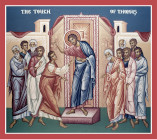
20 19When it was evening on that day, the first of the week—and the doors were closed where the disciples were gathered together for fear of the Jews—Jesus came and stood in the midst, and saith to them, “Peace be to you.” 20And after He said this, He showed them His hands and His side. Then were the disciples glad, after they saw the Lord. 21Then Jesus said to them again, “Peace be to you; even as the Father hath sent Me forth, I also send you.” 22And after He said this, He breathed on them, and saith to them, “Receive ye the Holy Spirit: 23“if ye forgive the sins of any, they are forgiven to them; if ye retain the sins of any, they are retained.” 24But Thomas, one of the twelve, who is called Didymos, was not with them when Jesus came. 25The other disciples therefore were saying to him, “We have seen the Lord.” But he said to them, “Unless I should see in His hands the mark of the nails, and put my finger into the mark of the nails, and put my hand into His side, in no wise will I believe.” 26And after eight days His disciples were again inside, and Thomas with them. Then cometh Jesus, the doors having been shut, and He stood in the midst, and said, “Peace be to you.” 27Then He saith to Thomas, “Bring thy finger here, and behold My hands; and bring thy hand, and put it into My side. And cease being unbelieving, but believing.” 28And Thomas answered and said to Him, “My Lord and my God.” 29Jesus said to him, “Because thou hast seen Me, thou hast believed; blessed are they who did not see, and yet believed.”
30Then indeed Jesus also did many other signs in the presence of His disciples, which are not written in this book; 31but these things have been written that ye might believe that Jesus is the Christ, the Son of God, and that believing ye may have life in His name.
Menaion — Fixed Calendar
The commemoration of our venerable Father John, disciple of St. Gregory the Decapolite.
No readings given.
Lives of the Saints (Prologue)
May 1st – Civil Calendar
April 18th – Church Calendar
1. Our Holy Father John.
He was a disciple of St. Gregory of Decapolis. In the time of the iconoclast heresy, the Emperor Leo the Armenian put John to torture, together with his teacher, Gregory, and Joseph the Hymnographer. When Gregory finished his earthly course, John became abbot of the Decapolite monastery in Constantinople. Becoming abbot, he intensified his asceticism for the sake of the kingdom of God. He died peacefully in about 820. After his death, St. Joseph buried him near the grave of St. Gregory.
2. The Holy Martyr John the New of Ioannina.
He was born in Ioannina, the ancient capital of King Pyrrhus. When his poor parents died, the young John went to Constantinople and there continued his trade, for he was a craftsman. The Turks had occupied Constantinople not long before this, and many Christians had, out of fear, denied Christ and accepted Islam. St. John had his workshop right in the midst of these men who had become Turks. The more inflamed St. John became with love for Christ, the more outwardly apparent this became to these apostates. He began to dispute with them about the Faith, and to reprimand them for their betrayal of Christ. They dragged him before the judge and falsely accused him of having earlier accepted Islam and having returned to Christianity. For this he was tortured—beaten and flogged with iron flails—and then cast into prison. On the second day, which was the day of Pascha, they brought him out for further torture, and John emerged full of joy and singing: ‘Christ is risen from the dead!’ He spoke courageously to his torturers, saying: ‘Do what you will to me, and send me as quickly as possible from this transient life into life eternal. I am Christ’s servant; I follow Christ, and I die for Christ that I may live with Him!’ After that, John was bound in chains and taken to the place of burning. Seeing the great flames prepared for him, John ran forward and leapt into them. But his torturers, seeing how he sought death in the fire, pulled him out of it and sentenced him to be beheaded. When they had cut off his head, they threw it and his body into the fire. Later, Christians gathered the ashes and some of his precious and wonder-working relics and buried them in the Great Church in Constantinople. Thus he died a martyr’s death and received the glorious wreath of martyrdom on April 18th, 1526.
3. The Holy Martyrs Victor, Zotikos, Zeno, Akyndios and Severian.
They were all martyred under the Emperor Diocletian. They were pagans until they witnessed the martyrdom of St. George the Great Martyr. Then, seeing the sufferings and courage of this glorious martyr and the many miracles that were wrought at that time, they embraced the Christian Faith. For this Faith they soon suffered, and were crowned with glory.
4. The Holy Martyr Apollonius.
He was a Roman senator. Denounced for his faith, he confessed it before the entire senate, for which he was beheaded in the year 186.
FOR CONSIDERATION
In one description of the Christian martyrs under the Persian King Sapor, it is said: ‘Swords become blunt, sword-bearers fall and sword-makers tire—but the Cross is ever higher and higher upraised and burnished with the blood of Christ’s martyrs.’ Times without number the persecutors of Christians have said complacently to themselves that they have done away with Christianity for good. In the event, their lives came to an end while Christianity sprouted and flowered anew. However, in the teeth of this experience, some of our contemporaries reckon that the Christian Faith can be uprooted forcibly. But—they do not say how. And they forget that this has already been attempted again and again without success. It was with reason that Tertullian cried to the pagans: ‘You are spilling our blood in vain; the blood of the martyrs is the seed of Christianity!’
Daily Scripture Readings taken from The Orthodox New Testament, translated and published by Holy Apostles Convent, Buena Vista, Colorado, copyright © 2000, used with permission, all rights reserved.
Daily Prologue Readings taken from The Prologue of Ochrid, by Bishop Nikolai Velimirovic, translated by Mother Maria, published by Lazarica Press, Birmingham, England, copyright © 1985, all rights reserved. Edited by Dormition Skete.