

Daily Devotional
Wednesday, April 20, 2022 (NS), April 7, 2022 (OS)
Fast Day. No Meat, Fish, Dairy, Eggs, Alcohol or Olive Oil Allowed.
Holy Week
| Holy and Great Wednesday |
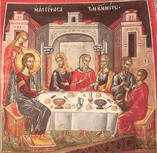
The commemoration of our holy father among the saints, George, Bishop of Mitylene, and the holy Martyr Kalliopios.
Scripture Readings
Paschalion — Movable Calendar
Holy and Great Wednesday
Epistle
There is no Epistle Reading this day because of Holy Week.
Gospel
In the Orthros
The Reading is from the Holy Gospel according to Saint John [§ mid 41]. At that time:
12 17The crowd that was with Jesus when He called Lazarus out of the grave and raised him from the dead bore witness. 18On this account the crowd also went to meet Him, because it heard that He had done this sign. 19The Pharisees therefore said among themselves, “Observe ye that ye profit nothing? Behold, the world hath gone away after Him.”
20And there were certain Greeks from among those going up that they might do reverence at the feast. 21Then these came to Philip, who was from Bethsaida of Galilee, and asked him, saying, “Sir, we wish to see Jesus.” 22Philip cometh and telleth Andrew, and again Andrew and Philip tell Jesus. 23But Jesus answered them, saying, “The hour hath come that the Son of Man should be glorified. 24“Verily, verily, I say to you, unless the grain of the wheat that falleth into the earth should die, it abideth alone; but if it should die, it beareth much fruit. 25“The one who loveth his life shall lose it; and the one who hateth his life in this world shall keep it to life eternal. 26“If anyone serve Me, let him keep on following Me; and where I am, there My servant shall be also. And if anyone serve Me, the Father shall honor him. 27“Now My soul hath been troubled; and what shall I say? ‘Father, save Me from this hour’; but on this account I came to this hour. 28“Father, glorify Thy name.” Then a voice came out of the heaven: “I both glorified it and will glorify it again.” 29The crowd then that stood by and heard it was saying that thunder had occurred; others were saying, “An angel hath spoken to Him.” 30Jesus answered and said, “This voice hath not occurred for My sake, but for your sakes. 31“Now is a judgment of this world; now the ruler of this world shall be cast out. 32“And I, if I be lifted up from the earth, will draw all to Myself.” 33But He was saying this, signifying by what manner of death He was about to die. 34The crowd answered Him, “We heard out of the law that the Christ abideth forever; and how sayest Thou, ‘The Son of Man must be lifted up’? Who is this Son of Man?” 35Then Jesus said to them, “Yet a little while is the light with you. Be walking while ye have the light, that darkness might not overtake you; and indeed the one who walketh in the darkness knoweth not where he goeth. 36“While ye have the light, keep on believing in the light, that ye might become sons of light.” Jesus spoke these things, and departed, and was hidden from them.
37But though He had done so many signs before them, yet they kept on not believing in Him, 38that the word of Esaias the prophet might be fulfilled, which he spoke, “Lord, who believed our report? And to whom was the arm of the Lord revealed [Is. 53:1]?” 39On this account they were not able to believe, because Esaias said again, 40“He hath blinded their eyes and hardened their heart, that they should not see with their eyes and understand with their heart and should be converted; and I shall heal them [cf. Is. 6:9, 10].” 41These things said Esaias when he saw His glory and spoke concerning Him. 42Yet, nevertheless, from among the rulers also many believed in Him, but because of the Pharisees they were not confessing Him, lest they should be expelled from the synagogue; 43for they loved the glory of men more than the glory of God. 44But Jesus cried and said, “The one who believeth in Me, believeth not in Me, but in the One Who sent Me; 45“and the one who seeth Me, seeth the One Who sent Me. 46“I have come a light into the world, that everyone who believeth in Me should not abide in the darkness. 47“And if anyone hear My words and believe not, I judge him not; for I came not that I might judge the world, but that I might save the world. 48“The one who rejecteth Me and receiveth not My words, hath that which judgeth him—the word which I spoke, that shall judge him in the last day. 49“For I spoke not of Myself, but the Father Who sent Me, He Himself gave a commandment to Me, what I should say and what I should speak. 50“And I know that His commandment is life everlasting. Therefore, what things I speak, as the Father hath said to Me, so I speak.”
In the Liturgy of the Presanctified Gifts
The Reading is from the Holy Gospel according to Saint Matthew [§ 108]. At that time:
26 6When Jesus was in Bethany, in the house of Simon the leper, 7a woman came to Him having an alabaster flask of very costly perfumed ointment, and she poured it upon His head as He reclined at table. 8But His disciples, having seen it, became indignant, saying, “For what is this loss? 9“For it was possible for this perfumed ointment to have been sold for much and to have been given to the poor.” 10But Jesus, perceiving it, said to them, “Why do ye cause trouble to the woman? For she wrought a good work toward Me. 11“For ye have the poor among yourselves always, but Me ye have not always. 12“For in putting this perfumed ointment upon My body, she did it for My burial. 13“Verily I say to you, wheresoever this Gospel shall be proclaimed in all the world, also what she did shall be spoken of for a memorial of her.” 14Then one of the twelve, who was called Judas Iscariote, went to the chief priests, 15and said, “What are ye willing to give to me, and I will deliver Him up to you?” And they fixed by agreement with him for thirty pieces of silver. 16And from that time he sought an opportunity that he might deliver Him up.
Menaion — Fixed Calendar
The commemoration of our holy father among the saints, George, Bishop of Mitylene, and the holy Martyr Kalliopios.
No readings given.
Lives of the Saints (Prologue)
April 20th – Civil Calendar
April 7th – Church Calendar
1. St. George the Confessor.
For his great virtues, which he acquired through long asceticism, George was chosen and installed as Metropolitan of Mytilene. And this saint governed his flock with zeal and wisdom to old age. But when a persecution arose under Leo V, the Armenian, who destroyed the holy icons, this holy elder was summoned by the emperor to Constantinople, to the council of bishops which was summoned, at the emperor’s desire, to put a stop to the veneration of icons. But George not only refused to act according to the emperor’s desire; he, together with some other courageous bishops, stood up in defence of the holy icons. For this he was held in derision by the emperor and exiled to the region of Cherson, where, in physical pain and every sort of need, he spent the remainder of his earthly life. He died and went to immortal life in about 816. He was a wonder-worker both during his life and after his death, through his great righteousness and love for the Lord Jesus.
2. Our Holy Father Nil Sorsky.
One of the great fathers of the Russian Church, he was the founder of the monastic ‘skete’ way of life in Russia. He died peacefully in 1508, and his relics are preserved in the monastery at Sora. His rule of life in the sketes presents a spiritual and pragmatic work of the first order.
3. The Holy Martyr Calliopus (Kalliopios).
He was the only son, obtained from God with tears, of a senator of Perga in Pamphylia. His devout mother, Theoklea, taught him veneration of God and purity of life at an early age. Calliopus was still very young when a terrible persecution arose under the Emperor Maximian. To save him from death, his mother put him into a ship, gave him a sufficient sum of money and sent him off to the city of Pompeiopolis. But things turned out differently, by the providence of God. Disembarking at Pompeiopolis, Calliopus walked straight into some tumultuous pantheistic celebration. When he, in the press of the crazed mob, refused to take part in that senseless feast, he was brought to the commander, Maximus, to whom he confessed that he was a Christian. The commander ordered that he be beaten with iron staves, burned by fire and finally, wounded all over, thrown into prison. Hearing of the torture of her son, his mother, Theoklea, gave away all her goods to the poor and needy, and with a small sum of money, hurried to her son’s prison. Entering the prison, she bowed to her son and bound up his wounds. Finally, the commander pronounced the sentence that Calliopus be crucified. Joy and anguish were mingled together in his mother’s heart. When they led her son to the place of execution, she passed the executioner five gold pieces to crucify her son, not like the Lord, but upside-down. This she did from humility towards the Lord. Calliopus was crucified, upside-down, on Holy Thursday, and his mother stood below the cross giving thanks to God. When they took his dead body down from the cross the next day, she fell on it and breathed her last. Thus these two went to stand before the throne of the King of glory. They suffered with honor in 304.
4. Our Holy Father Daniel of Pereyaslavl.
He had as his special asceticism the care of the dead. Whenever he heard that someone had frozen to death or died in some other way, he hurried to give him burial and to pray to God for him. He died peacefully in 1540. His healing relics are preserved to this day.
5. Our Holy Father Gregory the Sinaite.
A great saint and ascetic of Sinai and Athos (see August 8th).
FOR CONSIDERATION
‘Those in spiritual authority must be careful to differentiate between themselves and those under them, as a shepherd must between himself and his sheep.’ So speaks St. Isidore of Pelusium, interpreting the First Epistle to St. Timothy. The life of a priest always serves as an example, whether for good or for ill. By a good life, a priest confirms the Gospel, and denies it by a bad one. No one else is in such a position to confirm or deny the Gospel as is a priest by his life. A good priest is differentiated by his actions from a bad priest, no less than a shepherd from a wolf. Therefore the portion of the good priest will be with the sons of God, and that of the bad with the wild beasts in darkness. Good shepherds of the Church, even at the moment of their last breath, were concerned for the flock that they were leaving behind them. On his deathbed, St. Joseph the Hymnographer prayed to God: ‘Defend Thy flock, O Son of God, and protect all the works of Thy hands to the end of time. Be Thou a helper of the beloved sons of Thy Church. Give to Thy Bride (the holy Church) eternal peace and stormless quiet.’ And St. Antipas, burning in a red-hot copper ox, prayed to God: ‘Not for myself alone, but for those who will, after me, become partakers of Thy mercy.’
Daily Scripture Readings taken from The Orthodox New Testament, translated and published by Holy Apostles Convent, Buena Vista, Colorado, copyright © 2000, used with permission, all rights reserved.
Daily Prologue Readings taken from The Prologue of Ochrid, by Bishop Nikolai Velimirovic, translated by Mother Maria, published by Lazarica Press, Birmingham, England, copyright © 1985, all rights reserved. Edited by Dormition Skete.