

Daily Devotional
Saturday, April 2, 2022 (NS), March 20, 2022 (OS)
Fast Day, but Shellfish, Wine and Olive Oil Allowed.
Holy & Great Fast
The Saturday of the Fourth Week of the Great Fast
The commemoration of the holy fathers slain at the Monastery of St. Savvas the Sanctified, the Martyrs John, Sergius, Patrick, and others.
Scripture Readings
Paschalion — Movable Calendar
The Saturday of the Fourth Week of the Great Fast
Epistle
The Reading is from the Epistle of Saint Paul to the Hebrews [§ 313]. Beloved:
6 9We have been persuaded of the better things concerning you, even those things which hold on to salvation, though we speak thus. 10For God is not unjust, to be forgetful of your work and the labor of love which ye yourselves showed toward His name, in that ye have ministered to the saints and do minister. 11And we desire each of you to show the same earnestness to the full assurance of the hope until the end, 12in order that ye might not become sluggish, but imitators of those who through faith and long-suffering inherit the promises.
Another Reading for Saturday of the Fourth Week of the Great Fast in Commemoration of the Departed
The Reading is from the First Epistle of Saint Paul to the Corinthians [§ 163]. Brethren:
15 47The first man is of earth, earthy; the second Man is the Lord from heaven. 48As is the earthy, such are they also who are earthy; and as is the heavenly, such are they also who are heavenly. 49And even as we bore the image of the earthy, let us also bear the image of the heavenly. 50Now this I say, brethren, that flesh and blood is not able to inherit the kingdom of God; neither doth corruption inherit incorruption. 51Behold, I tell you a mystery: On the one hand we shall not all fall asleep, but on the other hand we shall all be changed— 52in a moment, in a wink of an eye, at the last trumpet. For a trumpet shall sound, and the dead shall be raised incorruptible, and we shall be changed. 53For it is needful for this corruptible to put on itself incorruption and this mortal to put on itself immortality. 54But whenever this corruption should put on itself incorruption, and this mortal should put on itself immortality, then the word which hath been written shall come to pass: “Death is swallowed up in victory [cf. Is. 25:8]. 55“O death, where is thy sting? O Hades, where is thy victory [cf. Hos. 13:14]?” 56Now the sting of death is sin, and the power of sin is the law. 57But thanks be to God Who giveth us the victory through our Lord Jesus Christ.
Gospel
The Reading is from the Holy Gospel according to Saint Mark [§ 31]. At that time:
7 31Jesus, having departed from the borders of Tyre and Sidon, came to the Sea of Galilee, in the midst of the borders of Decapolis. 32And they bring to Him a deaf man having an impediment in his speech; and they beseech Him that He might lay His hand on him. 33And He took him away, aside from the crowd, and put His fingers into his ears, and He spit and touched his tongue. 34And having looked up to the heaven, He sighed, and saith to him, “Ephphatha,” that is, “Be thou opened.” 35And straightway his ears were opened, and the band of his tongue was loosed, and he began to speak rightly. 36And He Himself gave them express orders that they should tell no one; but as much as He was giving them express orders, much more abundantly were they proclaiming it. 37And beyond all measure they were astonished, saying, “He hath done all things well. He maketh both the deaf to hear and the dumb to speak.”
Commemoration of the Departed
The Reading is from the Holy Gospel according to Saint John [§ 16]. The Lord said to the Jews who had come to Him:
5 24“Verily, verily, I say to you, that the one who heareth My word and believeth the One Who sent Me hath everlasting life, and cometh not into judgment, but hath passed over out of death into life. 25“Verily, verily, I say to you, that an hour cometh, and now is, when the dead shall hear the voice of the Son of God, and they who hear shall live. 26“For even as the Father hath life in Himself, so He also gave to the Son to have life in Himself, 27“and He also gave to Him authority to execute judgment. That He is Son of Man, 28“cease marvelling at this; for an hour is coming in which all those in the graves shall hear His voice, 29“and shall go forth—they who did good things to a resurrection of life, but they who practised bad things to a resurrection of condemnation. 30“I am not able to do anything of Myself. Even as I hear, I judge; and My judgment is just, because I seek not Mine own will, but the will of the One Who sent Me, the Father.”
Menaion — Fixed Calendar
The commemoration of the holy fathers slain at the Monastery of St. Savvas the Sanctified, the Martyrs John, Sergius, Patrick, and others.
No readings given.
Lives of the Saints (Prologue)
April 2nd – Civil Calendar
March 20th – Church Calendar
1. Our Holy Father John, and those martyred with him from the Community of St. Sava the Sanctified near Jerusalem.
This famous monastery, both visited by St. Sava of Serbia and endowed by various Serbian rulers, is still in existence today. Several times fallen to the savage Arabs, plundered and left empty, it has always been restored by the providence of God. In the time of the reign of Constantine and Irene it fell to the Arabs and was plundered. The monks would not flee, but took counsel together with their abbot, Thomas, saying: ‘We have fled from the world into this wilderness for the love of Christ; it would be shame to us now to flee from the wilderness from fear of men. If we are killed here, we shall be killed through love for Christ, for Whose sake we have come here to live.’ And, so deciding, they awaited unarmed the armed Arabs, as lambs before wolves. The Arabs killed some of them with arrows, and others they shut into the cave of St. Sava and lit a fire at the entrance to suffocate them in the smoke. And thus many of them died as martyrs for the sake of Christ and went to the kingdom of Him Whom they had loved and for the sake of Whose love they had perished. They suffered with honor before Pascha in 796, in the time of Patriarch Elias of Jerusalem. But a just punishment quickly fell on their savage destroyers. Returning to their tents, they began to quarrel, and in the ensuing battle killed each other off.
2. The Holy Martyr Photine.
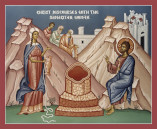 This was that Samaritan woman who had the rare fortune to speak with the Lord
Christ Himself at Jacob’s Well in Sychar (Jn. 4). Coming to faith in the Lord, she then
came to belief in His Gospel, together with her two sons, Victor and Josiah, and five sisters who
were called Anatolia, Phota, Photida, Paraskeve and Kyriake. They went to Carthage in Africa. But
they were arrested and taken to Rome in the time of the Emperor Nero, and thrown into prison. By
the providence of God, Domnina, Nero’s daughter, came into contact with St. Photine and was
brought by her to the Christian Faith. After imprisonment, they all suffered for Christ. Photine,
who first encountered the light of truth by a well, was thrown into a well, where she died and
entered into the immortal kingdom of Christ.
FOR CONSIDERATION
God does not punish sinners because it gives Him pleasure to annihilate man. If that had given Him pleasure, He would not have formed man out of nothing. But He punishes sinners for more important reasons, of which two are obvious to us. Firstly, that by punishment He may set the sinner aright and lead him onto the way of salvation, and secondly, that others may see and be fearful of sinning. St. Isaac thinks the same when he says: ‘A truly wise man is like God, for he punishes a man, not in order to be revenged for sin, but either to correct the man or to make others fearful.’ An undisciplined young man, who blasphemed against God and against his parents, suddenly went out of his mind. The whole town in which this young man lived saw this as God’s punishment, and was possessed by the fear of God. The young man was kept under restraint for three years. But his mother wept bitterly and prayed to God for her son. One year, on the Feast of the Holy Spirit, the mother took her mad son to the monastery of St. Basil at Ostrog. After prayers there, the mad boy was healed and came to himself. After that he repented and became an exemplary man and a true Christian.
Daily Scripture Readings taken from The Orthodox New Testament, translated and published by Holy Apostles Convent, Buena Vista, Colorado, copyright © 2000, used with permission, all rights reserved.
Daily Prologue Readings taken from The Prologue of Ochrid, by Bishop Nikolai Velimirovic, translated by Mother Maria, published by Lazarica Press, Birmingham, England, copyright © 1985, all rights reserved. Edited by Dormition Skete.