

Daily Devotional
Friday, February 18, 2022 (NS), February 5, 2022 (OS)
No Fasting.
Friday of the Thirty-Fourth Week
The commemoration of the Afterfeast of the Meeting of the Lord, and the holy Martyr Agatha of Palermo in Sicily, and our father among the saints, Theodosios, Archbishop of Chernigov, the Wonder-worker.
Scripture Readings
Paschalion — Movable Calendar
Friday of the Thirty-Fourth Week
Epistle
The Reading is from the First General Epistle of Saint John [§ 70].
2 7Brethren, I write no new commandment to you, but an old commandment which ye had from the beginning; the old commandment is the word which ye heard from the beginning. 8Again, a new commandment I write to you, which thing is true in Him and in you, because the darkness is passing on its way, and the true light already shineth. 9The one who saith he is in the light, and hateth his brother, is in the darkness until now. 10The one loving his brother abideth in the light, and there is not an occasion of stumbling in him. 11But the one hating his brother is in darkness, and walketh in the darkness, and knoweth not where he goeth, because the darkness blinded his eyes.
12I write to you, little children, because ye have been forgiven your sins for His name’s sake. 13I write to you, fathers, because ye have come to know Him Who is from the beginning. I write to you, young men, because ye have overcome the evil one. I am writing to you, little children, because ye have come to know the Father. 14I am writing to you, fathers, because ye have come to know Him Who is from the beginning. I am writing to you, young men, because ye are strong, and the word of God abideth in you, and ye have overcome the evil one. 15Do not keep on loving the world, nor the things in the world. If anyone love the world, the love of the Father is not in him. 16For all that is in the world—the desire of the flesh, and the desire of the eyes, and the false pretensions of life—is not of the Father, but is of the world. 17And the world is passing on its way, and the desire of it; but the one doing the will of God abideth forever.
Gospel
The Reading is from the Holy Gospel according to Saint Mark [§ 63]. At that time:
14 3While Jesus was in Bethany in the house of Simon the leper, reclining at table, there came a woman having an alabaster flask of pure, costly perfumed ointment of spikenard. And she broke the alabaster flask and poured it down upon His head. 4And some were feeling indignant within themselves, and saying, “For what hath this waste of the perfumed ointment taken place? 5“For it was possible for this perfumed ointment to have been sold for above three hundred denarii, and to have been given to the poor.” And they were snorting with indignation at her. 6But Jesus said, “Let her alone; why do ye cause her trouble? She wrought a good work toward Me. 7“For ye have the poor among yourselves always, and whenever ye wish ye are able to do them good; but Me ye have not always. 8“What she could do, she did; she undertook beforehand to anoint My body for the burial. 9“Verily I say to you, wheresoever this Gospel shall be proclaimed in all the world, also what she did shall be spoken of for a memorial of her.”
Menaion — Fixed Calendar
The commemoration of the Afterfeast of the Meeting of the Lord, and the holy Martyr Agatha of Palermo in Sicily, and our father among the saints, Theodosios, Archbishop of Chernigov, the Wonder-worker.
Epistle
For the Hierarch:
The Reading is from the Epistle of Saint Paul to the Hebrews [§ 335]. Brethren:
13 17Be obedient to those who lead you, and keep on submitting, for they are watchful for your souls, as those about to render an account, that they may do this with joy, and not groaning; for this would be unprofitable for you. 18Keep on praying for us; for we trust that we have a good conscience, in all things wishing to conduct ourselves well. 19But I beseech you more abundantly to do this, that I might be restored more quickly to you.
20Now the God of peace Who brought up from the dead our Lord Jesus, the Shepherd of the sheep, the great One, in the blood of an everlasting covenant, 21may He render you perfect in every good work, in order to do His will, doing in you that which is well-pleasing before His face, through Jesus Christ, to Whom be glory to the ages of the ages. Amen.
Gospel
The Reading is from the Holy Gospel according to Saint Luke [§ 24]. At that time:
6 17Jesus stood upon a level place. And there was a crowd of
His disciples, and a great multitude of the people from all of Judæa and Jerusalem and the
seacoast of Tyre and Sidon, who came to hear Him, and to be healed of their diseases—
18even those who were troubled by unclean spirits; and they were cured.
19And all the crowd was seeking to touch Him, for power was coming forth from Him and
healing all. 20And He lifted up His eyes to His disciples, and began to say:
“Blessed are the poor, for yours is the kingdom of God.
21“Blessed are ye who hunger now, for ye shall be
filled.
Blessed are ye who weep now, for ye shall laugh.
22“Blessed are ye whenever men hate you, and whenever they
separate you, and reproach you, and cast out your name as evil, on account of the Son of
Man.
23“Rejoice in that day and leap for joy, for behold, your
reward is great in the heavens.”
Lives of the Saints (Prologue)
February 18th – Civil Calendar
February 5th – Church Calendar
1. The Holy Martyr Agatha.
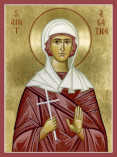 This glorious virgin and martyr for Christ was born in the
Sicilian town of Palermo of noble and prosperous parents. When Emperor Decius launched a
persecution of Christians, St. Agatha was arrested and brought to judgement before Quintian, the
judge. He saw Agatha’s beauty and desired her for his wife. When he suggested this to her,
she replied that she was the bride of Christ and could not be faithless to her Betrothed. The
judge condemned her to cruel torture: Agatha was flogged, mocked, bound to a tree and beaten till
the blood flowed. After that, the judge again urged her to deny Christ and so escape further
torture, to which Christ’s bride replied: ‘These tortures are of great help to me. As
wheat cannot come to the granary until it is cleansed of its chaff, so my soul cannot enter
Paradise unless my body has first been broken by torture.’ Then the torturer ordered that
her breasts be cut off, and that she then be thrown into prison. The holy Apostle Peter appeared
to her in the prison and restored her to physical wholeness and health. She was once again taken
out for torture and again cast back into prison, where she gave her soul to God in the town of
Catania in the year 251. After her death, her torturer, Quintian, set out to appropriate her
lands; but on the way, the horses became maddened under him and his soldiers. They were savaged
on the face, thrown onto the ground and trampled to death. Thus God’s punishment came
swiftly upon him for his ferocious crime against St. Agatha.
2. The Holy Martyr Theodula.
She suffered for Christ in the time of Diocletian, the impious Roman emperor. During her tortures, Theodula brought one of her torturers, Helladius, to his senses and to the Christian Faith. When Helladius openly confessed his faith in Christ, he was beheaded. Theodula showed great courage at her trial, for which the judge considered her witless. To this, she retorted: ‘It is you who are witless, for you forget the one true God and bow down to lifeless stones.’ The judge put her to cruel torture, which Theodula endured with heroism, making her torturers marvel and bringing them to Christ. Among these were two eminent citizens, Makarius and Evagrius. With these two and many others, Theodula was thrown into a red-hot furnace, where they all finished this life with honor and were made worthy of the kingdom of Christ.
3. St. Polyefktos, Patriarch of Constantinople.
For his great mind, his zeal for the Faith and his power of oratory, he was called a second Chrysostom. The Russian Princess Olga came to Constantinople in the time of Patriarch Polyefktos and Emperor Constantine Porphyrogenitus, and was baptized there in 957. The patriarch baptized her, and the emperor stood godfather. St. Polyefktos prophesied: ‘Blessed art thou among Russian women, for thou hast desired the light and cast away darkness; the sons of Russia will bless thee to the last generation.’ From being a simple monk, Polyefktos was raised to the patriarchate in 946, and remained on the patriarchal throne until his death in 970.
FOR CONSIDERATION
The great Abba Ischyrion was asked by his monks: ‘What have we accomplished?’ ‘We have fulfilled the commandments of God,’ replied Ischyrion. ‘And what will those who come after us accomplish?’ ‘They will accomplish what we have accomplished, but only half as much as we.’ ‘And those after them?’ ‘Those in the last days will have no monastic training, but such assaults and temptations will come upon them that they will, through these trials, be revealed in the kingdom of God as greater than us and than our fathers.’
Daily Scripture Readings taken from The Orthodox New Testament, translated and published by Holy Apostles Convent, Buena Vista, Colorado, copyright © 2000, used with permission, all rights reserved.
Daily Prologue Readings taken from The Prologue of Ochrid, by Bishop Nikolai Velimirovic, translated by Mother Maria, published by Lazarica Press, Birmingham, England, copyright © 1985, all rights reserved. Edited by Dormition Skete.