

Daily Devotional
Saturday, April 4, 2020 (NS), March 22, 2020 (OS)
Fast Day, but Shellfish, Wine and Olive Oil Allowed.
Holy & Great Fast
The Saturday of the Fifth Week of the Great Fast and of the Akathist
The commemoration of the holy Martyr Basil the presbyter of Ankyra.
Scripture Readings
Paschalion — Movable Calendar
The Saturday of the Fifth Week of the Great Fast and of the Akathist
Epistle
The Reading is from the Epistle of Saint Paul to the Hebrews [§ 322]. Brethren:
9 24The Christ entered not into the holies made by hand, antitypes of the true things, but into the heaven itself, now to be manifested before the face of God on our behalf; 25not in order that He may offer Himself many times, even as the high priest entereth into the holies year by year with blood belonging to another; 26for otherwise it would be necessary for Him many times to have suffered from the foundation of the world; but now, once for all, at the consummation of the ages, He hath been manifested for the setting at nought of sin by the sacrifice of Himself. 27And inasmuch as it is laid up for men to die once, but after this, judgment, 28thus the Christ Who was offered once for all to bear up the sins of many, shall appear the second time without sin to those who await Him unto salvation.
Another Reading for Saturday of the Fifth Week of the Great Fast for the Theotokos
The Reading is from the Epistle of Saint Paul to the Hebrews [§ 320]. Brethren:
9 1The first tabernacle also used to have both ordinances of worship and the sanctuary of this world. 2For a tabernacle was furnished: the first in which were both the lampstand and the table, and the laying forth of the loaves, which is called Holy; 3and after the second veil, a tabernacle which is called Holy of Holies, 4which hath a golden censer, and the ark of the covenant which hath been covered all around from every side with gold, in which was the golden jar having the manna, and the rod of Aaron that budded, and the tablets of the covenant; 5and above it were the cherubim of glory overshadowing the mercy seat, concerning which now is not the time to speak severally. 6Now after these things were thus furnished, the priests, on the one hand, enter into the first tabernacle, performing worship services; 7on the other hand, into the second, the high priest entereth alone once for all every year, not without blood, which he offereth on behalf of himself and the faults of ignorance of the people.
Gospel
The Reading is from the Holy Gospel according to Saint Mark [§ 35]. At that time:
8 27Jesus went out, and His disciples, into the villages of Cæsarea Philippi; and on the way He was asking His disciples, saying to them, “Whom do men say that I am?” 28And they answered, “John the Baptist, but others say Elias; and others, one of the prophets.” 29And He saith to them, “But ye, whom do ye say that I am?” And Peter answereth and saith to Him, “Thou art the Christ.” 30And He strictly warned them that they should tell no one about Him. 31And He began to teach them that it is necessary for the Son of Man to suffer many things, and to be rejected by the elders and chief priests and scribes, and to be killed, and after three days to rise.
Another Reading for the Theotokos
The Reading is from the Holy Gospel according to Saint Luke [§ 54]. At that time:
10 38Jesus entered into a certain village. And a certain woman, by name Martha, received Him into her house. 39And she had a sister called Mary, who also sat down beside the feet of Jesus, and was listening to His word. 40But Martha was distracted about much serving, and she came up to Him and said, “Lord, is it no concern to Thee that my sister left me to serve alone? Speak to her therefore that she should help me.” 41And Jesus answered and said to her, “Martha, Martha, thou art anxious and troubled about many things. 42“But there is need of one thing, and Mary chose the good part, which shall not be taken away from her.”...
11 27And it came to pass, as He was speaking these things, a certain woman out of the crowd lifted up her voice and said to Him, “Blessed is the womb that bore Thee, and the breasts which Thou didst suck.” 28But He said, “Yea rather, blessed are they who hear the word of God and keep it.”
Menaion — Fixed Calendar
The commemoration of the holy Martyr Basil the presbyter of Ankyra.
No readings given.
Lives of the Saints (Prologue)
April 4th – Civil Calendar
March 22nd – Church Calendar
1. The Hieromartyr Basil, Priest of Ankyra.
Under the Emperor Constantius there was much suffering at the hands of the Arians. At that time, Basil became known as a staunch defender of Orthodoxy and a true shepherd of his flock in Ankyra. When, after Constantius, Julian the Apostate came to the throne and began to persecute the Christians, Basil openly denounced this new wickedness and encouraged his people in the Faith. For this he was thrown into prison. When the Emperor Julian came to Ankyra, Basil was brought before him and he began to urge Basil to abandon the Christian Faith, promising him honors and wealth. Then Basil answered him: ‘I believe in my Christ, Whom you have denied and Who gave you this earthly kingdom, but He will shortly take this from you. How can you have no shame before the altar under which you were saved from death as an eight-year-old child when they sought to kill you? Therefore He will soon take this earthly kingdom from you, and your body shall not be buried when you have spewed forth your soul in bitter torments.’ Julian was furious and ordered that a strip of skin be torn from his body every day. And his torturers carried this out for seven days. When Basil was brought out again before the emperor, he tore a strip of his own flesh off and threw it into Julian’s face, shouting: ‘Take this and eat it, Julian, if such food is sweet to you, but Christ is life for me!’ This occurrence was noised in the town, and the emperor left Ankyra in secret out of shame and went to Antioch. And they continued to torture Basil with red-hot irons until he surrendered his soul to his Lord for Whom he had suffered so much. This was in the year 363.
2. St. Drosida.
The daughter of the Emperor Trajan, she was seized with five other women when they were gathering the bodies of the martyrs who had suffered for Christ by night, and was for this cruelly mutilated by the emperor. The five women were terribly tortured and at last thrown into molten copper, where they surrendered their souls to their Lord. But Drosida remained under strict imperial guard. However, she escaped from the court and after eight days she gave her soul into God’s hands.
3. Our Holy Father, the Martyr Efthymios (Euthymius).
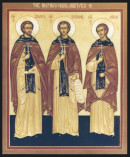 He was born in the
village of Dimitsana in the Peloponnese. As a boy, he lived as a Christian, but later he went to
Romania and there gave himself over to great debauchery. In this debasement, the evil spirit led
him to embrace Islam. No sooner had he done so than he began to repent bitterly. He returned to
the Christian Faith and became a monk on the Holy Mountain. After several years spent in strict
fasting and prayer, he made up his mind to die for Christ. With the blessing of his spiritual
father, he went to Constantinople, where he somehow succeeded in gaining access to the grand
vizier. He began to make the sign of the Cross in front of him, to praise Christ and to denounce
Mohammed. After long-drawn-out torture, he was condemned to death and was slain on March 22nd,
1814, on Palm Sunday. Many miraculous healings of the sick were wrought through his relics. His
precious head is in the Russian monastery of St. Panteleimon on the Holy Mountain. Thus this
twenty-year-old youth first died to Christ and then died for Christ.
FOR CONSIDERATION
Even in His agony on the Cross, the Lord Jesus did not condemn sinners, but held up before His Father forgiveness for their sins, saying: ‘they know not what they do!’ Let us judge no man, that we be not condemned. For no one is certain that he will not, before his death, commit that very sin for which he has condemned his brother. St. Anastasios of Sinai teaches: ‘If you see someone sinning, do not condemn him, for you do not know how he will finish his life. That thief crucified with Christ was a murderer, and Judas was an apostle of Christ’s, but the thief entered Paradise and Judas went to perdition. If you see someone sin, you do not know his good works. For many sin in public and repent in private, and we see their sin but do not know of their repentance. Therefore, my brethren, let us condemn no man, that we be not condemned.’
Daily Scripture Readings taken from The Orthodox New Testament, translated and published by Holy Apostles Convent, Buena Vista, Colorado, copyright © 2000, used with permission, all rights reserved.
Daily Prologue Readings taken from The Prologue of Ochrid, by Bishop Nikolai Velimirovic, translated by Mother Maria, published by Lazarica Press, Birmingham, England, copyright © 1985, all rights reserved. Edited by Dormition Skete.