

Daily Devotional
Thursday, February 2, 2017 (NS), January 20, 2017 (OS)
No Fasting.
Thursday of the Thirty-Third Week
20. The commemoration of our venerable and God-bearing Father Efthymios the Great.
Scripture Readings
Paschalion — Movable Calendar
Thursday of the Thirty-Third Week
Epistle
The Reading is from the First General Epistle of Saint Peter [§ 62].
4 12Beloved, cease being astonished by the strangeness of the proving by fire which is taking place among you, in order to test you, as if a strange thing were happening to you, 13but according as ye take part in the sufferings of Christ, be rejoicing, that also in the revelation of His glory ye might rejoice exultingly. 14If ye are being reproached in the name of Christ, happy are ye; for the Spirit of the glory and power and the Spirit of God resteth upon you. On the one hand, according to them, He is being blasphemed, but on the other hand, according to you, He is being glorified. 15For let none of you be suffering as a murderer, or a thief, or an evildoer, or as a busybody in the matters of others. 16But if any suffer as a Christian, let him cease being ashamed, but keep on glorifying God in respect to this. 17For it is the time for the judgment to begin from the house of God; but if first from us, what shall be the end of those who disobey the Gospel of God? 18And “if the righteous one scarcely is saved, where shall the ungodly one and sinner appear [cf. Prov. 11:31]?” 19Therefore, they who suffer indeed according to the will of God, let them be committing their souls in well doing, as to a faithful Creator.
5 1The presbyters who are among you I exhort, I who am a fellow presbyter and witness of the sufferings of the Christ, who also am a partaker of the coming glory to be revealed: 2Shepherd the flock of God among you, exercising the episcopal office, not by constraint, but willingly, not for sordid greed of gain, but readily, 3neither as exercising lordship over the clergy, but becoming examples to the flock; 4and after the chief Shepherd hath been made manifest, ye shall carry off the unfading crown of the glory. 5In like manner ye younger ones, be subject to the elders. And all being subject to one another, gird yourselves with humility; for God “setteth Himself against the proud, but giveth grace to the humble [Prov. 3:34].”
Gospel
The Reading is from the Holy Gospel according to Saint Mark [§ 52]. At that time:
11 27Jesus came again to Jerusalem. And as He was walking about in the temple, the chief priests, and the scribes, and the elders come to Him, 28and say to Him, “By what authority doest Thou these things? And who gave Thee this authority that Thou mayest be doing these things?” 29And Jesus answered and said to them, “I also will question you for one word; and answer Me, and I will tell you by what authority I am doing these things: 30“The baptism of John, was it from heaven or from men? Answer Me.” 31And they were reasoning with themselves, saying, “If we should say, ‘From heaven,’ He will say, ‘Why then did ye not believe him?’ 32“But if we should say, ‘From men’?”—they were fearing the people; for all held that John was a prophet. 33And answering, they say to Jesus, “We know not.” And Jesus answered, saying to them, “Neither do I tell you by what authority I am doing these things.”
Menaion — Fixed Calendar
20. The commemoration of our venerable and God-bearing Father Efthymios the Great.
Epistle
The Reading is from the Second Epistle of Saint Paul to the Corinthians [§§ 176, 177]. Brethren:
4 6It is God Who said, “Let there be light [cf. Gen. 1:3]” to shine out of darkness, Who shined in our hearts, for the illumination of the knowledge of the glory of God in the face of Jesus Christ.
7But we have this treasure in earthen vessels, that the preeminence of the power may be of God, and not from us. 8In every way we are afflicted, but not straitened; we are at a loss, but not utterly at a loss; 9persecuted, but not abandoned; cast down, but not destroyed— 10always bearing about in the body the dying of the Lord Jesus, that the life also of Jesus might be made manifest in our body. 11For we, the living, are always being delivered to death on account of Jesus, that also the life of Jesus might be made manifest in our mortal flesh. 12So that indeed death energizeth itself in us, but life in you. 13But having the same spirit of faith, according to that which hath been written: “I believed, wherefore I spoke [Ps. 115(116):1(10)],” we also believe, and therefore speak, 14knowing that the One Who raised up the Lord Jesus shall raise up us also through Jesus, and shall present us with you. 15For all things are for your sakes, that the grace, which abounded through the majority, might cause the giving of thanks to abound more to the glory of God.
for Sl. usage, see [Heb. 13:17-21].
Gospel
The Reading is from the Holy Gospel according to Saint Luke [§ 24]. At that time:
6 17Jesus stood upon a level place. And there was a crowd of
His disciples, and a great multitude of the people from all of Judæa and Jerusalem and the
seacoast of Tyre and Sidon, who came to hear Him, and to be healed of their diseases—
18even those who were troubled by unclean spirits; and they were cured.
19And all the crowd was seeking to touch Him, for power was coming forth from Him and
healing all. 20And He lifted up His eyes to His disciples, and began to say:
“Blessed are the poor, for yours is the kingdom of God.
21“Blessed are ye who hunger now, for ye shall be
filled.
Blessed are ye who weep now, for ye shall laugh.
22“Blessed are ye whenever men hate you, and whenever they
separate you, and reproach you, and cast out your name as evil, on account of the Son of
Man.
23“Rejoice in that day and leap for joy, for behold, your
reward is great in the heavens.”
Lives of the Saints (Prologue)
February 2nd – Civil Calendar
January 20th – Church Calendar
1. Our Holy Father Efthymios the Great.
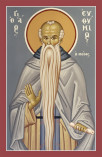 He was born in the Armenian town of Melitene near the
River Euphrates in 377, the only son of noble and eminent parents. His mother, Dionysia, had
prayed for a child, and had a heavenly vision concerning his birth. He lived in asceticism from
his youth, at first in the vicinity of his town, but then, after a visit to Jerusalem at the age
of 29, in the Wilderness of Pharan, between Jerusalem and Jericho. He filled his days and nights
with prayer and meditation, contemplation and physical toil. Many disciples gathered round him,
such as Kyriakos the Hermit, Sava the Sanctified, Theoktistos and others. He was, by God’s
gift, a great worker of wonders: he drove out demons, healed grave illnesses, brought forth water
in the desert, multiplied bread and prophesied. He taught his monks the love of hardship, saying:
‘If you eat bread that comes not from your own labors, that means that you eat the labor of
another’. When one of the younger brethren desired to fast more than others, he forbade him
and ordered him to come to the common table, so that he should not become proud through his
too-great fasting. He also said that it is not good for a monk to move from place to place, for,
he said: ‘A tree that is frequently transplanted does not bear fruit.’ Whoever
desires to do good can do it in the place where he is. On love, he said: ‘As salt is to
bread, so is love to the other virtues.’ He went off into the desert in the first week of
the Great Fast and remained there in silence and meditation on God until before Pascha. During
his lifetime, a great monastery grew up near his cave, which was for centuries as full of monks
as a hive of bees. His last command was that there should be loving hospitality to guests in the
monastery, and that its gate should never be closed. He entered into rest at the age of 97.
Patriarch Anastasios of Jerusalem was at his funeral. The patriarch waited the entire day while a
great mass of people gave the saint the last kiss, and only in the evening was he able to finish
the funeral. On the seventh day after his death, Efthymios appeared to his disciple, Domitian, in
light and joy. St. Efthymios was a true ‘son of light’. He entered into rest in the
year 473.
2. The Holy Martyrs Innas, Nirras and Pinnas.
They are thought to be the first Slav martyrs recorded in history and they lived to a great age in Scythia, being disciples of the holy Apostle Andrew. They suffered for the Faith near Varna at the hands of their pagan neighbors from the other side of the Danube. Bound and left on the ice, they froze to death and entered into rest in the Lord.
FOR CONSIDERATION
The saints of the Church were compassionate towards human weakness and fiercely unyielding and unsubmissive with regard to the confession of the truths of the Faith. St. Nicholas of Myra struck Arius with his hand at the First Ecumenical Council. St. Anthony left his desert and went to Alexandria publicly to denounce Arius. St. Efthymios, under great pressure from the Empress Evdokia and the false Patriarch Theodosios, and being unable further to fight with arguments, left his monastery and hid in the desert, an example followed by monks thereafter. Efthymios remained in the desert until the false patriarch had been dethroned and Orthodoxy confirmed. And when agitation was spread in Jerusalem in the emperor’s name against the Fourth Ecumenical Council which had taken place in Chalcedon, and when the entire population was going in terror of the heretics, then St. Theodosios the Great, already burdened with years, came as the fearless soldier of Christ he was to Jerusalem, went into one of the great churches, mounted the steps, and gesticulating with his arms, said to the people: ‘If a man does not revere the Four Ecumenical Councils as he does the Four Gospels, let him be anathema (accursed)!’ All his hearers were deeply impressed by these words, and none of the heretics dared speak against him.
Daily Scripture Readings taken from The Orthodox New Testament, translated and published by Holy Apostles Convent, Buena Vista, Colorado, copyright © 2000, used with permission, all rights reserved.
Daily Prologue Readings taken from The Prologue of Ochrid, by Bishop Nikolai Velimirovic, translated by Mother Maria, published by Lazarica Press, Birmingham, England, copyright © 1985, all rights reserved. Edited by Dormition Skete.