

Daily Devotional
Wednesday, January 25, 2017 (NS), January 12, 2017 (OS)
Fast Day, but Wine and Olive Oil Allowed.
Wednesday of the Thirty-Second Week
The commemoration of the Afterfeast of Theophany, and the Virgin-martyr Tatiane the deaconess of Old Rome, and our father among the saints, Savva, first Archbishop and Teacher of the Serbs.
Scripture Readings
Paschalion — Movable Calendar
Wednesday of the Thirty-Second Week
Epistle
The Reading is from the General Epistle of Saint Iakovos [§ 55]. Brethren:
3 11A fountain doth not gush forth the sweet and the bitter out of the same opening, doth it? 12My brethren, a fig tree is not able to produce olives, is it, or a vine, figs? Thus not even one fountain is able to produce salt and fresh water.
13Who is wise and endued with knowledge among you? Let him show forth out of a good manner of life his works in meekness of wisdom. 14But if ye have bitter jealousy and intriguing in your hearts, cease boasting and lying against the truth. 15This is not the wisdom which descendeth from above, but is earthly, material-minded, demoniacal. 16For where jealousy and intriguing are, there is confusion and every bad thing. 17But the wisdom from above indeed is first pure, then peaceable, equitable, easily entreated, full of mercy and of good fruits, impartial and without hypocrisy. 18And the fruit of righteousness is sown in peace for those who make peace.
4 1From what place come wars and fights among you? They are from this place, from your desires after pleasure which war in your members, are they not? 2Ye desire and have not. Ye murder and are jealous and are not able to attain. Ye fight and war, but ye have not, because ye ask not for yourselves. 3Ye ask and receive not, because ye ask wrongly for yourselves, that ye might consume it in your desires for pleasure. 4O adulterers and adulteresses! Ye know, do ye not, that the friendship of the world is enmity with God? Whosoever therefore would be a friend of the world is rendered an enemy of God. 5Or think ye that the Scripture saith emptily, “The spirit that dwelleth in us desireth to envy”? 6But He giveth greater grace. Wherefore it saith, “God setteth Himself against the proud, but giveth grace to the humble [cf. Prov. 3:34].”
Gospel
The Reading is from the Holy Gospel according to Saint Mark [§ 29]. At that time:
7 14After Jesus called to Himself all the crowd, He was saying to them, “Be ye hearing Me, everyone, and understanding: 15“There is nothing from outside the man, when it entereth into him, which is able to defile him; but the things which go out from him, those are the things which defile the man. 16“If anyone hath ears to hear, let him hear.” 17And when He entered into a house away from the crowd, His disciples began asking Him about the parable. 18And He saith to them, “Are ye so without understanding also? Do ye not perceive that everything that entereth from the outside into the man is not able to defile him? 19“Because it entereth not into his heart, but into the belly, and goeth out into the privy”; this He said making all the foods clean. 20And He was saying, “That which goeth forth out of the man, that defileth the man. 21“For from within, out of the heart of men, go forth evil thoughts, adulteries, fornications, murders, 22“thefts, covetings, wickednesses, guile, licentiousness, an evil eye, blasphemy, pride, folly; 23“all these evils from within go forth and defile the man.”
24And from that place He arose and went away into the borders of Tyre and Sidon.
Menaion — Fixed Calendar
The commemoration of the Afterfeast of Theophany, and the Virgin-martyr Tatiane the deaconess of Old Rome, and our father among the saints, Savva, first Archbishop and Teacher of the Serbs.
Epistle
For the Hierarch:
The Reading is from the Epistle of Saint Paul to the Hebrews [§ 318]. Brethren:
7 26Such a High Priest was fitting for us: holy, guileless, undefiled, Who hath been separated from the sinners and hath become higher than the heavens, 27Who hath no need daily, even as the high priests, to offer up sacrifices, first for his own sins, then for those of the people; for this He did once for all after He offered up Himself. 28For the law appointeth men high priests who have weakness; but the word of the oath, which is after the law, appointeth the Son, Who hath been perfected forever.
8 1Now in reference to the things being spoken of, the chief point is: We have such a High Priest, Who sat down on the right of the throne of the majesty in the heavens, 2a Liturgist of the holies and of the tabernacle, the true one, which the Lord pitched, and not man.
Gospel
For the Hierarch:
The Reading is from the Holy Gospel according to Saint John [§ 36]. The Lord said to the Jews who had come to Him:
10 9“I am the door; by Me if anyone should enter, he shall be saved, and shall go in and go out and find pasture. 10“The thief cometh not, except that he might steal, and slay, and destroy. I came that they may have life, and may have it abundantly. 11“I am the good shepherd. The good shepherd layeth down his life for the sheep. 12“But the hireling, who indeed is not a shepherd, whose own the sheep are not, seeth the wolf coming, and leaveth the sheep and fleeth; and the wolf seizeth them and scattereth the sheep. 13“Now the hireling fleeth, because he is a hireling and careth not about the sheep. 14“I am the good shepherd; and I know those that are Mine, and am known of those that are Mine. 15“Even as the Father knoweth Me, I also know the Father; and I lay down My life for the sheep. 16“And I have other sheep which are not of this fold; them also it is needful for Me to bring, and they shall hear My voice; and there shall be one flock and one Shepherd.”
Lives of the Saints (Prologue)
January 25th – Civil Calendar
January 12th – Church Calendar
1. St. Sava, Archbishop of Serbia.
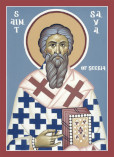 The son of Stefan Nemanja, the great Serbian national
leader, he was born in 1169. As a young man he yearned for the spiritual life. This led him to
flee to the Holy Mountain, where he became a monk and with rare zeal followed all the ascetic
practices. Nemanja followed his son’s example and himself went to the Holy Mountain, where
he lived and ended his days as the monk Simeon. Sava obtained the independence of the Serbian
Church from the emperor and the patriarch and became its first archbishop. He, together with his
father, built the monastery of Hilandar and many other monasteries, churches and schools
throughout the land of Serbia. He traveled to the Holy Land on two occasions, on pilgrimage to
the holy places. He made peace among his brothers, who were in conflict over their rights, and
also between the Serbs and their neighbors. In creating the Serbian Church, he created the
Serbian state and Serbian culture along with it. He brought peace to all the Balkan peoples,
working for the good of all, for which he was venerated and loved by all on the Balkan peninsula.
He gave a Christian soul to the people of Serbia, which survived the fall of the Serbian state.
He died in Trnovo in the reign of King Asen, being taken ill after the divine Liturgy on the
Feast of the Theophany in 1236. King Vladislav took his body to Mileševa, whence Sinan
Pasha, the impious Moslem, removed it, burning it at Vračar in Belgrade on April 27th,
1595.
2. The Holy Martyr Tatiana of Rome.
She was a Christian of an eminent family and a deaconess in the Church. After the death of the Emperor Heliogabalus, the Emperor Alexander came to the throne in Rome. His mother, Julia Mammaea, was a Christian, but the emperor himself was unsure and hesitant about his faith; an uncertainty that was clearly expressed by his keeping statues of both Christ and Apollo, of both Abraham and Orpheus, in his palace. His chief advisors took it into their own hands to persecute the Christians without his orders.
When the virgin Tatiana was led to martyrdom, she prayed for her executioners. And lo, their eyes were opened and they saw four angels around the martyr. Seeing this, eight of them were converted to Christ, for which they were tortured and killed. St. Tatiana’s martyrdom was long-drawn-out: she was flogged, parts of her flesh were cut off, she was sawn with an iron saw, and then, all disfigured and bleeding, was flung that evening into prison to be brought out on the following day for further torture. But God sent His angel to the prison to give her courage and heal her wounds. Tatiana, therefore, appeared before her torturers each morning in perfect health. She was thrown to a lion, but the lion became tame before her and did her no harm. Her hair was shorn—from an idea that occurred to their godless minds that some sorcery, some magical strength, might be hidden in it. Finally she was led out, together with her father, and the two were beheaded. In such manner this heroic maiden finished her earthly life in about the year 225, and was crowned with an immortal crown of glory. She had the weak body of a woman, but a manly and valiant spirit.
3. The Holy Martyr Peter Apselamus.
A native of Eleftheropolis in Palestine, he suffered as a youth for the Christian Faith in the year 311 under the Emperor Maximian. After terrible tortures, he was condemned to death. Hearing the sentence pronounced, he cried out with great joy: ‘My one desire is to die for my God!’ He was crucified, like his Lord, and gave up his spirit on the cross.
4. The Icon of the Mother of God, “Milk-Giver”.
This is the name given to the icon of the Mother of God that St. Sava of Serbia brought from the monastery of St. Sava the Sanctified near Jerusalem and placed in his hermitage at Karyes on the Holy Mountain. In that way a prophecy, made 800 years previously by St. Sava the Sanctified, was fulfilled—that one day a Serbian priest called Sava would come and would be given the icon and his staff. When Sava of Serbia visited the community of St. Sava the Sanctified, the monks called to mind the prophecy of their founder and gave the icon and the staff to Sava. The icon was placed at the right-hand side of the Beautiful Gates in the hermitage, and the staff in a cell which received the name ‘Pateritsa’*, also situated at Karyes.
* Pateritsa—The name used for a bishop’s staff, the father’s rod. —Tr.
5. Our Holy Mother Theodora
A famous nun and instructress of nuns from Alexandria, this holy woman said: ‘As cold and snow are necessary to a tree for it to bear fruit, so are trials and temptations to our life.’ She entered peacefully into rest at the beginning of the fifth century.
FOR CONSIDERATION
There is no greater honor or calling on earth than to be a Christian. When the judge-torturer Severus asked the young Peter Apselamus: ‘Of what family are you?’ Peter replied: ‘I am a Christian.’ The judge questioned him further: ‘Of what rank are you?’ To this he replied: ‘There is no higher or finer rank than that of a Christian.’ Saint John of Kronstadt writes: ‘The whole world is as thistledown in comparison with the soul of a Christian man.’ A Christian is an earthen vessel into which are poured godly strength and light. If that vessel be placed on a king’s golden throne or tucked away in some lightless beggar’s hovel, its worth is thereby neither magnified nor diminished. Does not gold have the same worth, whether wrapped in a silk scarf or a cabbage leaf?
Daily Scripture Readings taken from The Orthodox New Testament, translated and published by Holy Apostles Convent, Buena Vista, Colorado, copyright © 2000, used with permission, all rights reserved.
Daily Prologue Readings taken from The Prologue of Ochrid, by Bishop Nikolai Velimirovic, translated by Mother Maria, published by Lazarica Press, Birmingham, England, copyright © 1985, all rights reserved. Edited by Dormition Skete.