

Daily Devotional
Friday, January 20, 2017 (NS), January 7, 2017 (OS)
Fast Day, but Fish, Wine and Olive Oil Allowed.
Friday of the Thirty-First Week
The commemoration of the Afterfeast of Theophany, and the Synaxis of the honorable and glorious prophet, forerunner, and Baptist John.
Scripture Readings
Paschalion — Movable Calendar
Friday of the Thirty-First Week
Epistle
The Reading is from the General Epistle of Saint Iakovos [§ 52]. Brethren:
2 1Cease having, with respect of persons, the faith of our Lord Jesus Christ, the Lord of the glory. 2For if a gold-ringed man in splendid apparel should enter into your congregation, and a poor man in dirty apparel should also enter, 3and ye have regard for him wearing the splendid apparel, and say to him, “Sit thou in this good place,” and say to the poor man, “Stand thou there,” or “Sit thou here down beside my footstool,” 4ye also made a distinction in yourselves, did ye not, and became judges with evil thoughts? 5Hearken, my beloved brethren: God chose for Himself, did He not, the poor of this world to be rich in faith and heirs of the kingdom which He promised to those who love Him? 6But ye dishonored the poor man. The rich oppress you and drag you to courts of judgment, do they not? 7They blaspheme the good name, the one having been invoked upon you, do they not? 8If ye indeed fulfill the royal law according to the Scripture, “Thou shalt love thy neighbor as thyself [Lev. 19:18],” ye do well; 9but if ye have respect of persons, ye work sin, being convicted by the law as transgressors. 10For whosoever shall keep the whole law, but shall stumble in one point, he hath become guilty of all. 11For the One Who said, “Do not commit adultery [cf. Ex. 20:13(14)],” also said, “Do not commit murder [cf. Ex. 20:15(13)].” Now if thou shalt not commit adultery, but shalt murder, thou hast become a transgressor of the law. 12In this manner be speaking and in this manner be doing, as those who are to be judged by the law of freedom. 13For the judgment shall be merciless to him who rendered no mercy. Mercy boasteth against judgment.
Gospel
The Reading is from the Holy Gospel according to Saint Mark [§ 58]. At that time:
13 1As Jesus went forth out of the temple, one of His disciples saith to Him, “Teacher, see what manner of stones and what manner of buildings!” 2And Jesus answered and said to him, “Seest thou these great buildings? By no means shall a stone be left upon a stone which surely shall not be put down.” 3And as He sat upon the Mount of Olives opposite the temple, Peter and Iakovos and John and Andrew were questioning Him privately, 4“Tell us, when shall these things be, and what shall be the sign when all these things are about to be completed?” 5And Jesus, answering them, began to say, “Be taking heed, lest anyone should lead you astray. 6“For many shall come in My name, saying, ‘I am the Christ,’ and they shall lead astray many. 7“But whenever ye hear of wars and reports of wars, cease being clamorous; for it must come to pass, but the end is not yet. 8“For nation shall be stirred up against nation, and kingdom against kingdom. And there shall be earthquakes in place after place, and there shall be famines and troubles. These are the beginnings of birth pangs.”
Menaion — Fixed Calendar
The commemoration of the Afterfeast of Theophany, and the Synaxis of the honorable and glorious prophet, forerunner, and Baptist John.
Epistle
The Reading is from the Acts of the Apostles [§ 42]. In those days:
19 1It came to pass, while Apollos was in Corinth, Paul, having passed through the upper parts, came to Ephesus. And having found certain disciples, 2he said to them, “Did ye, having believed, receive the Holy Spirit?” And they said to him, “Nay, we did not even hear whether there is a Holy Spirit.” 3And he said to them, “Into what then were ye baptized?” And they said, “Into the baptism of John.” 4And Paul said, “John indeed baptized with a baptism of repentance, saying to the people that they should believe in the One coming after him, that is, in the Christ, Jesus.” 5And after they heard this, they were baptized in the name of the Lord Jesus. 6And after Paul laid his hands upon them, the Holy Spirit came upon them, and they were speaking with tongues and prophesying. 7And all the men were about twelve. 8And he entered into the synagogue and kept on speaking boldly for three months, discoursing and trying to persuade them concerning the things of the kingdom of God.
Gospel
The Reading is from the Holy Gospel according to Saint John [§ 3]. At that time:
1 29John seeth Jesus coming to him, and saith, “Behold the Lamb of God Who taketh away the sin of the world. 30“This is He concerning Whom I said, ‘After me cometh a Man Who hath come to be before me, for He was before me.’ 31“And I knew Him not; but that He should be made manifest to Israel, therefore I came baptizing in the water.” 32And John bore witness, saying, “I have beheld the Spirit descending out of heaven as a dove, and He abode upon Him. 33“And I knew Him not, but the One Who sent me to baptize in water, that One said to me, ‘Upon whomsoever thou shalt see the Spirit descending and abiding on Him, this is the One Who baptizeth in the Holy Spirit.’ 34“And I have seen and have borne witness that this is the Son of God.”
Lives of the Saints (Prologue)
January 20th – Civil Calendar
January 7th – Church Calendar
1. St. John the Baptist.
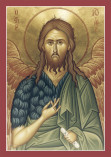 John’s greatest role during his life was enacted on the day of
the Theophany, and because of this the Church has, from the earliest times, dedicated the day
following that feast to his memory. This day is also connected with an event involving the hand
of the Forerunner. The Evangelist Luke desired to take John’s body from Sebaste, where the
great prophet had been beheaded by Herod, to Antioch, his own birthplace. He succeeded, though,
in acquiring and taking only one hand, which was kept in Antioch till the tenth century. It was
then moved to Constantinople, whence it disappeared during the Turkish occupation.
St. John is commemorated several times during the year, but his greatest feast is on this day, January 7th. Among the Gospel-figures surrounding the Savior, the person of John the Baptist holds a very special place, by the manner of his birth in this world and of his earthly life, by his role of baptizer of men to repentance and his Baptism of the Messiah, and lastly, by the tragic manner of his departure from this world. He was of such moral purity that he indeed deserved the name ‘angel’*, as he was named in the Scriptures, rather than being thought of as just a mortal man. St. John differs from all the other prophets in that he had the joy of showing forth to the world the One Whom he had foretold.
About the hand of St. John: it is related that each year, on his feast day, the archbishop would bring it out before the people. Sometimes the hand appeared open, and sometimes clenched. In the first case it indicated that it would be a fertile year, and in the second that it would be a year of famine.
* The word ‘messenger’ is, in Greek, ‘angelos’. See Malachi 3:1; Matt. 11:10. —Tr.
2. The Holy New-Martyr Athanasius.
This martyr of Christ was a poor and simple man, but was rich in faith and in wisdom through the Spirit of God. On one occasion he was inadvertently involved in a quarrel with a Turk. The Turk was educated and adroit with words, but Athanasius strove with all his might to present and uphold the truth of the Christian Faith and its superiority over Islam. They then parted. On the following day, Athanasius was summoned to trial, and found the Turk standing there as his accuser. When the judge called on Athanasius to repudiate his faith and embrace Islam, as he had given the impression of declaring to his companion of the previous day, Athanasius cried out: ‘I would die a thousand deaths before I would deny the Faith of Christ!’ He was therefore condemned to death and beheaded in the year 1700. His body was buried in the Church of St. Paraskeve in Smyrna, the city of his execution.
FOR CONSIDERATION
‘The whole man is not outwardly visible,’ says St Basil the Great. As one house is like another, so it is with the external appearance of a man. But a house receives honor from him who inhabits it, as likewise does a man from the spirit within him. It is easily apparent to bodily sight that the house is not the householder, but only the place where the householder lives; but it is only clear to spiritual sight that the body is not the man but only the dwelling his soul inhabits.
Daily Scripture Readings taken from The Orthodox New Testament, translated and published by Holy Apostles Convent, Buena Vista, Colorado, copyright © 2000, used with permission, all rights reserved.
Daily Prologue Readings taken from The Prologue of Ochrid, by Bishop Nikolai Velimirovic, translated by Mother Maria, published by Lazarica Press, Birmingham, England, copyright © 1985, all rights reserved. Edited by Dormition Skete.