

Daily Devotional
Wednesday, January 4, 2017 (NS), December 22, 2016 (OS)
Fast Day. No Meat, Fish, Dairy, Eggs, Alcohol or Olive Oil Allowed.
Wednesday of the Twenty-Ninth Week
The commemoration of the holy Great-martyr Anastasia, the deliverer from potions and drugs.
Scripture Readings
Paschalion — Movable Calendar
Wednesday of the Twenty-Ninth Week
Epistle
The Reading is from the Epistle of Saint Paul to the Hebrews [§ 312]. Brethren:
5 11Concerning Melchisedek there is much for our discourse and difficult in interpretation to speak, since ye have become dull in hearing. 12For though you even ought to be teachers by reason of the time, ye have need of one to teach you again what are the elements of the beginning of the oracles of God; and ye have come to be in need of having milk and not of solid food. 13For everyone who partaketh of milk is inexperienced in the word of righteousness, for he is an infant; 14but solid food is for the mature who, by reason of habit, have the senses exercised for discernment of both good and evil.
6 1Wherefore having left the discourse of the beginning principle of the Christ, let us be borne on to perfection, not laying down again a foundation of repentance from dead works, and of faith in God, 2of the teaching of baptisms, and of laying on of hands, and of resurrection of the dead, and of eternal judgment. 3And this we will do if indeed God permit. 4For it is impossible for those who were enlightened once for all, and who tasted of the gift, the heavenly one, and became partakers of the Holy Spirit, 5and tasted the good word of God and the powers of the age to come, 6and who fell away, to renew them again to repentance, since they crucify anew to themselves the Son of God and make a public example of Him. 7For the earth which drinketh up the oft coming rain, and produceth herbage fit for those by whom it is cultivated, receiveth blessing from God; 8but that which shooteth forth thorns and thistles is not approved and near cursing, of which the end is for burning.
Gospel
The Reading is from the Holy Gospel according to Saint Mark [§ 44]. The Lord said:
10 11“Whosoever shall divorce his wife and marry another committeth adultery against her; 12“and if a woman shall divorce her husband and be married to another, she committeth adultery.”
13And they were bringing to Him little children, in order that He should touch them; but the disciples were rebuking those who brought them. 14But after Jesus saw it, He was displeased, and said to them, “Let alone the little children to come to Me, and cease hindering them; for of such is the kingdom of God. 15“Verily I say to you, whosoever shall not receive the kingdom of God as a little child, in no wise shall he enter into it.” 16And having taken them in His arms, He was fervently blessing them, laying His hands upon them.
Menaion — Fixed Calendar
The commemoration of the holy Great-martyr Anastasia, the deliverer from potions and drugs.
Epistle
For Gk. usage, see [Gal. 3:23-4:5]. For Sl. usage, see [Gal. 3:23-29].
The Reading is from the Epistle of Saint Paul to the Galatians [§§ 208, 209]. Brethren:
3 23Before faith came, we were being guarded under the law, having been closed up to the faith about to be revealed. 24Therefore the law hath become our tutor until Christ, in order that we might be justified by faith. 25But faith having come, we are no longer under a tutor. 26For all are sons of God through faith in Christ Jesus. 27For as many as were baptized into Christ, ye put on Christ. 28There is neither Jew nor Greek, there is neither slave nor free, there is neither male and female; for ye are all one in Christ Jesus. 29And if ye are Christ’s, then are ye Abraham’s seed, and heirs according to promise.
4 1Now I say, as long as the heir is an infant, he differeth nothing from a slave, though he is lord of all; 2but he is under guardians and stewards until the appointed time of the father. 3So we also, when we were infants, were enslaved under the elements of the world. 4But when the fullness of the time came, God sent forth His Son, born of a woman, born under the law, 5in order that He might redeem those under the law, that we might receive what is our due, the adoption as sons.
Gospel
The Reading is from the Holy Gospel according to Saint Luke [§ 33]. At that time:
7 36A certain one of the Pharisees was asking Jesus that He would eat with him. And He entered into the house of the Pharisee, and reclined at table. 37And behold, a woman in the city who was a sinner, when she found out that He was reclining at table in the house of the Pharisee, brought an alabaster flask of perfumed ointment, 38and she stood beside His feet behind Him, weeping; and she began to wet His feet with tears, and was wiping them off with the hairs of her head; and she was kissing His feet ardently and anointing them with the perfumed ointment. 39Now when the Pharisee who invited Him saw it, he spoke within himself, saying, “This One, if He were a prophet, would know who and of what sort the woman is who toucheth Him, for she is a sinner.” 40And Jesus answered and said to him, “Simon, I have something to say to thee.” And he saith, “Teacher, say it.” 41“There were two debtors to a certain creditor: the one was owing five hundred denarii, and the other fifty. 42“But when they had nothing to pay back the debt, he showed himself gracious to both. Say which of them then will love him more?” 43Simon answered and said, “I suppose that he, to whom he showed himself the more gracious.” And He said to him, “Rightly thou didst judge.” 44And He turned to the woman, and said to Simon, “Seest thou this woman? I entered into thy house; water thou gavest Me not for My feet, but she with tears did wet My feet, and with the hairs of her head wiped them off. 45“A kiss thou gavest Me not, but she from the time that I entered did not cease from ardently kissing My feet. 46“With oil thou didst not anoint My head, but she anointed My feet with perfumed ointment. 47“For which reason I say to thee, her sins, which are many, have been forgiven, for she loved much. But to whom little is forgiven, the same loveth little.” 48And He said to her, “Thy sins have been forgiven.” 49And those reclining at table with Him began to say among themselves, “Who is this Who even forgiveth sins?” 50And He said to the woman, “Thy faith hath saved thee; go thy way in peace.”
Lives of the Saints (Prologue)
January 4th – Civil Calendar
December 22nd – Church Calendar
1. The Holy and Great Martyr Anastasia the Deliverer from Poison, and those with her.
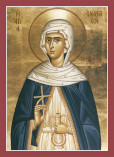 This great heroine of the
Christian Faith was born in Rome into a wealthy senatorial family, her father being a pagan and
her mother a Christian. From her early youth, she clave in love to the Lord Jesus, guided in
Christian teaching by a devout teacher, Chrysogonus. Under pressure from her father, Anastasia
married a pagan landowner, Publius, but using the pretext of bodily illness, she never had
physical relations with him. For this, her husband tortured her harshly by imprisonment and
starvation, and laid even heavier tortures on her when he discovered that she went secretly to
the prisons of the Christian martyrs, ministering to their needs, washing their wounds and
loosening their bonds. But, by God’s providence, she was freed from her wicked husband.
Publius was sent to Persia by the emperor, and was drowned on the voyage. Then St. Anastasia
began to minister openly to the Christian martyrs, and from her great inheritance, helped the
poor with alms. The Emperor Diocletian was once in the town of Aquileia, and commanded that
Chrysogonus, the confessor of Christ, be brought to him. As he was being brought, Anastasia
followed him on the way. Holy Chrysogonus was beheaded at the emperor’s command, and then
three sisters, Agapia, Chionia and Irene (April 16th) suffered, the first two being cast into
fire and the third shot through with arrows. St. Anastasia took their bodies, wrapped them in
white linen, and anointing them with aromatic spices, gave them burial. Then Anastasia went to
Macedonia, where she ministered to those who were suffering for Christ. There, she became
widely-known as a Christian, for which she was seized and taken for interrogation before various
judges. Desiring to die for her beloved Christ, Anastasia constantly clung to Him in her heart. A
certain pagan high priest, Ulphian, tried to touch St. Anastasia’s body out of lust, but he
was suddenly blinded and gave up the spirit. Condemned to death by starvation, St. Anastasia lay
in prison for thirty days, nourishing herself only with tears and prayers. After that, she was
put in a boat with several other Christians to be drowned, but God saved her from this death. She
was finally tied hand and foot to four wheels over a fire, and thus gave her holy soul into
God’s hands. She suffered and entered into Christ’s kingdom in 304.
2. The Holy Martyr Theodota with her three Children.
Left a young widow with three children, Theodota gave herself utterly to the service of God and the bringing-up of her children in piety. St. Anastasia lived with her when she was in Macedonia, and together with her, ministered to the Christian captives in the prisons. Taken for trial, Theodota confidently confessed Christ the Lord. She was then sent to the Governor of Bithynia, Niketas. When a shameless pagan tried to touch her body, an angel of God suddenly appeared beside her and struck the man. Condemned to death and thrown into a glowing furnace with her three children, St. Theodota finished her earthly course with honor and entered into the kingdom of eternal glory.
FOR CONSIDERATION
Our merciful God often sends comfort to those pleasing to Him on earth through His saints from the other world. St. Theodota suffered for Christ before St. Anastasia did. Anastasia was then thrown into a small, dingy prison to die there of hunger at the judge’s command. During the thirty days of her imprisonment, St. Theodota appeared to her every night from the other world, and strengthened her in her sufferings. When St. Anastasia had conversed many times in this way with St. Theodota, she asked her one night how it was that she was able to come to her after her death. Theodota replied that God gave to the souls of the martyrs the special grace that, after leaving this world, they could come to whomsoever they would in order to instruct or comfort. When the thirty days had passed, the torturer brought Anastasia out of the prison, amazed to see that she was still alive. He then condemned her to death by drowning, along with several others. The soldiers put the Christians into a small boat and themselves got into another, and when they got out into deep water, they upset the boat containing the Christians, so that the water would flow in and drown them. Then a wonderful thing happened: St. Theodota appeared walking on the water and took the boat to the shore, and thus they were all preserved from death together with St. Anastasia. Seeing this wonder, a hundred and twenty pagans came at once to faith in Christ and were baptized.
Daily Scripture Readings taken from The Orthodox New Testament, translated and published by Holy Apostles Convent, Buena Vista, Colorado, copyright © 2000, used with permission, all rights reserved.
Daily Prologue Readings taken from The Prologue of Ochrid, by Bishop Nikolai Velimirovic, translated by Mother Maria, published by Lazarica Press, Birmingham, England, copyright © 1985, all rights reserved. Edited by Dormition Skete.