

Daily Devotional
Wednesday, December 21, 2016 (NS), December 8, 2016 (OS)
Fast Day. No Meat, Fish, Dairy, Eggs, Alcohol or Olive Oil Allowed.
Wednesday of the Twenty-Seventh Week
The commemoration of our holy Father Patapios of Thebes.
Scripture Readings
Paschalion — Movable Calendar
Wednesday of the Twenty-Seventh Week
Epistle
The Reading is from the First Epistle of Saint Paul to Saint Timothy [§ 287]. Child Timothy:
5 22Do not be laying hands quickly on anyone, nor taking part in the sins of others; be keeping thyself pure. 23Be drinking water no longer, but be using a little wine for thy stomach and thy frequent infirmities. 24The sins of some men are manifest beforehand, going before to judgment, but some men they also follow after. 25In like manner also the good works of some are manifest beforehand, and those that are otherwise cannot be hid.
6 1Let as many as are under a yoke as slaves be deeming their own masters worthy of all honor, in order that the name of God and the teaching may not be blasphemed. 2And they that have believing masters, cease despising them, because they are brethren; but rather be rendering them service, because they are faithful and beloved who are themselves conferring benefits in return.
These things be teaching and exhorting. 3If anyone teach differently and draw not near to sound words—those of our Lord Jesus Christ, and the teaching according to piety— 4he hath been puffed up with pride, knowing nothing, but is sick concerning questions and disputes about words, out of which cometh envy, strife, blasphemies, evil suspicions, 5wasting time with wearing disputations of people who have been corrupted in mind and deprived of the truth, supposing piety to be a means of gain. Be withdrawing from such. 6But piety with sufficiency is a great means of gain. 7For we brought nothing into the world, and it is manifest that neither are we able to carry anything out; 8but having sustenance and coverings, we shall be satisfied with these. 9Now they who wish to be rich fall into temptation and a snare and many foolish and harmful desires, which sink men into destruction and perdition. 10For the love of money is a root of all evils, by which some, reaching out for themselves, were led astray from the faith and pierced themselves with many griefs.
11But thou, O man of God, be fleeing these things; and be pursuing righteousness, piety, faith, love, patience, meekness.
Gospel
The Reading is from the Holy Gospel according to Saint Luke [§ 104]. At that time:
For Gk. usage, see Lk. 21:5-8, 10, 11, 20-24; for Sl. usage, see Lk. 21:5-7, 10, 11, 20-24.
21 5As some spoke to Jesus about the temple, that it had been adorned with goodly stones and votive offerings, He said, 6“As for these things which ye behold, the days will come in which not a stone shall be left upon a stone, which shall not be put down.” 7And they asked Him, saying, “Teacher, when then shall these things be, and what shall be the sign when these things are about to take place?” 8And He said, “Be taking heed lest ye be led astray; for many shall come in My name, saying, ‘I am the Christ,’ and ‘The time hath drawn near.’ Do not then begin to go after them.”... 10Then He was saying to them, “Nation shall be stirred up against nation, and kingdom against kingdom. 11“And there shall be great earthquakes in place after place, and famines, and plagues; there shall be both terrors and great signs from heaven.... 20“But whenever ye see Jerusalem being encircled by encamped armies, then know that her desolation hath drawn near. 21“Then those in Judæa, let them flee to the mountains. And those in the midst of her, let them depart. And those in the fields, cease entering into her. 22“For these are the days of avenging, in order that all things that have been written might be fulfilled. 23“And woe to those with child and to those who give suck in those days! For there shall be great anguish upon the land and wrath on this people. 24“And they shall fall by the edge of the sword, and shall be led away captive into all the nations. And Jerusalem shall be trodden underfoot by the nations, until the times of the nations should be fulfilled.”
Menaion — Fixed Calendar
The commemoration of our holy Father Patapios of Thebes.
Epistle
The Reading is from the Second Epistle of Saint Paul to the Thessalonians [§ 276]. Brethren:
2 13We are bound to give thanks to God always concerning you, brethren beloved by the Lord, because God chose you for Himself from the beginning to salvation in sanctification of the Spirit and belief of the truth, 14to which He called you through our Gospel, to acquisition of the glory of our Lord Jesus Christ. 15So then, brethren, be standing firm and holding fast the traditions which ye were taught, whether by word or by our epistle. 16Now may our Lord Jesus Christ Himself, and our God and Father, the One Who loved us and gave everlasting consolation and good hope by grace, 17comfort your hearts and establish you in every good word and work.
3 1For the rest, brethren, be praying for us, that the word of the Lord may run and be glorified, even as also it is with you, 2and that we might be delivered from wayward and evil men; for not all have the faith. 3But faithful is the Lord, Who shall establish you and guard you from the evil one. 4And we trust in the Lord as to you, that ye both do and will do what we command you. 5And may the Lord direct your hearts into the love of God, and into the patience of the Christ.
Gospel
No reading given.
Lives of the Saints (Prologue)
December 21st – Civil Calendar
December 8th – Church Calendar
1. Our Holy Father Patapios.
Born and brought up in the Faith and in the fear of God by pious parents in the Egyptian city of Thebes, he early perceived and rejected the empty vanity of the world and went into the Egyptian desert, where he devoted himself to cleansing his heart from every worldly thought and desire for the sake of divine love. When his virtues became known among the people, they began to come to him and seek relief from their troubles. Afraid of human glory, which darkens a man’s mind and separates it from God, Patapios fled from the desert to Constantinople, for this wonderful saint thought that he could more easily hide himself from men in the heart of a city than in the desert. He built himself a hut close to the Vlachernai church and there, enclosed and unknown, took up again his interrupted life of asceticism. But the light cannot be hidden. A child, blind from birth, was led by divine providence to St. Patapios and begged him to offer a prayer that he might be given his sight and look upon God’s creation, and praise God all the more. Patapios had pity on the suffering child and prayed to God, and the child saw. Through this miracle, Patapios’ godly life became known throughout the entire capital, and people began to turn to him for healing, comfort and teaching. Patapios healed one eminent man of dropsy after blessing him with a cross and anointing him with oil. Making the sign of the Cross in the air, he freed a youth from an unclean spirit which had cruelly tormented him, and the evil spirit went out of God’s creature like smoke, uttering a great cry. He made the sign of the Cross over a woman who had sores on her breasts all filled with worms, and she was healed. St. Patapios worked many other miracles, all through prayer in the name of Christ and by the power of the Cross. He entered into rest in great old age, going to the kingdom of God in the seventh century.
2. The Holy Apostles Sosthenes, Apollos, Tychicus, Epaphroditus, Onesiphorus, Cephas and Caesar.
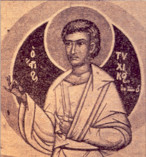 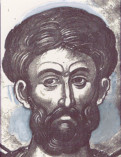 All these are
commemorated on January 4th with the other lesser apostles. St. Apollos is also
commemorated on September 10th, St. Onesiphorus on September 7th, and Cephas and Caesar on
March 30th. St. Sosthenes was Bishop of Caesarea and Tychicus succeeded him in the same
city. Epaphroditus was bishop in Colophon in Pamphylia, Cephas in Iconium and Caesar in the
Peloponnese. They all preached the Gospel of Christ with burning love, and endured
suffering for His name’s sake before they entered into the kingdom of eternal joy. |
FOR CONSIDERATION
He who entrusts himself completely to God is led by Him towards salvation, and is used by Him for the good of many others. St. Nicholas, entrusting himself to the will of God, fled from human vanity, from his town of Patara, and came to the city of Myra in Lycia, where he knew no one and was known by none. With no means at all of supporting himself (for, although he had been rich, he had abandoned everything), without acquaintance and without any plan, he went unnoticed about the city, waiting for God to direct his footsteps. At that time, John, the archbishop of the city, died and the synod that was assembled for the election of a new archbishop could not agree on any one candidate. Finally, the members of the synod decided to fast and pray that God would show them who was most worthy of the position. God heard the prayers of His servants, and disclosed to them who was the most worthy. While the presiding bishop was standing at prayer, a man appeared to him, clothed in white, and told him to go out early and stand in front of the church, awaiting the first man to arrive for morning prayer. ‘Make him archbishop; he is called Nicholas,’ he said. The bishop informed the others of what he had heard and seen, and he went to the church early the next morning and waited. St. Nicholas, who was accustomed to rising early to pray, came to the church. Seeing him, the bishop asked: ‘What is your name, my son?’ Nicholas was silent. The bishop asked him again, and this time he answered: ‘I am called Nicholas, and am your lordship’s servant.’ Then the bishop took him by the hand, and leading him into the synod, said: ‘Receive, my brethren, your pastor, whom the Holy Spirit has anointed and who has been elected not by a human synod, but by divine providence.’
Daily Scripture Readings taken from The Orthodox New Testament, translated and published by Holy Apostles Convent, Buena Vista, Colorado, copyright © 2000, used with permission, all rights reserved.
Daily Prologue Readings taken from The Prologue of Ochrid, by Bishop Nikolai Velimirovic, translated by Mother Maria, published by Lazarica Press, Birmingham, England, copyright © 1985, all rights reserved. Edited by Dormition Skete.