

Daily Devotional
Thursday, September 29, 2016 (NS), September 16, 2016 (OS)
No Fasting.
Thursday of the Fifteenth Week
The commemoration of the Afterfeast of the Exaltation, and the holy Great-martyr Ephemia the All-praised.
Scripture Readings
Paschalion — Movable Calendar
Thursday of the Fifteenth Week
Epistle
The Reading is from the Epistle of Saint Paul to the Galatians [§§ 208, 209]. Brethren:
3 23Before faith came, we were being guarded under the law, having been closed up to the faith about to be revealed. 24Therefore the law hath become our tutor until Christ, in order that we might be justified by faith. 25But faith having come, we are no longer under a tutor. 26For all are sons of God through faith in Christ Jesus. 27For as many as were baptized into Christ, ye put on Christ. 28There is neither Jew nor Greek, there is neither slave nor free, there is neither male and female; for ye are all one in Christ Jesus. 29And if ye are Christ’s, then are ye Abraham’s seed, and heirs according to promise.
4 1Now I say, as long as the heir is an infant, he differeth nothing from a slave, though he is lord of all; 2but he is under guardians and stewards until the appointed time of the father. 3So we also, when we were infants, were enslaved under the elements of the world. 4But when the fullness of the time came, God sent forth His Son, born of a woman, born under the law, 5in order that He might redeem those under the law, that we might receive what is our due, the adoption as sons.
Gospel
The Reading is from the Holy Gospel according to Saint Mark [§ 25]. At that time:
6 30The apostles were gathered together to Jesus, and related to Him all things, both as much as they did and as much as they taught. 31And He said to them, “Come ye yourselves privately to a desolate place, and rest yourselves a little.” For those coming and those going were many, and they did not even have an opportunity to eat. 32And they went away by the ship privately to a desolate place. 33And the crowds saw them going, and many recognized Him, and ran together there on foot from all the cities, and went before them, and came together to Him. 34And Jesus, after He came out, saw a great crowd and was moved with compassion toward them, because they were as sheep not having a shepherd; and He began to teach them many things. 35And much time already having elapsed, His disciples came to Him and said, “The place is desolate, and already it is a late hour. 36“Dismiss them in order that they might go away into the fields and villages round about, and buy bread for themselves; for they have not what they might eat.” 37But He answered and said to them, “Give ye them to eat.” And they say to Him, “Shall we go away and buy bread worth two hundred denarii and give them to eat?” 38But He saith to them, “How many loaves have ye? Go and see.” And having known, they say, “Five, and two fish.” 39And He enjoined them to make all recline by companies upon the green grass. 40And they laid back in rows, like beds in a garden, up to a hundred and up to fifty. 41And having taken the five loaves and the two fish, He looked up to the heaven and blessed and broke the loaves, and kept on giving them to His disciples that they might set them before them; and the two fish He divided to all. 42And all ate and were filled. 43And they took up twelve baskets full of fragments, and from the fish. 44And they who ate of the loaves were five thousand men.
45And straightway He constrained His disciples to embark into the ship, and to go before to the other side toward Bethsaida, until He should dismiss the crowd.
Menaion — Fixed Calendar
The commemoration of the Afterfeast of the Exaltation, and the holy Great-martyr Ephemia the All-praised.
Epistle
The Reading is from the Second Epistle of Saint Paul to the Corinthians [§ 181]. Brethren:
6 1We, working together, beseech you also not to receive the grace of God in vain— 2for He saith, “In an acceptable time I heard thee, and in a day of salvation I helped thee [Is. 49:8]”; behold, now is an acceptable time; behold, now is a day of salvation— 3by not giving even one cause of stumbling in anything, that the ministry might not be blamed. 4But in all things commending ourselves as ministers of God, in much patience, in afflictions, in necessities, in straits, 5in blows, in imprisonments, in instabilities, in toils, in vigils, in fastings, 6in pureness, in knowledge, in long-suffering, in kindness, in the Holy Spirit, in love unfeigned, 7in the word of truth, in the power of God, by the weapons of righteousness of the right hand and of the left, 8by glory and dishonor, by ill-fame and good fame; as deceivers and yet true; 9as unknown and well-known; as dying, and, behold, we live; as chastened, and not put to death; 10as ones sorrowful, but always rejoicing; as poor, but enriching many; as having nothing, and yet possessing all things.
Gospel
The Reading is from the Holy Gospel according to Saint Luke [§ 33]. At that time:
7 36A certain one of the Pharisees was asking Jesus that He would eat with him. And He entered into the house of the Pharisee, and reclined at table. 37And behold, a woman in the city who was a sinner, when she found out that He was reclining at table in the house of the Pharisee, brought an alabaster flask of perfumed ointment, 38and she stood beside His feet behind Him, weeping; and she began to wet His feet with tears, and was wiping them off with the hairs of her head; and she was kissing His feet ardently and anointing them with the perfumed ointment. 39Now when the Pharisee who invited Him saw it, he spoke within himself, saying, “This One, if He were a prophet, would know who and of what sort the woman is who toucheth Him, for she is a sinner.” 40And Jesus answered and said to him, “Simon, I have something to say to thee.” And he saith, “Teacher, say it.” 41“There were two debtors to a certain creditor: the one was owing five hundred denarii, and the other fifty. 42“But when they had nothing to pay back the debt, he showed himself gracious to both. Say which of them then will love him more?” 43Simon answered and said, “I suppose that he, to whom he showed himself the more gracious.” And He said to him, “Rightly thou didst judge.” 44And He turned to the woman, and said to Simon, “Seest thou this woman? I entered into thy house; water thou gavest Me not for My feet, but she with tears did wet My feet, and with the hairs of her head wiped them off. 45“A kiss thou gavest Me not, but she from the time that I entered did not cease from ardently kissing My feet. 46“With oil thou didst not anoint My head, but she anointed My feet with perfumed ointment. 47“For which reason I say to thee, her sins, which are many, have been forgiven, for she loved much. But to whom little is forgiven, the same loveth little.” 48And He said to her, “Thy sins have been forgiven.” 49And those reclining at table with Him began to say among themselves, “Who is this Who even forgiveth sins?” 50And He said to the woman, “Thy faith hath saved thee; go thy way in peace.”
Lives of the Saints (Prologue)
September 29th – Civil Calendar
September 16th – Church Calendar
1. The Holy and Great Martyr Ephemia (Euphemia).
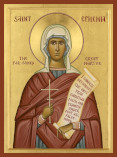 Born in Chalcedon, her father was the senator Philophronus and her mother’s name was
Theodorisia, both devout Christians. Ephemia was a girl beautiful in both body and soul. When the
proconsul, Priscus, celebrated a festival of sacrifice to Ares in Chalcedon, forty-nine
Christians absented themselves from the festivities and hid themselves. But they were discovered
and brought before Priscus, holy Ephemia being among them. When the furious Priscus asked them
why they had not carried out the imperial command, they replied: ‘Both the emperor’s
commands and yours must be obeyed if they are not contrary to the God of heaven. If they are,
they must not only not be obeyed; they must be resisted.’ Then Priscus put them to various
tortures for nineteen days, from day to day. On the twelfth day, he held Ephemia apart from the
others and began to flatter her beauty, hoping to bring her thus to idolatry. When all his
flattery proved fruitless, he ordered that she be tortured. First, she was put on a wheel, but an
angel of God appeared and broke it. Then he had her thrown into a fiery furnace, but she was
preserved by God’s power. Seeing this, two soldiers, Victor and Sosthenes, came to faith in
Christ, for which they were thrown to the wild beasts and thus finished their earthly course with
glory. After that, Ephemia was thrown into a pit filled with water and all kinds of poisonous
reptiles, but she made the sign of the Cross over the water as she went into the pit, and
remained unharmed. She was finally thrown to the wild beasts, and with a prayer of thanksgiving,
gave her soul into God’s hands. Her parents buried her body. She suffered in the year 303,
and entered into eternal joy. (St. Ephemia is also commemorated on July 11th.)
2. Our Holy Father Dorotheos.
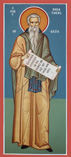 An Egyptian hermit of the fourth century, he lived in
asceticism for sixty years in a cell in the Thebaid. He was distinguished by a rare love of
labor and by wonder-working power. By day he built cells for the new monks and by night
plaited mats, never interrupting his prayer and psalmody. |
3. St. Cyprian, Metropolitan of Kiev.
Born in Trnovo and given a Serbian* upbringing on the Holy Mountain, he devoted himself especially to the translation and writing of books. His patron was Patriarch Philotheos of Constantinople, who came to know him on the Holy Mountain, took him into his service and then sent him to Kiev as metropolitan. He lived through all this with greatness of soul, and by his fruitful labors, brought much benefit to the Russian Church, spending almost thirty years as metropolitan. At the time of his death, he wrote a Farewell which was read at his graveside. He entered into rest on September 16th, 1406, and his wonder-working relics are preserved in the Church of the Dormition in Moscow.
* Author’s note: Metropolitan Philaret writes that Cyprian was a Serb. See his ‘Lives’.
4. The Holy Martyr Ludmilla.
The grandmother of the Czech King Vatslav (Wenceslas) and wife of the Czech Prince Borivoy, she was very zealous for the Christian Faith and was greatly instrumental in freeing the Church from paganism. Her daughter-in-law hated her, and sent men to kill the aged Ludmilla in Techino in 927. Vatslav buried her in the Church of St. George in Prague, and many miracles were wrought over her relics. Holy Vatslav, a great zealot for the Orthodox Faith, was murdered by his brother Boleslav.
FOR CONSIDERATION
Often some unexpected misfortune comes upon us, and we vainly ask why. The Church of Christ alone is able to explain the cause of every misfortune. The Church places all misfortunes in two groups: One, those that come upon sinners because of their old, unrepented sin, and two, those that come upon the righteous and serve, according to the words of St. Chrysostom, ‘as a means of receiving a wreath, as was the case with Lazarus and Job.’ The Empress Evdokia was secretly in sympathy with the Eftychian heresy, hearkening in this to the counsel of the treacherous eunuch Chrysaphios. Misfortune suddenly came upon her. One day her husband, the Emperor Theodosios, brought her a large apple. The empress sent the apple to the sick senator Paulinos. He, out of love for the emperor, sent this same apple to Theodosios. This gave rise in the emperor to suspicion and uncertainty towards his wife and the senator, and he asked his wife where the apple was. She lied, and said that she had eaten it. This added to the emperor’s suspicions, and he exiled Evdokia to Palestine. In time, Evdokia recovered from her heresy, and acting on the advice of the great Palestinian spiritual teachers, returned whole-heartedly to Orthodoxy. The empress’ misfortune did not arise from any misconduct with Paulinos—in this she was completely innocent—but because of her heretical beliefs. Another and different example: the Emperor Marcian, as a military commander, was traveling one day near Philippopolis when he saw the dead body of a man on the highway. From simple compassion, he got off his horse and began to bury the man. Someone came upon him, and brought the commander to trial as a murderer. Marcian would have been punished by death if God had not quickly revealed who was the real murderer. This misfortune falls in the second group: ‘for the receiving of a wreath’. General Marcian was soon after this chosen as emperor.
Daily Scripture Readings taken from The Orthodox New Testament, translated and published by Holy Apostles Convent, Buena Vista, Colorado, copyright © 2000, used with permission, all rights reserved.
Daily Prologue Readings taken from The Prologue of Ochrid, by Bishop Nikolai Velimirovic, translated by Mother Maria, published by Lazarica Press, Birmingham, England, copyright © 1985, all rights reserved. Edited by Dormition Skete.