

Daily Devotional
Friday, September 23, 2016 (NS), September 10, 2016 (OS)
Fast Day. No Meat, Fish, Dairy, Eggs, Alcohol or Olive Oil Allowed.
Friday of the Fourteenth Week
The commemoration of the Afterfeast of the Nativity, and the Martyrs Menodora, Metrodora, and Nymphodora.
Scripture Readings
Paschalion — Movable Calendar
Friday of the Fourteenth Week
Epistle
The Reading is from the Epistle of Saint Paul to the Galatians [§ 201]. Brethren:
2 6From those who were reputed to be something—of what sort they once were, it maketh no difference to me; God accepteth the person of no man—for those who were of repute offered nothing else of themselves to lay upon me. 7But on the contrary, after they saw that I have been entrusted with the Gospel of the uncircumcision, even as Peter that of the circumcision 8(for the One having energized in Peter toward an apostleship of the circumcision, energized also in me toward the nations), 9and after Iakovos and Kephas and John, those who were reputed to be pillars, perceived the grace which was given to me, they gave to me and Barnabas the right hands of fellowship, that we go to the nations, but they to the circumcision; 10only that we be remembering the poor, which very thing I also was eager to do.
Gospel
The Reading is from the Holy Gospel according to Saint Mark [§§ 20, mid 21]. At that time:
5 22There cometh to Jesus one of the rulers of the synagogue, by name Jairos; and after he saw Him, he fell at His feet, 23and was beseeching Him very much, saying, “My little daughter is at her end, so come and lay Thy hands on her, that she might be made well, and she shall live.” 24And He went away with him; and a great crowd was following Him and pressing upon Him.... 35And some came from the ruler of the synagogue’s house, saying, “Thy daughter died; why art thou still troubling the Teacher?” 36But Jesus, after He heard the word spoken, straightway saith to the ruler of the synagogue, “Cease being afraid, only keep on believing.” 37And He allowed no one to follow along with Him, except Peter, and Iakovos, and John the brother of Iakovos. 38And He cometh to the house of the ruler of the synagogue, and seeth a tumult, and the crowd weeping and wailing greatly. 39And after He entered, He saith to them, “Why are ye being clamorous and weeping? The little child did not die, but sleepeth.” 40And they kept on laughing scornfully at Him. But when He put all out, He took the father of the child and the mother, and those with Him, and entered in where the little child was lying. 41And He laid hold of the little child’s hand, and saith to her, “Talitha, koumi,” which is, being interpreted, “Little girl, I say to thee, arise.” 42And straightway the little girl arose and was walking about, for she was twelve years old. And they were amazed with great ecstasy; 43and He Himself earnestly gave them express orders that no one should know this; and He said that something should be given to her to eat.
6 1And He went out from that place, and came into His own country; and His disciples followed Him.
Menaion — Fixed Calendar
The commemoration of the Afterfeast of the Nativity, and the Martyrs Menodora, Metrodora, and Nymphodora.
No readings given.
Lives of the Saints (Prologue)
September 23rd – Civil Calendar
September 10th – Church Calendar
1. The Holy Martyrs Menodora, Metrodora and Nymphodora.
They were three sisters from some place in Asian Bithynia. Brought up in a Christian spirit, they withdrew from the city into the desert, desiring to lift up their minds to God and free themselves from the illusory world, and thus to live their lives with purity and virginity as true brides of Christ. They gave themselves to fasting, prayer and toil, and God adorned them with the gift of wonder-working. When people began to bring the sick to them for healing, they became known against their will. A certain governor, Fronton, heard of them and brought them to trial. Seeing them, the governor was amazed at their beauty, for, although they were nuns and their bodies were withered, their faces were radiant, illumined by an inner peace and the grace of God. The governor at first flattered them and promised to send them to the emperor, who would give them in marriage to his nobles, but when he realized that his flattery and promises were having no effect on these brides of Christ the Lord, he ordered that Menodora be put to torture and her sisters be thrown into prison. After harsh torture, the governor cried to Menodora, all wounded and covered in blood: ‘Offer sacrifice to the gods!’ To this the holy martyr replied: ‘Don’t you see that I am doing nothing but offering myself in sacrifice to my God?’ When she expired under torture, the governor brought out her two sisters and stood them beside Menodora’s dead body, and pointing to it, urged them to deny Christ. As they remained steadfast, he tortured them to death. At that, a thunderbolt fell from the sky and killed the soulless Fronton and his servants. Christians buried the bodies of these holy martyrs, who suffered some time between 305 and 311, in the time of Galerius, and entered into rest in the kingdom of Christ.
2. St. Pulcheria the Empress.
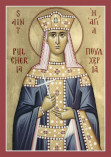 Daughter of the Emperor Arkadios, she vowed to remain in
perpetual virginity, and as an earnest of this vow, had a table of gold and precious stones
made for the cathedral. She reigned together with her brother Theodosios the Younger, and
was greatly zealous for the Orthodox Faith. It was at her instigation that the Third
Ecumenical Council in Ephesus was summoned, which condemned the Nestorian heresy. She built
the famous church of the Mother of God at Vlachernai in Constantinople. After
Theodosios’ death, she married Marcian, who was chosen as emperor, and lived with him
as a brother. It was she who found the relics of the Forty Martyrs of Sebaste. She entered
into rest in the Lord on September 10th, 453, at the age of fifty-five. |
3. Ss. Apollos, Lucius and Clement.
Apostles among the Seventy: Apollos (Acts 18:24-25) was bishop in Smyrna before St. Polycarp. St. Lucius (Rom. 16:21) was bishop in Laodicea and St. Clement was bishop in Sardis.
4. The Three Holy Women of Constantinople.
A noblewoman of Constantinople with her two handmaids, they scorned the vanity of the world and withdrew to solitude, where, after eleven years of asceticism, they entered into rest in the Lord.
FOR CONSIDERATION
The examples of courage and endurance that are given by the Christian martyrs—thousand upon thousand of them—shine with radiant glory through every page of the history of the Christian Church. But, as the examples of voluntary martyrs are given us to marvel at, so also (and no less) are the examples of the Christian ascetics, known and unknown, for asceticism is nothing other than a long-drawn-out martyrdom. Paul, Bishop of Monemvasia, has given to posterity the instructive example of a group of women ascetics. While he was still a layman and a tax-collector, he happened to stay in a monastery. Seeing ravens set about the fruit trees, stealing the fruit and carrying it off, he was curious, and together with the monks, set off after them to see where they were carrying the fruit. Going thus, they came to an impenetrable forest, into the depths of which the ravens disappeared, left their stolen fruit and quickly returned. Exploring, they found a cave, and in it, three nuns. The eldest of them told him of their life: how she had been a Constantinopolitan noblewoman whose husband had died and whom another noble had wanted to take by force as his wife. But she had decided, after her husband’s death, that she would spend the rest of her life in virginity, and had therefore given her goods away to the poor, and with her two handmaids, had fled to this remote spot. They had spent eleven years there in fasting and prayer, seeing no one and seen of no one but God. He, in His providence, had arranged for birds to bring them fruit to eat. They then begged the abbot to bring them holy Communion. When they had received Communion, three days later, all three holy women entered into rest, and the monks buried them.
Daily Scripture Readings taken from The Orthodox New Testament, translated and published by Holy Apostles Convent, Buena Vista, Colorado, copyright © 2000, used with permission, all rights reserved.
Daily Prologue Readings taken from The Prologue of Ochrid, by Bishop Nikolai Velimirovic, translated by Mother Maria, published by Lazarica Press, Birmingham, England, copyright © 1985, all rights reserved. Edited by Dormition Skete.