

Daily Devotional
Monday, September 12, 2016 (NS), August 30, 2016 (OS)
No Fasting.
Monday of the Thirteenth Week
The commemoration of the Afterfeast of the beheading of St. John the Baptist, and our holy fathers among the saints, Alexander, John, and Paul the New, Patriarchs of Constantinople, and the translation of the relics of the holy and right-believing great Prince Alexander Nevsky.
Scripture Readings
Paschalion — Movable Calendar
Monday of the Thirteenth Week
Epistle
The Reading is from the Second Epistle of Saint Paul to the Corinthians [§ 186]. Brethren:
8 7Even as ye abound in everything—in faith, and in word, and in knowledge, and in all earnestness, and in accordance with your love in us—see that ye be abounding in this grace also. 8I speak not by command, but as proving through the earnestness of others, the genuineness also of your love; 9for ye know the grace of our Lord Jesus Christ, that being rich, He became poor for your sakes, that ye might become rich by the poverty of that One. 10And in this I give advice; for this is profitable for you, who began before not only to do, but also to will from last year. 11But now also accomplish the doing of it, that even as there was the readiness to will, so there may be the accomplishment also out of that which ye are able. 12For if the readiness is present, it is acceptable according to what one may have, not according to what one doth not have. 13For it is not that for others there may be ease and for you pressure; 14but in accordance with equality in the present time: your abundance for their want, that their abundance also might be for your want, so that there might come to be an equality— 15even as it hath been written: “The one who gathered much had nothing over; and the one who gathered little had no lack [cf. Ex. 16:18].”
Gospel
The Reading is from the Holy Gospel according to Saint Mark [§ 11]. At that time:
3 6The Pharisees were holding counsel with the Herodians against Jesus, how they might destroy Him.
7And Jesus withdrew with His disciples to the sea; and a great multitude from Galilee followed Him, and from Judæa, 8and from Jerusalem, and from Idumæa, and from beyond the Jordan; and they about Tyre and Sidon, a great multitude, after they heard how much He was doing, came to Him. 9And He told His disciples that a small ship should be waiting on Him on account of the crowd, lest they should press hard upon Him. 10For He cured many; insomuch that they fell upon Him that they might touch Him for themselves, as many as had scourges. 11And the spirits, the unclean ones, whenever they beheld Him, were falling down before Him and crying out, saying, “Thou art the Son of God.” 12And He was strictly warning them very much that they should not make Him manifest.
Menaion — Fixed Calendar
The commemoration of the Afterfeast of the beheading of St. John the Baptist, and our holy fathers among the saints, Alexander, John, and Paul the New, Patriarchs of Constantinople, and the translation of the relics of the holy and right-believing great Prince Alexander Nevsky.
Epistle
For St. Alexander Nevsky:
The Reading is from the Epistle of Saint Paul to the Galatians [§ 213]. Brethren:
5 22The fruit of the Spirit is love, joy, peace, long-suffering, kindness, goodness, faith, 23meekness, self-control; against such things there is no law. 24But they who are of the Christ crucified the flesh with the passions and the lusts. 25If we live by the Spirit, let us also be walking by the Spirit. 26Let us not become vainglorious, provoking one another, envying one another.
6 1Brethren, even if a man should be overtaken in some transgression, ye, the spiritual ones, be restoring such a one in the spirit of meekness, looking out for thyself, lest thou also be tempted. 2Keep on bearing one another’s burdens, and thus fill up the law of the Christ.
Gospel
For the right-believing Prince:
The Reading is from the Holy Gospel according to Saint Luke [§ 24]. At that time:
6 17 Jesus stood upon a level place. And there was a crowd of His disciples, and a great multitude of the people from all of Judæa and Jerusalem and the seacoast of Tyre and Sidon, who came to hear Him, and to be healed of their diseases— 18even those who were troubled by unclean spirits; and they were cured. 19And all the crowd was seeking to touch Him, for power was coming forth from Him and healing all. 20And He lifted up His eyes to His disciples, and began to say:
“Blessed are the poor, for yours is the kingdom of God.
21“Blessed are ye who hunger now, for ye shall be filled.
Blessed are ye who weep now, for ye shall laugh.
22“Blessed are ye whenever men hate you, and whenever they separate you, and reproach you, and cast out your name as evil, on account of the Son of Man.
23“Rejoice in that day and leap for joy, for behold, your reward is great in the heavens.”
Lives of the Saints (Prologue)
September 12th – Civil Calendar
August 30th – Church Calendar
1. Ss. Alexander, John and Paul, Patriarchs of Constantinople.
Alexander took part in the First Ecumenical Council in Nicaea, in place of the aged Patriarch Metrophanes, whom he then succeeded. When certain philosophers tried to dispute with him about faith, he said to one of them: ‘In the name of my Lord Jesus Christ, I command you to remain silent!’ and the philosopher became dumb from that moment. By his prayers, also, Arius’ life was shortened. Alexander died at the age of ninety-eight, in the year 340.
St. John III Scholastikos governed the Church in the time of Emperor Justin II and added the canons of Sardica and of St. Basil the Great to the Church’s collection of canons. He reposed in 577.
St. Paul IV governed the Church for five years and eight months and renounced the throne to receive the Great Habit secretly, to repent of his sins when he first supported the iconoclasts. He was the predecessor of the great Tarasios, and entered into rest in the time of Irene and Constantine, in 784.
2. The Assembly of the Enlighteners and Teachers of Serbia.
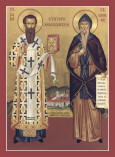 On this day are commemorated, not all the saints of Serbia in
general, but several archbishops and patriarchs:
St. Sava, the first Archbishop of Serbia, called equal to the apostles.
Arsenius, St. Sava’s successor, a great hierarch and wonder-worker.
Sava II, son of King Stefan the First-Crowned, who lived a long time in Jerusalem and was called ‘like to Moses in meekness’.
Nicodemus, who lived in asceticism on the Holy Mountain, and was abbot of Hilandar and archbishop of ‘all the Serbian and maritime lands’.
Ioannikios, archbishop and then, from 1346-1349, patriarch.
Ephraim, an ascetic who, in 1376, was chosen against his will as patriarch in the time of Prince Lazar. He crowned Lazar and then renounced the patriarchal throne and withdrew into solitude.
Spiridon, Ephraim’s successor, who died in 1388.
Macarius, who restored many old foundations, printed Church books in Skadar, Venice, Belgrade and other places, built the famous refectory in the monastery at Peć, and did much for the advancement of the Church with the help of his brother, Mehmed Sokolović. He entered into rest in 1574.
Gavrilo (Gabriel), by birth a nobleman of the Rajić family, who took part in the Moscow Council under Patriarch Nikhon, because of which he was tortured by the Turks for treason and hanged in 1656.
As well as these, there are also commemorated Eustace, Jacob, Danilo, Sava III, Gregory, John, Maxim and Nikhon. Many of them lived the ascetic life on the Holy Mountain, and all were ‘gentle and faithful servants, good laborers in the Lord’s vineyard’.
3. Our Holy Father Christopher.
An ascetic of the sixth century in the community of St. Theodosios in Palestine, he saw in a vision that the lamp of the monk who labored was burning, and the lamp of the lazy monk was not.
4. St. Evlalios, Bishop of Caesarea in Cappadocia.
One of St. Basil’s predecessors, he deprived his son of his priesthood for wearing clothing unsuited to his spiritual calling.
FOR CONSIDERATION
Noisy heretics perish with hubbub and disgrace, and their deaths themselves show God’s wrath towards them for the lies that they spread and that disturbed the Church of God. Arius, after being condemned at Nicaea, came one day to the Emperor Constantine and begged that he might be received back into the Church. Constantine asked him if he believed the Nicene Creed and he, cunningly carrying in his bosom a paper on which his heretical creed was written, indicated his breast with his hand, and said to the Emperor: ‘Thus I believe.’ The emperor believed that Arius had repented and sent him to Patriarch Alexander to be reconciled with the Church. Alexander was unwilling to receive Arius, knowing that he was lying, but the emperor fixed a certain Sunday on which Arius was to be brought into the Great Church. The evening before that day, the holy patriarch begged God to take his soul before the blasphemous heretic was brought into the church. When the appointed Sunday dawned, the patriarch was in church at the service, and Arius, with the emperor’s men and his fellow-heretics, set off for the church. When they reached the Square of Constantine, he was suddenly seized by pains in the spirit and the body, and sought a place to relieve himself. There, in the square, was such a place, and he went there. His companions waited a long time for him, and became impatient. When someone went to see what was the matter, he found him dead in that filthy place, lying in foulness and blood.
Daily Scripture Readings taken from The Orthodox New Testament, translated and published by Holy Apostles Convent, Buena Vista, Colorado, copyright © 2000, used with permission, all rights reserved.
Daily Prologue Readings taken from The Prologue of Ochrid, by Bishop Nikolai Velimirovic, translated by Mother Maria, published by Lazarica Press, Birmingham, England, copyright © 1985, all rights reserved. Edited by Dormition Skete.