

Daily Devotional
Saturday, September 10, 2016 (NS), August 28, 2016 (OS)
No Fasting.
Saturday of the Twelfth Week
The commemoration of our venerable Father Moses the Ethiopian of Scete, and the venerable Fathers of the Kiev Caves, whose incorrupt relics rest in the Far Cave, and the venerable God-bearing wonder-worker, Abbot Job of Pochaev.
Scripture Readings
Paschalion — Movable Calendar
Saturday of the Twelfth Week
Epistle
The Reading is from the First Epistle of Saint Paul to the Corinthians [§ mid 125].
For Gk. usage, see 1 Cor. 1:26-2:5; for Sl. usage, see 1 Cor. 1:26-29.
1 26Brethren, ye see your calling, that there are not many wise according to the flesh, not many powerful, not many well-born. 27But God chose for Himself the foolish things of the world, that He may put to shame the wise; and God chose for Himself the weak things of the world, that He may put to shame the mighty things. 28And God chose for Himself the low-born of the world and the despised, and the things that are nothing, that He might make of no effect the things that are, 29so that no flesh should boast before Him. 30But of Him are ye in Christ Jesus, Who became for us wisdom from God, and righteousness and sanctification and redemption, 31in order that, even as it hath been written: “He that boasteth, in the Lord let him boast [cf. Jer. 9:23, 24].”
2 1And I, brethren, having come to you, came not according to excellency of speech or of wisdom, announcing to you the testimony of God. 2For I decided not to know anything among you, except Jesus Christ, even this One Who was crucified. 3And I was with you in weakness, and in fear, and in much trembling. 4And my speech and my preaching were not in persuasive words of human wisdom, but in demonstration of the Spirit and of power, 5that your faith should not be in the wisdom of men, but in the power of God.
Gospel
The Reading is from the Holy Gospel according to Saint Matthew [§ 82]. At that time:
20 29As Jesus went forth from Jericho, a great crowd followed Him. 30And behold, two blind men sitting by the wayside, after they heard “Jesus is passing by,” cried out, saying, “Have mercy on us, O Lord, Son of David.” 31And the crowd rebuked them that they should be silent; but they kept on crying out the more, saying, “Have mercy on us, O Lord, Son of David.” 32And Jesus stood still and called them, and said, “What do ye wish that I should do to you?” 33They say to Him, “Lord, that our eyes might be opened.” 34And Jesus was moved with compassion and touched their eyes; and straightway their eyes recovered sight, and they followed Him.
Menaion — Fixed Calendar
The commemoration of our venerable Father Moses the Ethiopian of Scete, and the venerable Fathers of the Kiev Caves, whose incorrupt relics rest in the Far Cave, and the venerable God-bearing wonder-worker, Abbot Job of Pochaev.
Epistle
For the venerable Fathers:
The Reading is from the Epistle of Saint Paul to the Galatians [§ 213]. Brethren:
5 22The fruit of the Spirit is love, joy, peace, long-suffering, kindness, goodness, faith, 23meekness, self-control; against such things there is no law. 24But they who are of the Christ crucified the flesh with the passions and the lusts. 25If we live by the Spirit, let us also be walking by the Spirit. 26Let us not become vainglorious, provoking one another, envying one another.
6 1Brethren, even if a man should be overtaken in some transgression, ye, the spiritual ones, be restoring such a one in the spirit of meekness, looking out for thyself, lest thou also be tempted. 2Keep on bearing one another’s burdens, and thus fill up the law of the Christ.
Gospel
The Reading is from the Holy Gospel according to Saint Luke [§ 24]. At that time:
6 17Jesus stood upon a level place. And there was a crowd of
His disciples, and a great multitude of the people from all of Judæa and Jerusalem and the
seacoast of Tyre and Sidon, who came to hear Him, and to be healed of their diseases—
18even those who were troubled by unclean spirits; and they were cured.
19And all the crowd was seeking to touch Him, for power was coming forth from Him and
healing all. 20And He lifted up His eyes to His disciples, and began to say:
“Blessed are the poor, for yours is the kingdom of God.
21“Blessed are ye who hunger now, for ye shall be
filled.
Blessed are ye who weep now, for ye shall laugh.
22“Blessed are ye whenever men hate you, and whenever they
separate you, and reproach you, and cast out your name as evil, on account of the Son of
Man.
23“Rejoice in that day and leap for joy, for behold, your
reward is great in the heavens.”
Lives of the Saints (Prologue)
September 10th – Civil Calendar
August 28th – Church Calendar
1. Our Holy Father Moses the Black.
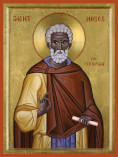 An Ethiopian, he was at first a robber and the leader of
a robber band, but he then became a penitent and a great ascetic. As a slave, Moses escaped from
his owner and became a robber. Because of his great physical strength and recklessness, the
robbers chose him as their leader. Suddenly his conscience was filled with remorse and repentance
for the crimes he had committed. He left the band, went to a monastery and gave himself entirely
to obedience to his spiritual father and to the rule of the monastery. He made great use of the
teaching of Saints Makarios, Arsenius and Isidore. Later, he withdrew to solitude in a cell,
where he gave himself utterly to physical labor, prayer, vigils—and pondering on God. Tormented
by the demon of lust, he confessed to his spiritual father, Isidore, and received from him the
advice to fast as much as possible, and never to eat his fill. When this proved to be of no help,
he, at the elder’s advice, began to keep night-vigils and to pray standing; he then got
into the way of carrying water from a distant well for the older monks. After six years of
terrible striving, St. Isidore finally healed him miraculously of the lustful thoughts,
imaginings and dreams visited on him by the demon. He was ordained priest in old age. He founded
a monastery of his own, and had seventy-five disciples, himself living to the age of
seventy-five. He foresaw his own death, and one day told his disciples to flee, as barbarians
were coming to attack the monastery. When his disciples urged him to flee as well, he told them
that he must perish in the attack, for he had himself at one time done violence, according to the
words: ‘All they that take the sword shall perish with the sword’ (Matt. 26:52). So
he stayed, with six of his brethren. The barbarians came and ran them through. One of the
brethren, hiding nearby, saw seven shining wreaths descend upon the seven martyrs.
2. Our Holy Father Sava of Pskov and Krypetsk.
A Serb by birth, he lived first in asceticism in the monastery of the holy Mother of God in Pskov, and was abbot of that monastery. But he was praised, so he fled from the glory of men and withdrew to an island in the lake of Krypetsk, where he founded a new community dedicated to St. John the Theologian. However, he was not able there, either, to hide from praise and eminence. Prince Yaroslav of Pskov visited him with his wife. Sava would not allow the woman to enter the monastery, but blessed her and prayed for her outside it, healing her of an infirmity. This godly saint entered into rest in 1495, and his relics had wonder-working power. Of those he received at Krypetsk, Abbot Dositheus is the best-known.
FOR CONSIDERATION
True Christians flee the praise of men. They not only flee it; they have a real fear of it. St. Sava of Pskov left his abbacy, the monastery and the good brethren in it, and went to a barren region, only to escape the praise of men. For the praise of men steals our hearts. A devout prince, hearing of the ascetic feats of St. Moses the Black, set off to the desert with his retinue to see him. Moses was informed that the prince was coming to his monastery. He ran out quickly, to escape and hide somewhere, but unexpectedly came on the noble visitors. ‘Where is Abba Moses’ cell?’ asked the prince’s servant, not suspecting that this was Moses himself. Moses opened his mouth and said: ‘What can he do for you? He is a foolish man, given to lying, and of unclean life.’ The visitors were amazed at these words, and went on their way. When they arrived at Moses’ cell, they asked for the elder and were told that he was not there. The visitors then related what a monk had told them on the way about Moses. The monks were greatly saddened, then asked: ‘What was he like, this old man who spoke such scurrilous words about the holy man?’ When they said that he was very dark-skinned, tall and poorly-clad, the monks exclaimed aloud: ‘That was Abba Moses!’ This incident was of great spiritual help to the prince, and he went home rejoicing.
Daily Scripture Readings taken from The Orthodox New Testament, translated and published by Holy Apostles Convent, Buena Vista, Colorado, copyright © 2000, used with permission, all rights reserved.
Daily Prologue Readings taken from The Prologue of Ochrid, by Bishop Nikolai Velimirovic, translated by Mother Maria, published by Lazarica Press, Birmingham, England, copyright © 1985, all rights reserved. Edited by Dormition Skete.