

Daily Devotional
Thursday, September 1, 2016 (NS), August 19, 2016 (OS)
No Fasting.
Thursday of the Eleventh Week
The commemoration of the Afterfeast of the Dormition, and the holy Martyr Andrew the General and the 2,593 martyrs with him.
Scripture Readings
Paschalion — Movable Calendar
Thursday of the Eleventh Week
Epistle
The Reading is from the Second Epistle of Saint Paul to the Corinthians [§ 175]. Brethren:
For Gk. usage, see 2 Cor. 4:1-12; for Sl. usage, see 2 Cor. 4:1-6.
4 1Having this ministry, even as we received mercy, we are not fainthearted, 2but we renounced the hidden things of shame, not walking in craftiness, nor adulterating the word of God, but by manifestation of the truth commending ourselves to every conscience of men before the face of God. 3But even if our Gospel is being veiled, it is hidden in those perishing, 4in whom the God of this age blinded the minds of the unbelieving, so that the illumination of the Gospel of the glory of the Christ, Who is the image of God, should not dawn on them. 5For we do not proclaim ourselves, but Christ Jesus as Lord, and ourselves your slaves for Jesus’ sake. 6Because it is God Who said, “Let there be light [cf. Gen. 1:3]” to shine out of darkness, Who shined in our hearts, for the illumination of the knowledge of the glory of God in the face of Jesus Christ.
7But we have this treasure in earthen vessels, that the preeminence of the power may be of God, and not from us. 8In every way we are afflicted, but not straitened; we are at a loss, but not utterly at a loss; 9persecuted, but not abandoned; cast down, but not destroyed— 10always bearing about in the body the dying of the Lord Jesus, that the life also of Jesus might be made manifest in our body. 11For we, the living, are always being delivered to death on account of Jesus, that also the life of Jesus might be made manifest in our mortal flesh. 12So that indeed death energizeth itself in us, but life in you.
Gospel
The Reading is from the Holy Gospel according to Saint Matthew [§ 99]. The Lord said to His disciples:
24 13“The one who endureth to the end, this one shall be saved. 14“And this Gospel of the kingdom shall be proclaimed in all the inhabited world, for a testimony to all the nations; and then shall the end come. 15“Whenever ye therefore see ‘the abomination of the desolation [cf. Dan. 9:27, 12:11],’ which was spoken of by Daniel the prophet, standing in the holy place”—the one who readeth, let him understand— 16“then let those in Judæa flee to the mountains. 17“The one on the housetop, let him not come down to take away anything out of his house. 18“And the one in the field, let him not return back to take up his clothes. 19“And woe to those who are with child and to those who give suck in those days. 20“But be praying that your flight might not take place in winter, neither on a sabbath. 21“For then there shall be great affliction, such as hath not been from the beginning of the world until the present, no, nor ever shall be. 22“And if those days were not shortened, no flesh would be saved; but for the elect’s sake those days shall be shortened. 23“Then if anyone should say to you, ‘Behold, here is the Christ,’ or ‘Here,’ do not begin to believe it. 24“For false christs and false prophets shall be raised up, and they shall produce great signs and wonders, so as to lead astray, if possible, even the elect. 25“Behold, I have told you beforehand. 26“If then they should say to you, ‘Behold, He is in the desert,’ do not begin to go forth; ‘Behold, He is in the secret chambers,’ do not begin to believe it. 27“For even as the lightning cometh forth from the east and appeareth as far as the west, so also shall be the coming of the Son of Man. 28“For wheresoever the corpse may be, there will the eagles be gathered together.”
Menaion — Fixed Calendar
The commemoration of the Afterfeast of the Dormition, and the holy Martyr Andrew the General and the 2,593 martyrs with him.
Epistle
The Reading is from the Epistle of Saint Paul to the Ephesians [§ 233].
6 10Brethren, keep on being empowered in the Lord and in the strength of His might. 11Put on the full armor of God, for you to be able to stand against the wiles of the devil; 12because for us the wrestling is not against blood and flesh, but against the principalities, against the powers, against the cosmic rulers of the darkness of this age, against spiritual hosts of evil on account of the heavenly things. 13For this cause take up the full armor of God, in order that ye might be able to withstand in the evil day, and having counteracted all things, to stand. 14Stand therefore, having girt your loins with truth, and having put on for yourselves the breastplate of righteousness, 15and having shod your feet in readiness of the Gospel of peace; 16on the whole, take up the shield of faith, with which ye shall be able to quench all the fiery darts of the evil one. 17And take the helmet of salvation, and the sword of the Spirit, which is the word of God.
Gospel
The Reading is from the Holy Gospel according to Saint Luke [§ 106]. The Lord said to His disciples, “Be taking heed of men:
21 12“For they shall lay their hands upon you and persecute you, delivering you up to synagogues and prisons, bringing you before kings and governors on account of My name; 13“but it shall prove to be a testimony for you. 14“Therefore settle it for yourselves in your hearts not to premeditate to make a defense; 15“for I will give you a mouth and wisdom, which all those who oppose you shall not be able to contradict nor withstand. 16“And ye shall be delivered up also by parents, and kinfolk, and friends, and brethren; and they shall put some of you to death. 17“And ye shall be hated by all for My name’s sake. 18“But a hair of your head in no wise shall perish. 19“In your patience win your souls.”
Lives of the Saints (Prologue)
September 1st – Civil Calendar
August 19th – Church Calendar
1. The Holy Martyr Andrew Stratelates.
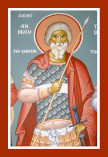 He was an officer, a tribune,
in the Roman army in the time of the Emperor Maximian. A Syrian by birth, he served in his native
land. When the Persians attacked the imperial Roman army, this Andrew was entrusted with the
command in the battle against the enemy whence his title: commander, stratelates. A secret
Christian, although as yet unbaptized, Andrew commended himself to the living God, and taking
only the cream of the army, went to war. Before the battle, he told his soldiers that, if they
all called upon the aid of the one true God, Christ the Lord, their enemies would become as dust
scattered before them. All the soldiers, fired with enthusiasm by Andrew and his faith, invoked
Christ’s aid and attacked. The Persian army was utterly routed. When the victorious Andrew
returned to Antioch, some jealous men denounced him as a Christian and the imperial governor
summoned him for trial. Andrew openly proclaimed his steadfast faith in Christ. After harsh
torture, the governor threw Andrew into prison and wrote to the emperor in Rome. Knowing
Andrew’s popularity among the people and in the army, the emperor ordered the governor to
set Andrew free, but to seek another occasion and another excuse (not his faith) to kill him. By
God’s revelation, Andrew came to know of this imperial command, and taking his faithful
soldiers (2,593 in all) with him, went off to Tarsus in Cilicia, where they were all baptized by
the bishop, Peter. Persecuted here also by imperial might, Andrew and his companions withdrew
deep into the Armenian mountain of Tavros. There in a ravine, while they were at prayer, the
Roman army came upon them and beheaded them all. Not one of them would recant, all being
determined on death by martyrdom for Christ. On the spot where a stream of the martyrs’
blood flowed down, a spring of healing water sprang forth, healing from every disease. The
bishop, Peter, came secretly with his people and buried the martyrs’ bodies in that same
place. They all suffered with honor at the end of the third century and were crowned with wreaths
of eternal glory, entering into the kingdom of Christ our God.
2. Our Holy Father Theophanes.
Born in Ioannina, he left everything as a young man and went to the Holy Mountain, where he became a monk in the monastery of Docheiariou. In fasting, prayer, vigils and the stripping away of all that was unnecessary, he stood out among all the monks, and was consequently chosen in due time as abbot. Later, through some disagreement with the monks, he left the Holy Mountain, and with his nephew, went to Berea in Macedonia, where he founded a monastery dedicated to the most holy Mother of God. When this monastery began to flower with the spiritual life, he left his nephew in charge and went to Naousa, where he founded another monastery, in honor of the Holy Archangels. He died peacefully some time in the fifteenth century. His wonder-working relics rest today in Naousa, and reveal God’s great power.
3. The Holy Martyrs Timothy, Agapius and Thekla.
They suffered for Christ in the time of the wicked Emperor Diocletian. Timothy was burned by fire, and Agapius and Thekla thrown to the wild beasts.
FOR CONSIDERATION
When some unexpected trouble falls upon us guiltless, we should not immediately bemoan the fact, but seek God’s providence in it, which can, through this trouble, bring us something new and helpful. The great Theophanes, abbot of Docheiariou, one day received the shocking news that the Turks had seized his sister’s son, forced him to embrace Islam and then taken him to Constantinople. Theophanes immediately went himself to Constantinople and succeeded, with God’s help, in locating his nephew and taking him secretly to his monastery on the Holy Mountain. There, he brought him back to the Christian Faith and made him a monk. But the brethren grumbled against their abbot and his nephew, from fear of the Turks, for they were afraid that the Turks would hear of it and would come and destroy the monastery. Not knowing what else to do, St. Theophanes took his nephew and withdrew secretly, not only from Docheiariou but from the Holy Mountain, and went to Berea. The later activities of Theophanes in Berea and Naousa prove how useful misfortune can be to the Church. That which Theophanes would never have achieved on the Holy Mountain, he achieved in these other places to which he had fled: he founded two monasteries in which, in due time, many monks found salvation and many people were upheld. Also, added to this, his holy relics among the people became a source of healing, for the strengthening of the Faith in unbelievers and in those of little faith. Thus God, in His wisdom, guides the destinies of men through unexpected ills, which seem to men at the time to be for their loss.
Daily Scripture Readings taken from The Orthodox New Testament, translated and published by Holy Apostles Convent, Buena Vista, Colorado, copyright © 2000, used with permission, all rights reserved.
Daily Prologue Readings taken from The Prologue of Ochrid, by Bishop Nikolai Velimirovic, translated by Mother Maria, published by Lazarica Press, Birmingham, England, copyright © 1985, all rights reserved. Edited by Dormition Skete.