

Daily Devotional
Friday, August 12, 2016 (NS), July 30, 2016 (OS)
Fast Day. No Meat, Fish, Dairy, Eggs, Alcohol or Olive Oil Allowed.
Friday of the Eighth Week
The commemoration of the holy Apostles Silas, Silouanos, Crescens, Epanetos, and Andronikos of the Seventy, and the holy Martyr John the soldier at Constantinople.
Scripture Readings
Paschalion — Movable Calendar
Friday of the Eighth Week
Epistle
The Reading is from the First Epistle of Saint Paul to the Corinthians [§ 148]. Brethren:
11 8Man is not of woman, but woman of man. 9For also man was not created on account of the woman, but woman on account of the man. 10For this cause ought the woman to have authority on the head on account of the angels. 11However neither is man without woman, nor woman without man in the Lord. 12For as the woman is of the man, so also the man is by the woman; but all things of God. 13Judge in yourselves: Is it becoming for a woman to be praying to God uncovered? 14Or doth not nature herself teach you that on the one hand if a man should have long hair, it is a dishonor to him, 15but on the other hand if a woman should have long hair, it is to her glory? For the long hair hath been given to her for a covering. 16But if anyone think to be contentious, we have no such custom, nor the churches of God.
17Now giving this order, I praise ye not, that ye come together not for the better, but for the worse. 18For indeed, first, when ye come together in the church, I hear that there be schisms among you, and in part I believe it. 19For there must be also heresies among you, that the approved might become manifest among you. 20When ye come together therefore in one place, it is not to eat a Lord’s Supper. 21For in eating each one taketh before others his own supper; and one is hungry, and another is drunk. 22Have ye not houses in order to eat and to drink? Or do ye despise the Church of God, and put to shame those who have not? What shall I say to you? Shall I praise you in this? I praise you not. 23For I received from the Lord that which I also delivered to you.
Gospel
The Reading is from the Holy Gospel according to Saint Matthew [§ 71]. At that time:
17 10The disciples of Jesus asked Him, saying, “Why then do the scribes say that it is necessary for Elias to come first?” 11And Jesus answered and said to them, “Elias indeed cometh first and shall restore all things. 12“But I say to you that Elias already came, and they did not recognize him, but did to him as much as they wished. Thus also the Son of Man is about to suffer under them.” 13Then the disciples comprehended that He spoke to them concerning John the Baptist.
14And after they came to the crowd, there came to Him a man, kneeling down to Him and saying, 15“Lord, have mercy on my son, for he is a lunatic, and suffereth badly; for often he falleth into the fire, and often into the water. 16“And I brought him to Thy disciples, and they were not able to cure him.” 17And Jesus answered and said, “O unbelieving and wayward generation, until when shall I be with you? Until when shall I bear with you? Bring him here to Me.” 18And Jesus rebuked it, and the demon came out from him; and the boy was cured from that hour.
Menaion — Fixed Calendar
The commemoration of the holy Apostles Silas, Silouanos, Crescens, Epanetos, and Andronikos of the Seventy, and the holy Martyr John the soldier at Constantinople.
Epistle
For the Martyr:
The Reading is from the Epistle of Saint Paul to the Romans [§ 88]. Brethren:
5 1Therefore, having been justified by faith, let us have peace with God through our Lord Jesus Christ, 2through Whom also we have had access by faith into this grace in which we stand, and we boast in hope of the glory of God. 3And not only so, but we boast in afflictions also, knowing that the affliction worketh out patience; 4and patience, a tested character; and a tested character, hope. 5And the hope doth not put to shame, for the love of God hath been poured out in our hearts through the Holy Spirit Who was given to us. 6For when we were yet without strength, in due time Christ died for the ungodly. 7For scarcely for a righteous man will one die, yet perhaps for a good man someone would even dare to die. 8But God commendeth His own love to us, in that while we were yet sinners, Christ died for us. 9Much more then, having now been justified by His blood, we shall be saved from wrath through Him. 10For if, when we were enemies, we were reconciled to God through the death of His Son, much more, having been reconciled, we shall be saved by His life.
Gospel
The Reading is from the Holy Gospel according to Saint Luke [§ 36]. The Lord said:
8 16“No one, having lit a lamp, covereth it with a vessel or putteth it underneath a bed, but placeth it upon a lampstand, that they who enter in may see the light. 17“For nothing is secret which shall not become manifest, nor hidden that shall not be known and come to light. 18“Be taking heed then how ye hear: for whosoever hath, it shall be given to him; and whosoever hath not, even what he seemeth to have shall be taken away from him.”
19And His Mother and brethren came to Him, and were not able to meet with Him on account of the crowd. 20And it was reported to Him by some who said, “Thy Mother and Thy brethren are standing outside, wishing to see Thee.” 21And He answered and said to them, “My mother and My brethren are these who hear the word of God and do it.”
for Sl. usage, see [Mt. 16:24-28].
Lives of the Saints (Prologue)
August 12th – Civil Calendar
July 30th – Church Calendar
1. The Holy Apostles Silas, Silvanus, Crescens, Epaenetus and Andronicus.
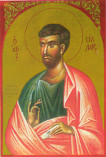
 These are all among the
Seventy. St. Silas was sent from Jerusalem to Antioch with Paul and Barnabas, to settle a quarrel
among the faithful concerning circumcision: namely, whether or not it was necessary to circumcise
pagans who had embraced Christianity (Acts 15:22). After that, Silas travelled with Paul around
Asia and Macedonia, and was installed as Bishop of Corinth, where he died peacefully. Silvanus
helped the two greatest apostles (I Pet. 5:12; II Cor. 1:19). As bishop in Thessalonica, he
labored much and suffered much, until he exchanged the earthly life for the heavenly. Crescens
was a fellow-worker with the Apostle Paul (II Tim. 4:10), and then bishop in Galatia and a
missionary in Gaul, where he died a martyr for Christ under Trajan. St. Epaenetus is mentioned by
the Apostle Paul (Rom. 16:5), and became Bishop of Carthage. Andronicus (Rom. 16:7), Bishop of
Pannonia, is also commemorated separately on May 17th.
2. The Hieromartyr Valentine.
He was bishop in the Italian town of Interamna. He healed the brother of the Roman tribune Frontanus of an illness. When Cherimon, the son of the eminent philosopher Craton, fell ill, Craton, at Frontanus’ advice, asked Bishop Valentine to come to Rome. Cherimon was all cramped-up, so that his head was caught between his knees. Valentine shut himself in the room with the sick boy and spent the whole night in prayer. The following day, he brought Cherimon out in full health, and gave him to his father. Then Craton was baptized, with his whole household and those of his pupils. Cherimon left his father’s house and went with Valentine. Then Abundius, son of the Roman eparch, was baptized. Infuriated by this, the eparch took Valentine, and after torturing him, had him beheaded. Three pupils of Craton: Proclus, Abibus and Apollonius, were beheaded at the same time. Abundius took their bodies and buried them. They all suffered in 273, and became citizens of the heavenly kingdom.
3. The Hieromartyr Polychronius, Bishop of Babylon.
When the Emperor Decius conquered Babylon, he arrested Polychronius, together with three priests, two deacons and two baptized princes, Eudin and Senis. Polychronius would make no reply before the emperor, but kept silent, while St. Parmenius, one of the priests, spoke for them all. The emperor took the bishop and priests to Persia, to the city of Kordoba, and had them beheaded with an axe, but he took the princes with him to Rome, threw them first to the wild beasts and then had them slain with the sword. They all suffered with honor in 251.
4. St. John the Soldier.
He was a secret Christian. Sent by Julian the Apostate to slaughter Christians, he did not kill them but helped them to hide. Julian had him thrown into prison in Constantinople. When the wicked emperor perished, John gave himself to the ascetic life, living with purity and holiness. He entered peacefully into rest in old age. After his death, he appeared to various people who needed his help. His prayers are of aid in the tracking-down of thieves.
5. Our Holy Mother Angelina.
Wife of a Serbian despot, her relics lie in the monastery of Krušedol.
FOR CONSIDERATION
It is necessary to distinguish between the sinner and the penitent. If you have taken on yourself the role of denouncing a sinner, take good care that you do not denounce a penitent. How dear a repentant sinner is to God is seen in the story of the Prodigal Son. So you also must hold dear him who has become dear to God.
It happened at one time that a monk fell into sin, because of which he was driven out of his monastery. This monk went to St. Anthony, confessed his sin, repented and stayed some time with him. Then St. Anthony sent him back to his monastery, but they would not receive him there and drove him out again. The penitent went again to St. Anthony. St. Anthony sent him back again to the monastery with the following message to the fathers: ‘A ship suffered shipwreck and lost its cargo. Only with great difficulty did it get to the harbor and you want to drown that which has been saved from drowning!’ Hearing this wise message, the fathers received their repentant brother into the monastery with joy.
Daily Scripture Readings taken from The Orthodox New Testament, translated and published by Holy Apostles Convent, Buena Vista, Colorado, copyright © 2000, used with permission, all rights reserved.
Daily Prologue Readings taken from The Prologue of Ochrid, by Bishop Nikolai Velimirovic, translated by Mother Maria, published by Lazarica Press, Birmingham, England, copyright © 1985, all rights reserved. Edited by Dormition Skete.