

Daily Devotional
Friday, July 29, 2016 (NS), July 16, 2016 (OS)
Fast Day. No Meat, Fish, Dairy, Eggs, Alcohol or Olive Oil Allowed.
Friday of the Sixth Week
The commemoration of Hieromartyr Athenogenes, Bishop of Pedachtoe, and his ten disciples.
Scripture Readings
Paschalion — Movable Calendar
Friday of the Sixth Week
Epistle
The Reading is from the First Epistle of Saint Paul to the Corinthians [§ mid 130]. Brethren:
4 5Cease judging anything before the time, until the Lord should come, Who both will bring to light the hidden things of darkness and make manifest the counsels of the hearts; and then to each one there shall be the praise from God.
6And these things, brethren, I transferred in a figure to myself and to Apollos for your sakes, that ye might learn in us not to think above what hath been written, that not one of you be puffed up one against the other. 7For who maketh thee to differ? And what hast thou that thou didst not receive? Now if thou didst receive, why boastest thou as if thou didst not receive? 8Already ye are filled; already ye became enriched. Ye did come to reign without us—and would that ye indeed did come to reign, that we also might reign with you.
Gospel
The Reading is from the Holy Gospel according to Saint Matthew [§ 55]. The Lord said this parable:
13 44“The kingdom of the heavens is like treasure which hath been hidden in the field, which, after a man found, he hid; and for the joy of it, he goeth and selleth all things, as much as he hath, and buyeth that field. 45“Again, the kingdom of the heavens is like a man, a merchant, seeking beautiful pearls, 46“who, after he found one very precious pearl, went away and sold all things, as much as he had, and bought it. 47“Again the kingdom of the heavens is like a dragnet which was cast into the sea and brought together of every kind, 48“which, when it was full, they drew up on the shore; and they sat down and gathered together the good into vessels, but the rotten they cast out. 49“Thus shall it be in the consummation of the age: the angels shall go forth, and shall separate the evil from the midst of the righteous, 50“and shall cast them into the furnace of the fire. There shall be there the weeping and the gnashing of the teeth.” 51Jesus saith to them, “Did ye understand all these things?” They say to Him, “Yes, Lord.” 52And He said to them, “On this account every scribe who was instructed into the kingdom of the heavens is like a man that is a master of a house, who putteth forth out of his treasure things new and old.”
53And it came to pass, when Jesus finished these parables, He departed from that place. 54And after He came into His own country, He was teaching them in their synagogue.
Menaion — Fixed Calendar
The commemoration of Hieromartyr Athenogenes, Bishop of Pedachtoe, and his ten disciples.
No readings given.
Lives of the Saints (Prologue)
July 29th – Civil Calendar
July 16th – Church Calendar
1. The Hieromartyr Athenogenes, Bishop of Sebaste in Armenia.
He lived in a monastery near the town with ten of his disciples. In the time of Diocletian, a fierce persecutor of Christians called Philomarchus came to Sebaste. He arrested and killed many of the Christians in the town. When he saw Athenogenes and his disciples, he told the elder to sacrifice to idols, that they should not perish as had the other Christians. Athenogenes replied: ‘O torturer, those whom you describe as having perished have not perished, but are in heaven and make merry with the angels!’ There was a touching moment when a deer, which had been hand-fed by the compassionate Athenogenes, ran up to him, and seeing him in such straits, shed tears. Wild animals of the hills had more pity on the martyrs than did the pagans! After harsh torture, during which an angel of God comforted them, they were all beheaded, first the priests and fellow-workers of Athenogenes and then Athenogenes himself, and went to their heavenly home in the year 311.
2. The Holy Martyr Julia the Virgin.
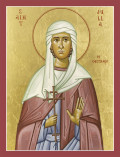 She was born in Carthage of noble parents. When the
Persians overran Carthage, many of the people were taken into slavery. St. Julia was one of
these, and was given to a Syrian merchant, who was a pagan. Seeing that Julia was a Christian, he
urged her many times to deny Christ and become of one faith with him, but Julia steadfastly
refused. As Julia was faithful and reliable in her work, the merchant left her in peace and spoke
no more about faith. One day, the merchant loaded his ship with goods, took Julia with him and
set off across the sea to a distant land to ply his trade. When they arrived at Corsica, there
was a pagan festival in progress, and the merchant took part in the foul idolatry while Julia
remained in the ship, weeping that so many people lived in foolish error, not knowing the truth.
The pagans somehow came to know about her, dragged her off the ship in spite of her owner’s
efforts to prevent them, and began to torture her in terrible ways. They cut off her breasts and
threw her onto the rock, then crucified her, at which Julia gave her soul to God. Her death was
revealed to some monks on the nearby island of Margarita (or Gorgona), and they went and buried
the martyr’s body. Many miracles were worked over St. Julia’s grave through the ages,
and she herself appeared to various people from the other world. She suffered with honor and went
to the kingdom of God in the sixth century.
After many years had passed, the faithful wanted to build a new church in honor of St. Julia in another place, because the old church was small and dilapidated. They prepared the materials: the stone, bricks, sand and everything else that was needed, on the new site. But it happened that, at night, on the night before the day on which the foundations were to be laid, that the materials were carried by invisible hands back to the old church. In great perplexity, the people carried them to the new site again, but again the same thing happened: the materials were taken to the old site and left beside the church. The night watchman saw a maiden bathed in light, using white oxen to carry the materials to the old church. By this, they understood that St. Julia did not wish her church to be built in another place, so they pulled down the old church and built the new one on the same spot.
3. The Fifteen Thousand Holy Martyrs of Persia.
They were beheaded for the Christian Faith in Persia.
4. The Holy Martyr Athenogenes.
The composer of the Vespers hymn ‘O Joyous Light,’ he perished for Christ in the flames and was made worthy of eternal glory in the kingdom of God.
Daily Scripture Readings taken from The Orthodox New Testament, translated and published by Holy Apostles Convent, Buena Vista, Colorado, copyright © 2000, used with permission, all rights reserved.
Daily Prologue Readings taken from The Prologue of Ochrid, by Bishop Nikolai Velimirovic, translated by Mother Maria, published by Lazarica Press, Birmingham, England, copyright © 1985, all rights reserved. Edited by Dormition Skete.