

Daily Devotional
Thursday, July 14, 2016 (NS), July 1, 2016 (OS)
No Fasting.
Thursday of the Fourth Week
The commemoration of the holy Wonder-workers and Unmercenaries Kosmas and Damian who were martyred at Rome.
Scripture Readings
Paschalion — Movable Calendar
Thursday of the Fourth Week
Epistle
The Reading is from the Epistle of Saint Paul to the Romans [§ 106]. Brethren:
11 13I speak to you, the nations. Inasmuch as I am indeed an apostle of the nations, I glorify my ministry, 14if by any means I might provoke to jealousy my flesh and might save some of them. 15For if the casting away of them is the reconciliation of the world, what shall the receiving of them be if not life from the dead? 16Now if the firstfruits be holy, the lump is also holy; and if the root is holy, so are the branches. 17And if some of the branches were broken off, and thou, being a wild olive tree, were grafted in among them, and became a partaker of the root and fatness of the olive tree, 18cease boasting against the branches. But if thou boast against them, thou bearest not the root, but the root thee. 19Thou wilt say then, “The branches were broken off that I might be grafted in.” 20Well; by unbelief they were broken off, and thou standest by faith. Cease being high-minded, but be afraid. 21For if God spared not the natural branches, take heed lest perchance He should not spare thee either. 22Behold then the kindness and severity of God: upon those that fell, severity; but upon thee, kindness, if thou continue in the kindness. Otherwise thou also shalt be cut off. 23And they also, if they continue not in unbelief, shall be grafted in; for God is able to graft them in again. 24For if thou wert cut out of the olive tree which is wild according to nature, and were grafted contrary to nature into a good olive tree, how much more shall these, which are natural branches, be grafted into their own olive tree?
Gospel
The Reading is from the Holy Gospel according to Saint Matthew [§ 43]. The Lord said to His disciples:
11 27“All things were delivered to Me by My Father. And no one doth fully know the Son, except the Father; nor doth anyone fully know the Father, except the Son, and he to whomsoever the Son is willing to reveal Him. 28“Come to Me, all ye who labor and are burdened, and I will give you rest. 29“Take up My yoke upon you and learn from Me, for I am meek and humble in heart; and ye shall find rest to your souls. 30“For My yoke is good and My burden is light.”
Menaion — Fixed Calendar
The commemoration of the holy Wonder-workers and Unmercenaries Kosmas and Damian who were martyred at Rome.
Epistle
The Reading is from the First Epistle of Saint Paul to the Corinthians [§ 153]. Brethren:
12 27Ye are the body of Christ, and members severally.
28And God set for Himself some in the Church: first apostles, second prophets, third teachers, then works of power, then free gifts of healings, helps, governments, kinds of tongues. 29All are not apostles, are they? All are not prophets, are they? All are not teachers, are they? All do not have works of power, do they? 30All do not have free gifts of healings, do they? All do not speak with tongues, do they? 31All do not interpret, do they? But keep on desiring earnestly the better gifts of grace. And yet I show you a more surpassing way.
13 1If I speak with the tongues of men and of angels, but I have not love, I have become as sounding brass or a clanging cymbal. 2And if I have prophecy, and know all the mysteries and all the knowledge, and if I have all the faith, so as to remove mountains from one place to another, but I have not love, I am nothing. 3And if I dole out all of my goods, and if I deliver up my body that I may be burned, but I have not love, I am being profited nothing. 4Love is long-suffering, is kind; love is not jealous; love vaunteth not itself, is not puffed up; 5doth not behave unseemly, seeketh not its own, is not provoked, thinketh no evil; 6rejoiceth not in unrighteousness, but rejoiceth with the truth; 7covereth all things, believeth all things, hopeth all things, endureth all things. 8Love never falleth away.
Gospel
The Reading is from the Holy Gospel according to Saint Matthew [§ mid 34]. At that time:
10 1After Jesus called to Himself His twelve disciples, He gave to them authority over unclean spirits, so as to cast them out, and to cure every disease and every weakness.... 5These twelve Jesus sent forth, and commanded them, saying, “Do not begin to go into the way of the nations, and do not begin to enter into a city of the Samaritans. 6“But go rather to the sheep, the lost of the house of Israel. 7“And as ye go, be preaching, saying, ‘The kingdom of the heavens hath drawn near.’ 8“Be healing the sick, cleansing lepers, raising the dead, casting out demons; freely ye received, freely give.”
Lives of the Saints (Prologue)
July 14th – Civil Calendar
July 1st – Church Calendar
1. The Holy Martyrs Cosmas and Damian.
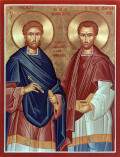 Unmercenary doctors and wonder-workers, these two
saints were brothers. Born in Rome, baptized as children and given a Christian education, they
were endowed by God with the gift of healing, generally by the laying-on of their hands, of both
men and animals. They sought no reward for their work, only urging the sick to faith in Christ
the Lord. Inheriting great wealth, they compassionately divided it among the poor and needy. The
Emperor Galerius was on the throne in Rome at that time. Persecutors of the Christian Faith
brought these two holy brothers, bound in chains, before him. After prolonged interrogation, the
emperor charged them to deny Christ and offer sacrifice to idols. Cosmas and Damian not only
refused to obey the Emperor; they urged him to forsake dead idols and come to the knowledge of
the one, true God. ‘Our God is not created, but is the Creator of all, and your gods come
of the imaginings of men and the hands of artists. If there were no artists to make your gods,
you would have nothing to worship.’ After a miracle was performed on the emperor
himself—healing him of a grave infirmity—the emperor declared his faith in Christ and let the
holy brothers go in peace. They continued to glorify Christ our God and to heal the sick, and
were themselves glorified on all sides by the people. A doctor, a former teacher of theirs,
envying their fame, lured them into the hills on the pretext of collecting herbs and stoned them
to death. They suffered with honor for the Christian Faith in 284. Their memory endures in the
Church on earth, and their souls went to the kingdom of the Lord, to live eternally in glory and
joy.
2. Our Holy Father Peter the Patrician.
This saint was a nobleman of Constantinople and a military commander in the time of the Emperor Nikephoros I (802-811). In a war against Bulgaria, the emperor was killed and Peter, together with fifty other Greek generals and princes, was captured and cast into prison. He was miraculously delivered from prison by St. John the Theologian. He then forsook all worldly glory, left his wife and son and withdrew to Mount Olympus, where, as a monk and a disciple of St. Ioannikios the Great, he lived in monasticism for thirty-four years. After the deaths of his wife and son, he settled in Constantinople, where he spent eight further years in fasting and prayer and entered into rest in the Lord in 865, at the age of seventy-seven.
3. The Holy Martyr Potitus.
A thirteen-year-old youth from Sardinia, he endured many trials for the sake of Christ, both from his father and from the official persecutors of Christianity. Potitus was beheaded in the time of the Emperor Antoninus (138-161), after healing and baptising the emperor’s daughter, Agnes.
FOR CONSIDERATION
Christians affirm the link between this world and the next in their prayers and alms for the dead. The Church in this world and the next is one Church, one body, one being; as the root of a tree beneath the earth is one organism with its trunk and branches above the earth. From this it is clear how we, being part of the Church on earth, can receive help from the saints in the Church in heaven, and that departed sinners can, in the other world, receive help from us on earth. St. Athanasius says, ‘As with wine inside a barrel, which, when the vineyard flowers, senses it and flowers together with it, so it is with the souls of sinners. They receive some release from the bloodless Sacrifice, offered for them in charity,’ wrought for the sake of their peace. St. Ephraim the Syrian uses the same example of wine and vineyard, then concludes: ‘And thus, when there exists such mutual sensitivity even among plants, do not the departed feel yet more keenly the prayers and sacrifices made for them?’
Daily Scripture Readings taken from The Orthodox New Testament, translated and published by Holy Apostles Convent, Buena Vista, Colorado, copyright © 2000, used with permission, all rights reserved.
Daily Prologue Readings taken from The Prologue of Ochrid, by Bishop Nikolai Velimirovic, translated by Mother Maria, published by Lazarica Press, Birmingham, England, copyright © 1985, all rights reserved. Edited by Dormition Skete.