

Daily Devotional
Sunday, July 3, 2016 (NS), June 20, 2016 (OS)
Fast Day, but Fish, Wine and Olive Oil Allowed.
Sunday of the Second Week
Mode One — Second Eothinon
The commemoration of Hieromartyr Methodios, Bishop of Patara.
Scripture Readings
Paschalion — Movable Calendar
Sunday of the Second Week
Mode One — Second Eothinon
Epistle
For the Second Sunday
The Reading is from the Epistle of Saint Paul to the Romans [§ mid 81]. Brethren:
2 10Glory and honor and peace to everyone who worketh good, both to the Jew first and also to the Greek. 11For there is no respect of persons with God. 12For as many as did sin without law shall also perish without law; and as many as did sin in the law shall be judged by the law. 13For not the hearers of the law are just before God, but the doers of the law shall be justified. 14For whenever the Gentiles, who have not the law, do by nature the things of the law, these, who have not the law, are a law to themselves, 15who show the work of the law written in their hearts, their conscience also bearing witness, and their thoughts one with another accusing or also excusing, 16in the day when God shall judge the secrets of men through Jesus Christ, according to my Gospel.
For All Saints of Russia
The Reading is from the Epistle of Saint Paul to the Hebrews [§§ 330, 331]. Brethren:
11 33All the saints through faith struggled against kingdoms, wrought righteousness, attained to promises, stopped mouths of lions, 34quenched the power of fire, escaped the edges of the sword, were empowered out of weakness, became strong in battle, turned back encampments of aliens. 35Women received their dead by resurrection. And others were tortured, not accepting release, that they might attain a better resurrection. 36And others received trial of mockings and of scourgings, and, moreover, of bonds and of imprisonment. 37They were stoned, they were sawn asunder, were tempted; they died, murdered by the sword. They went about in sheepskins, in goatskins, being in need, afflicted, ill-treated— 38of whom the world was not worthy. They were made to wander in deserts, and in mountains, and in caves, and in the holes of the earth. 39And these all, having been approved by testimony through faith, received not for themselves the promise, 40God having foreseen some better thing concerning us, that they should not be made perfect without us.
12 1Therefore we also, having so great a cloud of witnesses which is set around us, and having laid aside every weight and sin that is easily circumvented, let us by means of patience be running the course which is set before us, 2looking to Jesus, the originator and accomplisher of our faith, Who, in exchange for the joy set before Him, endured a cross, having despised the shame, and hath sat down on the right of the throne of God.
For All Saints of the Holy Mountain Athos
The Reading is from the Epistle of Saint Paul to the Galatians [§ 213]. Brethren:
5 22The fruit of the Spirit is love, joy, peace, long-suffering, kindness, goodness, faith, 23meekness, self-control; against such things there is no law. 24But they who are of the Christ crucified the flesh with the passions and the lusts. 25If we live by the Spirit, let us also be walking by the Spirit. 26Let us not become vainglorious, provoking one another, envying one another.
6 1Brethren, even if a man should be overtaken in some transgression, ye, the spiritual ones, be restoring such a one in the spirit of meekness, looking out for thyself, lest thou also be tempted. 2Keep on bearing one another’s burdens, and thus fill up the law of the Christ.
Gospel
For the Second Sunday
The Reading is from the Holy Gospel according to Saint Matthew [§ 9]. At that time:
4 18As Jesus walked by the Sea of Galilee, He saw two brothers, Simon who is called Peter, and Andrew his brother, throwing a casting-net into the sea; for they were fishermen. 19And He saith to them, “Come after Me, and I will make you fishers of men.” 20And they straightway left the nets and followed Him. 21And having gone on from that place, He saw two other brothers, Iakovos the son of Zebedee, and John his brother, in the ship with Zebedee their father, mending their nets; and He called them. 22And they straightway left the ship and their father, and followed Him.
23And Jesus was going around all Galilee, teaching in their synagogues, and proclaiming the Gospel of the kingdom, and curing every disease and every sickness among the people.
For All Saints of Russia:
The Reading is from the Holy Gospel according to Saint Matthew [§ 10]. At that time:
4 25Great crowds followed Jesus from Galilee, and Decapolis, and Jerusalem, and Judæa, and beyond the Jordan.
5 1And seeing the crowds, He went up into the mountain; and after He sat down, His disciples came to Him. 2And He opened His mouth and began to teach them, saying:
3“Blessed are the poor in spirit, for theirs is the kingdom of the heavens.
4“Blessed are they who mourn, for they shall be comforted.
5“Blessed are the meek, for they shall inherit the earth.
6“Blessed are they who hunger and thirst after righteousness, for they shall be filled.
7“Blessed are the merciful, for they shall find mercy.
8“Blessed are the pure in heart, for they shall see God.
9“Blessed are the peacemakers, for they shall be called sons of God.
10“Blessed are they who have been persecuted on account of righteousness, for theirs is the kingdom of the heavens.
11“Blessed are ye whenever they reproach you and persecute you, and say every evil word against you falsely on account of Me.
12“Be rejoicing and be exceedingly glad, for your reward is great in the heavens. For so they persecuted the prophets who were before you.”
For All Saints of the Holy Mountain Athos:
The Reading is from the Holy Gospel according to Saint Luke [§ 24]. At that time:
6 17Jesus stood upon a level place. And there was a crowd of
His disciples, and a great multitude of the people from all of Judæa and Jerusalem and the
seacoast of Tyre and Sidon, who came to hear Him, and to be healed of their diseases—
18even those who were troubled by unclean spirits; and they were cured.
19And all the crowd was seeking to touch Him, for power was coming forth from Him and
healing all. 20And He lifted up His eyes to His disciples, and began to say:
“Blessed are the poor, for yours is the kingdom of God.
21“Blessed are ye who hunger now, for ye shall be
filled.
Blessed are ye who weep now, for ye shall laugh.
22“Blessed are ye whenever men hate you, and whenever they
separate you, and reproach you, and cast out your name as evil, on account of the Son of
Man.
23“Rejoice in that day and leap for joy, for behold, your
reward is great in the heavens.”
Menaion — Fixed Calendar
The commemoration of Hieromartyr Methodios, Bishop of Patara.
No readings given.
Lives of the Saints (Prologue)
July 3rd – Civil Calendar
June 20th – Church Calendar
1. The Hieromartyr Methodius, Bishop of Patara,
He devoted himself from his youth to the ascetic life, and like a city set on a hill, was seen and called to the episcopate in the city of Patara in Lycia. Methodius was a learned and eloquent hierarch and wrote against the heresy of Origen. His words, ‘inspired by God, illumine the whole world like lightning’. The pagans rose up against him, tortured him and beheaded him in 311, in Chalkis in Syria.
2. The Holy Martyrs Aristokles, Dimitrianus and Athanasius.
Aristokles was a priest at the cathedral church in the town of Tamasus on Cyprus, and lived a life pleasing to God. Through his great zeal for the Faith, he was made worthy to hear a voice from heaven telling him to go to Salamis to receive the crown of martyrdom. The deacon Dimitrianus and the reader Athanasius joined him. On their arrival in Salamis, these men of God began to preach Christ. The pagans seized them, and after trial by torture, beheaded Aristokles with a sword, but Dimitrianus and Athanasius were cast into the flames. This was in the year 306.
3. Our Holy Father Naum of Ochrid.
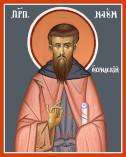 His chief festival is on December 23rd,
where his life is recorded, but June 20th is his summer feast. A great crowd gathers at the
monastery of St. Naum for this summer festival. Many of the sick come or are carried there
to receive healing through faith and prayer over the relics of this holy man. Not merely
Orthodox, but people of other faiths come seeking help from St. Naum. In 1926, a Moslem
from Resna (Resen) went there and donated a bell to the monastery in gratitude to the saint
for healing his brother and raising him from his deathbed. The donor was Jemail Zizo, and
his brother who was healed was called Suleiman Zizo. Both were eminent citizens of Resna. |
4. St. Kallistos I, Patriarch of Constantinople.
He lived the ascetic life for twenty-eight years as a disciple of Gregory the Sinaite on Mount Athos, in the skete of Magoula attached to the monastery of Philotheou. He later founded the community of St. Mamas there. He was elected Patriarch of Constantinople in 1350. After four years, he left the patriarchal throne to return to Athos, but in the reign of John Palaiologos, he was again called to the throne, where he remained until his death. He died in 1363 on the way to Serres to meet the Serbian Queen Helena, who was seeking help against the Turks. He wrote the Lives of St. Gregory the Sinaite and St. Theodosius of Trnovo, as well as numerous homilies. It is interesting to note how St. Maximus of Kapsokalyvia foretold the death of Patriarch Kallistos. On his way to Serbia, Kallistos called in at the Holy Mountain. St. Maximus saw him and said: ‘This elder will not see his flock again, because I hear behind him the hymn over the grave: “Happy are the blameless in the way...”.’
5. St. Leucius, Bishop of Brindisi.
Born in Alexandria, he entered a monastery young. He was worthy of great revelations and powerful grace, sufficient to raise the dead and drive demons from men. He was at first Bishop of Alexandria, and went to Italy in response to a command from heaven. He baptized the entire pagan city of Brindisi and built a church there to the Mother of God. After intensive and successful work for the Faith, he entered into eternity in the fifth century, in the reign of the Emperor Theodosios II.
6. Blessed Studios.
A famous nobleman and consul in Constantinople, he founded in 463 the Church of St. John the Forerunner near the Golden Gates, and a monastery, named the Studion after him. This monastery became famed for its many great men, spiritual teachers, ascetics and martyrs for the Faith, among whom St. Theodore the Studite is the best-known. The Latin Crusaders destroyed this monastery in 1204, but it was restored in 1293 by the Paleologue Emperor Andronikos II. The church, for some centuries a mosque, is now in ruins.
7. Feast of the Odegetria (Directress) Icon of the Mother of God.
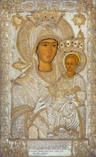 Luke the Evangelist painted this icon on
wood himself. When the most holy Mother of God saw it, she was pleased with it and blessed it.
St. Luke presented the icon to Theophilus, a state official for whom he wrote the Acts of the
Apostles. The icon was later taken from Antioch to Jerusalem, and sent from there by the Empress
Evdokia to Constantinople as a gift for Pulcheria, the emperor’s devout sister. Pulcheria
placed it in the Church of Vlachernai, which was her own foundation. The most holy Mother of God
once appeared to two blind men and led them into the church to her icon and restored the sight of
them both. For this reason, the icon has become known as ‘Odegetria’—
‘She who shows the way’. When the armies of the Persian king, Chozroes, and of Kagan,
leader of the Scythians, attacked Constantinople, Patriarch Sergios carried the icon around the
city ramparts, and the most holy Mother of God saved the Christians from the unbelievers. The
forces of the enemy became confused, the sea began to heave about, and the boats began to sink.
The enemy soldiers who remained alive saved themselves by fleeing. Ever since then, a
commemoration of this miracle wrought by the most holy Mother of God has been held on the
Saturday of the Fifth Week of the Great Fast, with the reading of the Akathist. During the
iconoclast period, this icon was taken to the monastery of the Pantocrator and sealed up in a
wall with a burning lamp hanging before it. It was found later, unharmed by its immuring.
FOR CONSIDERATION
St. Cyprian writes on immortality: ‘Whenever any famous person promises you something, you trust in his promise and do not think that he will deceive you, since he is always true to his word. But lo, O distrustful man, God Himself speaks to you and you vacillate in doubt! God has promised you immortality when you leave this world, and do you impudently doubt this promise? This means that you do not recognize God at all, it means that you insult Christ our Lord and Teacher with your lack of faith.’ What a strong faith is held by God’s saints! How clear and rational and well-attested it is by simple yet powerful examples! It is not because the unholy are rational that they doubt, but because they are unholy. The holier a man, the more rational, since he sees the truth in the undistorted mirror of his heart.
Daily Scripture Readings taken from The Orthodox New Testament, translated and published by Holy Apostles Convent, Buena Vista, Colorado, copyright © 2000, used with permission, all rights reserved.
Daily Prologue Readings taken from The Prologue of Ochrid, by Bishop Nikolai Velimirovic, translated by Mother Maria, published by Lazarica Press, Birmingham, England, copyright © 1985, all rights reserved. Edited by Dormition Skete.