

Daily Devotional
Sunday, June 19, 2016 (NS), June 6, 2016 (OS)
No Fasting.
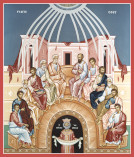
| Eighth Sunday, or the Sunday of Holy Pentecost |
The commemoration of our venerable Father Bessarion the Wonder-worker of Egypt, and our venerable Father Hilarion the New, Abbot of the Dalmaton Monastery, and the holy five Virgin-martyrs, Martha, Mary, Kyria, Vareria (Valeria), and Markia of Palestine (commemorated on Sl. calendar on the 7th of June).
Scripture Readings
Paschalion — Movable Calendar
Eighth Sunday, or the Sunday of Holy Pentecost
Epistle
The Reading is from the Acts of the Apostles [§ 3].
2 1While the day of Pentecost was being fulfilled, they were all with one accord in the same place. 2And suddenly there came to be a sound out of the heaven, like as of a violent wind borne along, and it filled the whole house where they were sitting. 3And there appeared to them tongues, as if of fire, being distributed; and it sat upon each one of them. 4And they were all filled with the Holy Spirit, and began to speak in other tongues, even as the Spirit was giving them to utter. 5And there were Jews abiding in Jerusalem, pious men, from every nation of those under the heaven. 6And the report of this having arisen, the multitude came together and was confounded, because they were hearing, each one of them, speaking in his own dialect. 7And they were all amazed and wondering, saying to one another, “Behold, all these who are speaking are Galilæans, are they not? 8“And how do we each hear in our own dialect in which we were born? 9“Parthians and Medes and Elamites and those who dwell in Mesopotamia, also Judæa and Cappadocia, Pontos and Asia, 10“also Phrygia and Pamphylia, Egypt and the parts of Libya which are in the region of Cyrene, and the Romans, both Jews and proselytes, who sojourn here, 11“Cretans and Arabians—we hear them speaking in our own tongues the magnificent works of God.”
Gospel
In the Orthros
The Reading is from the Holy Gospel according to Saint John [§ 65].
20 19When it was evening on that day, the first of the week—and the doors were closed where the disciples were gathered together for fear of the Jews—Jesus came and stood in the midst, and saith to them, “Peace be to you.” 20And after He said this, He showed them His hands and His side. Then were the disciples glad, after they saw the Lord. 21Then Jesus said to them again, “Peace be to you; even as the Father hath sent Me forth, I also send you.” 22And after He said this, He breathed on them, and saith to them, “Receive ye the Holy Spirit: 23“if ye forgive the sins of any, they are forgiven to them; if ye retain the sins of any, they are retained.”
In the Liturgy
The Reading is from the Holy Gospel according to Saint John [§ 27].
7 37In the last day, that great day of the feast, Jesus was standing and cried out, saying, “If anyone thirst, let him come to Me and drink. 38“The one who believeth in Me, even as the Scripture said—rivers of living water shall flow out of his belly.” 39But this He said concerning the Spirit, Whom those who believe in Him were about to receive; for the Holy Spirit was not yet given, because Jesus was not yet glorified. 40Many therefore of the crowd, having heard the utterance, were saying, “This is truly the Prophet.” 41Others were saying, “This is the Christ.” But others were saying, “The Christ is not coming out of Galilee, is He? 42“Hath not the Scripture said that of the seed of David and from the village of Bethlehem, where David was, the Christ is coming?” 43Therefore a division occurred in the crowd on account of Him. 44And some of them were wishing to lay hold of Him, but no one laid hands on Him. 45Then came the officers to the chief priests and Pharisees, and they said to them, “Why did ye not bring Him?” 46The officers answered, “Never did a man so speak as this Man.” 47Then the Pharisees answered them, “Ye have not also been deceived, have ye? 48“Not one of the rulers believe in Him or of the Pharisees, doth he? 49“But this people who knoweth not the law are accursed!” 50Nicodemos (the one who came by night to Him, being one of them) saith to them, 51“Our law doth not judge the man, unless it should first hear him, and know from the man himself what he doeth, doth it?” 52They answered and said to him, “Thou art not also of Galilee, art thou? Search and look, for a prophet hath not been raised out of Galilee.”...
8 12Then Jesus spoke again to them, saying, “I am the light of the world; the one who followeth Me in no wise shall walk in the darkness, but shall have the light of the life.”
Menaion — Fixed Calendar
The commemoration of our venerable Father Bessarion the Wonder-worker of Egypt, and our venerable Father Hilarion the New, Abbot of the Dalmaton Monastery, and the holy five Virgin-martyrs, Martha, Mary, Kyria, Vareria (Valeria), and Markia of Palestine (commemorated on Sl. calendar on the 7th of June).
No readings given.
Lives of the Saints (Prologue)
June 19th – Civil Calendar
June 6th – Church Calendar
1. Our Holy Father Bessarion.
Born and educated in Egypt, he devoted himself to the spiritual life at an early age, and ‘never soiled the spiritual garment in which he was clothed at his Baptism’. He visited St. Gerasimos by the Jordan and learned from St. Isidore of Pelusium. He conquered his flesh in strict fasting and vigils, but as far as possible, hid his asceticism from men. He once spent forty days in prayer, neither eating nor sleeping, and had one single garment that he wore summer and winter. He had a great gift of wonder-working. He had no fixed abode, but lived in the mountains and forests, healing the sick and performing many other miracles to help men and glorify God. He entered peacefully into rest in 466. (In the Greek Prologue, this saint is commemorated on February 20th.)
2. Our Holy Father Hilarion the New.
Abbot of the Dalmatian monastery in Constantinople, he was a disciple of Gregory of Decapolis and an imitator of the life of Hilarion the Great, whose name he took. Strong in prayer, enduring and courageous in suffering, he suffered much for the sake of the holy icons in the days of the iconoclast emperors, Leo the Armenian and others. Then the Emperor Leo was killed by his personal bodyguard in the very church and at the very spot where he had first scoffed at the holy icons and from which he had removed the first icon, and holy Hilarion was let out of prison—but only for a while. He was again tortured and held in prison right up to the time of the Orthodox Empress Theodora. He was gifted with insight and discernment, and saw angels of God taking the soul of St. Theodore the Studite to heaven. Being pleasing to God, he entered into rest in the kingdom of heaven in 845, at the age of seventy.
3. Our Holy Mothers, the Martyrs Archelais, Thecla and Susanna.
As pure and virginal nuns, they lived the ascetic life in an unknown monastery near Rome. When a persecution of Christians arose under the wicked Emperor Diocletian, they fled to Campania and settled near the town of Nola. Their holy life could not be concealed, and people from nearby began to come to them for counsel, instruction and help in various trials and sicknesses, and they were finally seized by the pagans and taken for trial. They publicly and freely confessed their faith in Christ. When the judge, Leontius, questioned holy Archelais about the Christian Faith, she replied: ‘It is by the power of Christ that I overcome the power of the devil and teach the people understanding and knowledge of the one, true God. By the name of my Lord Jesus Christ, the only-begotten Son of God, it is given that, through me His servant, the sick find healing.’ All three maidens were whipped, flogged with heavy staves, left to languish in prison and finally beheaded. When they were led out to the scaffold, angels appeared to them, which were seen by some of the executioners and inspired such fear in them that they dared not lift up their swords against the holy maidens. They, however, urged the executioners to finish their task. And thus, as lambs, were they beheaded in the year 293, and went to the kingdom of Christ to rest in eternity and delight in beholding the face of God.
FOR CONSIDERATION
Rejoicing in iniquity is a filthy garment in which our souls at times take pleasure in clothing themselves. At the hour in which you rejoice at your brother’s falling into sin, you also have fallen, to the joy of the devil, who has caught two fish with one hook. Brotherhood in the flesh is a great bond, but brotherhood in the spirit is greater. If you mourn at the sins of your brother in the flesh, how can you not mourn at the sins of your brother in the spirit? If you conceal the sin of your brother in the flesh, why do you proclaim to the housetops the sin of your brother in the spirit? Who are your brethren in the spirit? All Christians; all who communicate together with you from the one Cup, receiving the one life. Oh, how great was the brotherly love of the saints! How far removed from them was rejoicing in iniquity! The following is told of St. Bessarion: Once all the monks were gathered at prayer in the church. The abbot went up to one of the brethren, who had committed some sin, and told him to leave the church. The monk went outside, and Bessarion followed him, saying: ‘I also am so great a sinner.’
Daily Scripture Readings taken from The Orthodox New Testament, translated and published by Holy Apostles Convent, Buena Vista, Colorado, copyright © 2000, used with permission, all rights reserved.
Daily Prologue Readings taken from The Prologue of Ochrid, by Bishop Nikolai Velimirovic, translated by Mother Maria, published by Lazarica Press, Birmingham, England, copyright © 1985, all rights reserved. Edited by Dormition Skete.