

Daily Devotional
Friday, June 17, 2016 (NS), June 4, 2016 (OS)
Fast Day, but Wine and Olive Oil Allowed.
Friday of the Seventh Week - Apodosis of Ascension
The commemoration of our holy father among the saints, Metrophanes, Archbishop of Constantinople.
Scripture Readings
Paschalion — Movable Calendar
Friday of the Seventh Week - Apodosis of Ascension
Epistle
The Reading is from the Acts of the Apostles [§ 50A]. In those days:
27 1When it was decided that we should sail off to Italy, they were delivering up both Paul and certain other prisoners to a centurion, by name Julius, of Augustus’ cohort. 2And having boarded an Adramyttium ship about to sail toward Asian places, we put out to sea. Aristarchos, a Macedonian of Thessalonica, was with us. 3And the next day we landed in Sidon. And Julius treated Paul humanely, and permitted him to go to his friends to obtain care. 4And after we put out to sea from that place, we sailed under the lee of Cyprus, because the winds were contrary. 5And after we sailed across the high sea over against Cilicia and Pamphylia, we came down to Myra of Lycia. 6And there the centurion found an Alexandrian ship sailing to Italy, and put us on board therein. 7And when we sailed slowly for many days, and scarcely came over against Cnidus, the wind not suffering us to go further, we sailed under the lee of Crete over against Salmone. 8And hardly coasting along it, we came to a certain place called Fair Havens, which was near a city of Lasæa. 9And after considerable time intervened, and the voyage was already precarious, because the fast had gone by, Paul began advising them, 10saying, “Men, I perceive that the voyage is about to be with injury and much loss, not only of the cargo and of the ship, but also of our lives.” 11But the centurion was being persuaded by the steersman and the shipowner, rather than by the things which were spoken of by Paul. 12And because the harbor was inconvenient for wintering in, the majority gave counsel to set sail from that place also, if by any means they might be able to winter there after they arrived at Phœnice, a port of Crete, which looks toward the southwest and toward the northwest. 13And after a south wind blew gently, thinking that they had attained their purpose, they weighed anchor and were coasting along close by Crete. 14But not long after, a typhonic wind, called Euroclydon, fell against her. 15And after the ship was caught, and was not able to look the wind in the eye, we gave way, and were being borne along. 16And running under a certain small island which is called Clauda, we were hardly able to become masters of the skiff, 17which they hoisted up after they had used helps and undergirded the ship; and fearing lest they should be cast upon the Syrtis, they lowered the gear and were thus being borne along. 18And because we were exceedingly tempest-tossed, on the next day they began making a jettison of the cargo. 19And on the third day we cast out with our own hands the tackling of the ship. 20And when neither sun nor stars appeared for many days, and no small tempest was being laid upon us, finally all hope of our being saved began to be taken away. 21And since there was much abstinence from food, Paul then stood in their midst and said, “It was needful, indeed, O men, to have hearkened to me, and not to have set sail from Crete and reaped this injury and loss. 22“And now I advise you to be of good cheer; for not even one life among you shall be lost, except in respect of the ship. 23“For there stood by me this night an angel of God, Whose I am and Whom I worship, 24“saying, ‘Cease being afraid, Paul; it is needful for thee to stand before Caesar; and behold, God hath granted to thee all those sailing with thee.’ 25“Wherefore, be of good cheer, men, for I believe God that it shall be thus according to the way it hath been spoken to me. 26“But it is needful for us to be cast ashore upon a certain island.” 27Now when it came to be the fourteenth night, as we were tossed about in the Adria, toward the middle of the night the sailors began to surmise some land to be drawing near them. 28And they took soundings, and found it to be twenty fathoms. And after they went a little further, they took soundings again, and found it to be fifteen fathoms. 29And fearing lest they should suffer shipwreck in rough places, they cast four anchors out of the stern, and kept on praying for day to come. 30Now as the sailors who sought to flee out of the ship lowered the skiff into the sea with the pretext that they were about to cast out anchors from the prow, 31Paul said to the centurion and to the soldiers, “Unless these men stay in the ship, ye cannot be saved.” 32Then the soldiers cut off the ropes of the skiff, and let her fall off. 33And until day was about to come, Paul kept on beseeching all to partake of food, saying, “Today is the fourteenth day that ye wait with expectation and continue without food, having taken nothing. 34“Wherefore I beseech you to take food, for this is for your preservation; for not one hair from your head shall fall.” 35And after he said these things, he took bread and gave thanks to God before all; and having broken it he began to eat. 36And after they all became of good cheer, they also took food for themselves. 37And in all we were two hundred and seventy-six souls in the ship. 38And after they were satiated with food, they lightened the ship and cast out the wheat into the sea. 39And when it became day, they tried to recognize the land, but could not; but they began to perceive a certain bay having a beach, into which they purposed, if they could, to drive the ship on shore. 40And having slipped the anchors, they were leaving them in the sea, at the same time having loosed the yokes of the rudders; and having hoisted the foresail to the blowing wind, they began making toward the seashore. 41And having fallen into a place where two seas met, they ran the ship aground. And on the one hand the prow became fixed and remained unmovable, but on the other hand the stern was being broken by the violence of the waves. 42And the counsel of the soldiers was that they should kill the prisoners, lest any should swim out and escape. 43But the centurion was willing to save Paul, and hindered them of their purpose, and commanded those who were able to swim to cast themselves off first, and to go out on the land, 44and the rest, some on the one hand on planks, and some on the other hand on some of the things from the ship. And so it came to pass that all came through safely to the land.
28 1And having come through safely, then they found out that the island was called Melita.
Gospel
The Reading is from the Holy Gospel according to Saint John [§ 57]. At that time Jesus lifted up His eyes to the heaven and said:
17 18“Even as Thou didst send Me forth into the world, I also sent them forth into the world. 19“And on behalf of them I sanctify Myself, that they also may be sanctified in truth. 20“And I do not make request for these only, but also for those who shall believe on Me through their word; 21“in order that all may be one, even as Thou, Father, art in Me, and I in Thee, that they also may be one in Us, that the world might believe that Thou didst send Me forth. 22“And the glory which Thou hast given Me I have given them, in order that they may be one, even as We are one: 23“I in them, and Thou in Me, that they may be perfected into one, and that the world may know that Thou didst send Me forth, and didst love them even as Thou didst love Me. 24“Father, I will that they also, whom Thou hast given Me, be with Me where I am, in order that they may behold the glory, that which is Mine, which Thou gavest Me; for Thou didst love Me before the foundation of the world. 25“O righteous Father, indeed the world did not know Thee, but I knew Thee, and these knew that Thou didst send Me forth. 26“And I made known to them Thy name, and will make it known, in order that the love with which Thou didst love Me may be in them, and I in them.”
Menaion — Fixed Calendar
The commemoration of our holy father among the saints, Metrophanes, Archbishop of Constantinople.
Epistle
The Reading is from the Epistle of Saint Paul to the Hebrews [§ 318]. Brethren:
7 26Such a High Priest was fitting for us: holy, guileless, undefiled, Who hath been separated from the sinners and hath become higher than the heavens, 27Who hath no need daily, even as the high priests, to offer up sacrifices, first for his own sins, then for those of the people; for this He did once for all after He offered up Himself. 28For the law appointeth men high priests who have weakness; but the word of the oath, which is after the law, appointeth the Son, Who hath been perfected forever.
8 1Now in reference to the things being spoken of, the chief point is: We have such a High Priest, Who sat down on the right of the throne of the majesty in the heavens, 2a Liturgist of the holies and of the tabernacle, the true one, which the Lord pitched, and not man.
Gospel
The Reading is from the Holy Gospel according to Saint John [§ mid 35]. The Lord said to those Jews who had come to Him:
10 1“Verily, verily, I say to you, the one who entereth not by the door into the fold of the sheep, but goeth up from another place, that one is a thief and a robber. 2“But the one who entereth by the door is a shepherd of the sheep. 3“To this one the doorkeeper openeth, and the sheep hear his voice; and he calleth his own sheep by name and leadeth them out. 4“And whenever he should put forth his own sheep, he goeth before them; and the sheep follow him, because they know his voice. 5“But a stranger in no wise will they follow, but will flee from him, because they know not the voice of strangers.” 6This parable Jesus spoke to them; but they understood not what it was which He spoke to them. 7Then said Jesus to them again, “Verily, verily, I say to you that I am the door of the sheep. 8“All, as many as came before Me, are thieves and robbers; but the sheep heard them not. 9“I am the door; by Me if anyone should enter, he shall be saved, and shall go in and go out and find pasture.”
Lives of the Saints (Prologue)
June 17th – Civil Calendar
June 4th – Church Calendar
1. St. Metrophanes of Constantinople.
His father Dometius, brother of the Roman Emperor Probus, fled from Rome as a Christian during a persecution and went to Byzantium. The Bishop of Byzantium, Titus, ordained Dometius priest, and after Titus’ death, Dometius became Bishop of Byzantium. After Dometius’ death, his elder son Probus occupied the episcopal throne (Dometius had children from his earlier, pagan days), and Metrophanes succeeded him on his death. When the Emperor Constantine first set eyes on Metrophanes, he loved him as a father. At the time of the First Ecumenical Council, Metrophanes was a very old man, and being unable to take a full part in the council’s deliberations, appointed his assistant bishop, Alexander, as his representative. The emperor had Metrophanes raised to the rank of patriarch by the council, and he thus became the first Patriarch of Constantinople. The emperor further invited the whole council to visit the sick and aged hierarch. When the emperor asked him who he wished to succeed him on the patriarchal throne, Metrophanes named Alexander of Alexandria, after which he said to him: ‘My brother, you are my chosen successor!’ He also took Archdeacon Athanasius (later Athanasius the Great, Patriarch of Alexandria) by the hand and praised him before them all. After this prophetic act, he took leave of them all, and ten days later, gave his soul to God, in 325.
2. The Holy Martyr Concordius.
He was a great ascetic and a wonder-worker during his earthly life. Arrested as a Christian under the Emperor Antoninus, he was tortured and imprisoned, and led before the stone idol of Zeus to pay it reverence. He spat on the idol, for which he was at once beheaded.
3. The Holy Martyrs Frontasius, Severinus, Severian and Silanus.
They were martyred in France in the time of the Emperor Claudius. When they had been beheaded, they rose to their feet, took their heads in their hands, crossed the river Ile and came to the church of the most holy Mother of God, where Bishop Frontanus was at prayer. Entering the church, they laid their heads at the bishop’s feet and then lay down and crossed themselves. They were buried there, and at their burial, the singing of an unseen host of angels was heard.
4. Our Holy Father Zosimas, Bishop of New Babylon in Egypt.
He lived in asceticism on Mount Sinai. Going to Alexandria in the course of his work, he was consecrated by the venerable Patriarch Apollinarios as Bishop of New Babylon. He was a good pastor of Christ’s flock, but when old age and weariness came upon him, he withdrew again to Sinai, where he gave his soul into God’s hands and received a wreath of glory among the great hierarchs. He lived and died in the 6th century.
5. The Hieromartyr Astius (Asteios), Bishop of Dyrrachium.
He suffered under Trajan. First beaten with leaden rods, he was then stripped bare and crucified on a tree. His naked body, smeared with honey, was left for the wasps and hornets to eat. St. Astius breathed his last in great torment, praising God, and received a twofold wreath: as a martyr and a hierarch. He suffered at the beginning of the second century.
6. Ss. Mary and Martha, the Sisters of Lazarus.
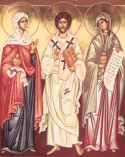 After the Lord’s Ascension,
Lazarus went about preaching the Gospel, and his sisters helped him in this work. It is not
known where they died. |
FOR CONSIDERATION
It is a terrible thing to murder a man. There are no words that would suffice to express the terror that seizes upon the murderer. While a man is plotting to kill another, he reckons that it is the same thing to kill a man as it is to kill an ox, but when he has carried out his planned wickedness, he suddenly finds that he has declared war on both heaven and earth and that he is exiled, cut off from both. The slain one gives him no peace either day or night.
A notorious brigand came to St. Zosimas on Sinai, and asked him to make him a monk. St. Zosimas clothed him in the monastic schema and sent him to the monastery of St. Dorotheos in Gaza, to live the ascetic life in the community there. Nine years later, this brigand-become-monk returned to him and sought his secular clothing, handing him back his monastic schema. When asked why he was doing this, he replied that he had, for nine years, prayed to God with all his heart, fasted, kept vigil and fulfilled every obedience; that he felt many of his sins had been forgiven, but that one sin constantly tormented him. He had once murdered an innocent child, and this child appeared to him day and night, asking: ‘Why did you murder me?’ He had therefore decided to go and give himself up to the authorities, that they might execute him and he might thus pay blood for blood. Dressing himself in his former garments, he went to the town of Diospolis, where he declared his evil-doing and was beheaded, and thus, by his blood, washed away his bloody sin.
Daily Scripture Readings taken from The Orthodox New Testament, translated and published by Holy Apostles Convent, Buena Vista, Colorado, copyright © 2000, used with permission, all rights reserved.
Daily Prologue Readings taken from The Prologue of Ochrid, by Bishop Nikolai Velimirovic, translated by Mother Maria, published by Lazarica Press, Birmingham, England, copyright © 1985, all rights reserved. Edited by Dormition Skete.