

Daily Devotional
Thursday, June 9, 2016 (NS), May 27, 2016 (OS)
No Fasting.
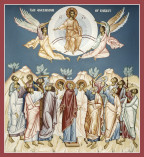
| The Thursday of the Ascension |
The commemoration of the holy and glorious Hieromartyr Elladios, and Hieromartyr Therapon, Bishop of Sardis, and the righteous Confessor John the Russian.
Scripture Readings
Paschalion — Movable Calendar
The Thursday of the Ascension
Epistle
The Reading is from the Acts of the Apostles [§ 1].
1 1The first account indeed I made for myself concerning all which, O Theophilos, Jesus began both to do and teach, 2until the day in which He was taken up, after He gave command to the apostles whom He chose for Himself through the Holy Spirit, 3to whom also He presented Himself alive after He had suffered by many proofs, being seen by them during forty days and speaking the things concerning the kingdom of God. 4And being assembled together with them, He ordered them not to depart from Jerusalem, but to wait for the promise of the Father, “which,” He said, “ye heard of Me; 5“for John indeed baptized with water, but ye shall be baptized in the Holy Spirit not many days after these.” 6Indeed therefore, after they came together, they kept on questioning, saying, “Lord, dost Thou at this time restore the kingdom to Israel?” 7And He said to them, “It is not yours to know times or seasons which the Father Himself put in His own authority. 8“But ye shall receive power, after the Holy Spirit is come upon you; and ye shall be witnesses to Me both in Jerusalem, and in all Judæa and Samaria, and unto the ends of the earth.” 9And having said these things, while they looked, He was taken up; and from before their eyes, a cloud took Him up from under. 10And while they were gazing intently into the heaven as He went, then behold, two men stood by them in white raiment, 11who also said, “Men, Galilæans, why do ye stand looking into the heaven? This Jesus, the One Who was taken up from you into the heaven, so shall He come in the manner ye beheld Him going into the heaven.” 12Then they returned to Jerusalem from the mount which is called the Mount of Olives, which is near Jerusalem, being a sabbath’s day journey.
Gospel
In the Orthros
The Reading is from the Holy Gospel According to Saint Mark. [§ 71]. At that time:
16 9After Jesus rose early the first day of the week, He appeared first to Mary Magdalene, from whom He had cast out seven demons. 10She went and brought tidings to those who had been with Him, who were mourning and weeping. 11And they, having heard that He liveth and was seen by her, disbelieved. 12And after these things He was made manifest in a different form to two of them as they were walking and went into the country. 13And they went and brought tidings to the rest; neither did they believe them. 14Afterwards He was made manifest to the eleven themselves as they reclined at table; and He reproached their unbelief and hardness of heart, because they believed not those who saw Him after He was raised. 15And He said to them, “Go into all the world and proclaim the Gospel to the whole creation. 16“The one who believeth and is baptized shall be saved; but the one who believeth not shall be condemned. 17“And these signs shall accompany those who believe: In My name they shall cast out demons; they shall speak in new tongues; 18“they shall take up serpents; and if they should drink anything deadly, in no wise shall it harm them; they shall lay hands on the sick, and they shall be well.”
19Then indeed, after speaking to them, the Lord was taken up into the heaven, and sat on the right of God. 20And they went forth and preached everywhere, the Lord working with them, and confirming the word by the accompanying signs. Amen.
In the Liturgy
The Reading is from the Holy Gospel according to Saint Luke [§ 114]. At that time:
24 36After Jesus rose from the dead, He stood in the midst of His disciples, and saith to them, “Peace be to you.” 37But they were terrified and affrighted, and kept on thinking that they saw a spirit. 38And He said to them, “Why are ye troubled? And why do reasonings come up in your hearts? 39“Behold My hands and My feet, that I am He. Touch Me and see, for a spirit hath not flesh and bones, even as ye see Me having.” 40And having said this, He showed them His hands and His feet. 41And while they yet disbelieved from the joy, and wondered, He said to them, “Have ye anything to eat here?” 42And they gave Him a portion of a broiled fish and of a honeycomb. 43And He took these and ate in their presence. 44And He said to them, “These are the words which I spoke to you while I was yet with you, that it is needful for all the things to be fulfilled, which were written in the law of Moses, and in the prophets, and in the psalms concerning Me.” 45Then He thoroughly opened their mind to understand the Scriptures, 46and said to them, “Thus it hath been written, and thus it was needful for the Christ to have suffered, and to have risen from the dead the third day, 47“and repentance and forgiveness of sins to have been preached in His name to all the nations, beginning from Jerusalem. 48“And ye are witnesses of these things. 49“And behold, I send forth the promise of My Father upon you; but sojourn in the city of Jerusalem, until ye are clothed with power from on high.”
50And He led them out as far as to Bethany. And having lifted up His hands, He blessed them. 51And it came to pass, as He was blessing them, He stood apart from them and was carried up into the heaven. 52And they made obeisance to Him, and returned to Jerusalem with great joy. 53And they were continually in the temple, praising and blessing God. Amen.
Menaion — Fixed Calendar
The commemoration of the holy and glorious Hieromartyr Elladios, and Hieromartyr Therapon, Bishop of Sardis, and the righteous Confessor John the Russian.
Epistle
For St. John:
The Reading is from the Second Epistle of Saint Paul to Saint Timothy [§ 292]. Child Timothy:
2 1Be thou empowered in the grace that is in Christ Jesus; 2and the things which thou heardest from me in the midst of many witnesses, commit thou these things to faithful men who shall be competent also to teach others. 3Thou therefore suffer hardship as a good soldier of Jesus Christ. 4No one serving as a soldier is entangled with the affairs of life, in order that he might please the one who enlisted him. 5And if anyone also contend as an athlete in the games, he is not crowned unless he contend lawfully. 6The farmer who laboreth must be first to partake of the fruits. 7Be considering what I say; O may the Lord give thee understanding in all things! 8Be remembering Jesus Christ, of the seed of David, Who hath been raised from the dead, according to my Gospel, 9in which I suffer hardship even to bonds as a malefactor, but the word of God hath not been bound. 10On this account I endure all things for the sake of the elect, that they might also attain salvation that is in Christ Jesus with eternal glory.
for Sl. usage, see [Gal. 5:22-6:2].
Gospel
The Reading is from the Holy Gospel according to Saint Luke [§ 24]. At that time:
6 17Jesus stood upon a level place. And there was a crowd of
His disciples, and a great multitude of the people from all of Judæa and Jerusalem and the
seacoast of Tyre and Sidon, who came to hear Him, and to be healed of their diseases—
18even those who were troubled by unclean spirits; and they were cured.
19And all the crowd was seeking to touch Him, for power was coming forth from Him and
healing all. 20And He lifted up His eyes to His disciples, and began to say:
“Blessed are the poor, for yours is the kingdom of God.
21“Blessed are ye who hunger now, for ye shall be
filled.
Blessed are ye who weep now, for ye shall laugh.
22“Blessed are ye whenever men hate you, and whenever they
separate you, and reproach you, and cast out your name as evil, on account of the Son of
Man.
23“Rejoice in that day and leap for joy, for behold, your
reward is great in the heavens.”
Lives of the Saints (Prologue)
June 9th – Civil Calendar
May 27th – Church Calendar
1. The Hieromartyr Therapon, Bishop of Sardis.
He brought many Greeks to the Christian Faith and was cruelly persecuted by the pagans, being starved, imprisoned and flogged. They stripped him and threw him to the ground, bound him to four posts and beat him mercilessly, until they had stripped the flesh from his bones. However, the martyr still remained alive and the four dry posts became green and grew into tall trees from which many of the sick received healing. Finally St. Therapon was slain like a lamb and entered into the kingdom, to behold the glory of God in eternity. He suffered with honor in the time of Valerian, in about 259.
2. The Holy Martyrs Theodora and Didymus.
In the reign of the wicked Emperor Maximilian, there lived in Alexandria a maiden, Theodora, well-educated and of noble lineage. She was brought to trial before the pagans for her Christian Faith. After long interrogation and torture for the Faith, the prince, her tormentor, ordered that she be thrown into a brothel and the soldiers given free access to her to indulge their carnal lusts. Theodora prayed fervently to God to save her from defilement, and when she had prayed, a soldier called Didymus came in to her and told her that he was a servant of Christ. He dressed her in his soldier’s garb and himself in her dress, then let her out and remained in the brothel himself. He was seized and brought before the judge, where he acknowledged that he was a Christian and had saved Theodora, and was now prepared to die for Christ. He was condemned to death and taken out to the place of execution. Theodora ran up to him there and cried out: ‘Although you saved my honor, I did not ask you to save me from death. Yield the martyr’s death to me!’ Didymus replied: ‘My beloved sister, do not hinder my death for Christ, nor the washing of my sins in my blood.’ Hearing this exchange, the pagans condemned them both to death, and they were beheaded and their bodies burned. They suffered with honor and received eternal wreaths of glory in Alexandria in the year 304.
3. St. David (Davit) of Garesjei.
This David is one of the thirteen Georgian fathers (see May 7th). He is thus named for the Garesjei desert near Tiflis, where he lived the ascetic life. In old age, David decided to visit the Holy Land with several of his disciples. He left the direction of the monastery to two elders, Lucian and Dodo, and set out on the way. When they came to a hill from which Jerusalem was visible, David burst into tears and said: ‘How can I dare to walk in the steps of God incarnate with these sinful feet?’ and he told his disciples to go and worship at the holy places, but he himself took up three stones and set off to return. But the Lord did not let such humility remain hidden from the world, and an angel appeared to Elias, the Patriarch of Jerusalem, and said to him: ‘Send at once for the elder who is even now returning to Syria; he has taken with him three stones, and is carrying off with him all the Holy Land’s grace. One stone is a sufficient blessing for him; let him return the other two to Jerusalem. He is called Abba David of Garesjei.’ The patriarch quickly sent men off to overtake the elder. They took two stones from him, and let him go on his way. The third stone lies on his grave to this day and possesses miraculous healing power.
FOR CONSIDERATION
Physical health is undoubtedly a gift of God. But physical well-being is not at all the greatest good of this world, as so many would say and write. Because, whatever physical health may be, it is transitory; and whatever is transitory cannot be man’s greatest good. Values that do not pass away are more precious than those that do, and so eternity is more precious than time. Intransitory values are counted as spiritual health. Saint John of Kronstadt writes: ‘Oh, I myself feel that, when I am quite well and do not tire myself with work, my spirit begins to die, the kingdom of God is not within me and my body begins to master me, and when the body is in control, then the devil finds an entrance.’
Daily Scripture Readings taken from The Orthodox New Testament, translated and published by Holy Apostles Convent, Buena Vista, Colorado, copyright © 2000, used with permission, all rights reserved.
Daily Prologue Readings taken from The Prologue of Ochrid, by Bishop Nikolai Velimirovic, translated by Mother Maria, published by Lazarica Press, Birmingham, England, copyright © 1985, all rights reserved. Edited by Dormition Skete.