

Daily Devotional
Sunday, May 29, 2016 (NS), May 16, 2016 (OS)
No Fasting.
| Fifth Sunday of Pascha, or Sunday of the Samaritan Woman Mode Four — Seventh Eothinon |
The commemoration of our venerable Father Theodore the Sanctified, disciple of St. Pachomios the Great.
Scripture Readings
Paschalion — Movable Calendar
Fifth Sunday of Pascha, or Sunday of the Samaritan Woman
Mode Four — Seventh Eothinon
Epistle
The Reading is from the Acts of the Apostles [§ 28]. In those days:
For Gk usage, see Acts 11:19-30; for Sl. usage. see Acts 11:19-26, 29, 30.
11 19The apostles, who were scattered because of the affliction that arose about Stephen, went abroad as far as Phœnicia and Cyprus and Antioch, speaking the word to no one except to Jews only. 20But some of them were men of Cyprus and Cyrene, who, after they came to Antioch, began speaking to the Hellenists, preaching as good tidings the Lord Jesus. 21And the hand of the Lord was with them, and a great number believed and turned to the Lord. 22Then the report concerning them was heard in the ears of the Church which was in Jerusalem. And they sent forth Barnabas to go through as far as Antioch, 23who, after he came and saw the grace of God, was glad and was exhorting all to keep on remaining near to the Lord with purpose of heart. 24For he was a good man, and full of the Holy Spirit and of faith; and a considerable crowd was added to the Lord. 25And Barnabas went forth to Tarsus to search for Saul. 26And having found him, he brought him to Antioch. And it came to pass that they were gathered together with the Church for a whole year, and taught a considerable crowd. And the disciples were called Christians first in Antioch.
27And in these days prophets came down from Jerusalem to Antioch. 28And one of them, by name Agavos, rose up, and signified by the Spirit that there was about to be a great famine over all the inhabited world, which also came to pass in the time of Claudius Cæsar. 29And according as any one of the disciples was prospered, each of them determined to send relief toward ministering to the brethren who dwelt in Judæa, 30which also they did, sending it off to the presbyters by the hand of Barnabas and Saul.
Gospel
The Reading is from the Holy Gospel according to Saint John [§ 12]. At that time:
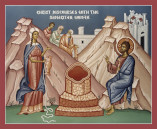
4 5Jesus came to a city of Samaria called Sychar, near the place which Jacob gave to his son Joseph. 6And Jacob’s well was there. Jesus then, having grown weary from the journey, was sitting thus on the well. It was about the sixth hour. 7There cometh a woman of Samaria to draw water. Jesus saith to her, “Give Me to drink.” 8For His disciples had gone away into the city in order that they might buy provisions. 9Then the Samaritan woman saith to Him, “How is it that Thou, being a Jew, askest to drink from me, who am a Samaritan woman? For the Jews have no dealings with Samaritans.” 10Jesus answered and said to her, “If thou knewest the gift of God, and Who is the One Who saith to thee, ‘Give Me to drink,’ thou wouldest have asked Him, and He would have given to thee living water.” 11The woman saith to Him, “Lord, Thou hast no bucket for drawing water, and the well is deep. From what place then hast Thou the water, the living one? 12“Thou art not greater than our father Jacob, who gave us the well, and drank from it himself, and his sons, and his animals, art Thou?” 13Jesus answered and said to her, “Everyone who drinketh of this water shall thirst again; 14“but whosoever drinketh of the water which I shall give him in no wise shall ever thirst. But the water which I shall give him shall become in him a fountain of water springing into eternal life.” 15The woman saith to Him, “Lord, give me this water, that I may not be thirsting, nor keep on coming here to draw.” 16Jesus said to her, “Go, call thy husband, and come here.” 17The woman answered and said, “I have no husband.” Jesus said to her, “Well didst thou say, ‘I have no husband,’ 18“for thou hast had five husbands, and now he whom thou hast is not thy husband; this truly thou hast spoken.” 19The woman saith to Him, “Lord, I perceive that Thou art a prophet. 20“Our fathers do reverence in this mountain, and ye say that in Jerusalem is the place where it is needful to do reverence.” 21Jesus saith to her, “Woman, believe Me, that there is coming an hour when neither in this mountain, nor in Jerusalem, shall ye do reverence to the Father. 22“Ye do reverence what ye know not; we do reverence what we know, for salvation is of the Jews. 23“But there is coming an hour, and now is, when the true worshippers shall do reverence to the Father in spirit and truth; for also the Father seeketh such as those who revere Him. 24“God is Spirit, and it is needful for those who revere Him to do reverence in spirit and truth.” 25The woman said to Him, “I know that Messiah is coming, the One Who is called Christ. Whenever that One should come, He will announce to us all things.” 26Jesus saith to her, “I am, the One Who speaketh to thee.” 27And upon this came His disciples, and they wondered that He was speaking with a woman; nevertheless no one said, “What seekest Thou?” or “Why speakest Thou with her?” 28The woman then left her waterpot, and went away into the city, and saith to the people, 29“Come, see a Man Who told me all things whatsoever I did. This One is not the Christ, is He?” 30Then they went forth out of the city and were going toward Him.
31But in the meantime the disciples were entreating Him, saying, “Rabbi, eat.” 32But He said to them, “I have food to eat which ye know not.” 33Therefore the disciples were saying to one another, “No one brought Him anything to eat, did he?” 34Jesus saith to them, “My food is that I be doing the will of Him Who sent Me, and that I should finish His work. 35“Do ye not say, ‘It is yet a space of four months, and the harvest cometh’? Behold, I say to you, lift up your eyes and see the fields, for they are white already to harvest. 36“And the one who reapeth receiveth a reward, and gathereth fruit to life eternal, that both the one who soweth and the one who reapeth may rejoice together. 37“For in this the saying is true, ‘There is one who soweth and another who reapeth.’ 38“I sent you forth to reap on what ye have not labored; others have labored, and ye have entered into their labor.” 39And many of the Samaritans of that city believed in Him, because of the utterance of the woman testifying, “He told me all things whatsoever I did.” 40Therefore, when the Samaritans came to Him, they were asking Him to stay with them; and He stayed there two days. 41And many more believed because of His word. 42And to the woman they were saying, “We no longer believe because of thy talk; for we ourselves have heard, and we know that this One is truly the Savior of the world, the Christ.”
Menaion — Fixed Calendar
The commemoration of our venerable Father Theodore the Sanctified, disciple of St. Pachomios the Great.
No readings given.
Lives of the Saints (Prologue)
May 29th – Civil Calendar
May 16th – Church Calendar
1. Our Holy Father Theodore the Sanctified.
He was a disciple of St. Pachomios, being born and growing up an unbeliever. Coming to the true Faith as a young man, he was baptized, and having heard of St. Pachomios, fled to him in his monastery, unknown to his parents. St. Pachomios made him a monk and came to love him for his rare zeal and his obedience. When his mother came to fetch him back home, he would not let her see him, but prayed to God to enlighten her with the truth. And indeed, his mother not only did not take her son back home, but herself did not return. Seeing a women’s monastery close by, ruled by Pachomios’ sister, she entered it and was tonsured. After a certain time, Paphnutios, Theodore’s brother, also came to the monastery and was tonsured. It once happened that the Bishop of Panopolis invited Pachomios to build a monastery for the many people who were desirous of the monastic life. Pachomios took Theodore with him, and entrusted to him the duty of building the monastery. Upon Pachomios’ death, Theodore became abbot of all Pachomios’ monasteries and lived until great old age, guiding a multitude of monks on the way of salvation. He entered peacefully into rest and went to the kingdom of eternal light in the year 368.
2. The Blessed Maiden Musa.
St. Gregory the Dialogist relates of her that she was a mere nine years old when the most holy Mother of God appeared to her on two occasions, surrounded by virgins bathed in light. When Musa expressed her desire to be included in the resplendent company of the Queen of heaven, the Mother of God told her that she would come for her and take her within a month, outlining for her how she should spend those thirty days. On the twenty-fifth day, Musa took to her bed and on the thirtieth day the most pure and holy Mother again appeared to her, calling to her in a quiet voice, to which Musa replied: ‘Here I am waiting, my Lady! I’m ready!’ and she breathed forth her spirit. She passed from this life to life eternal in the fifth century.
3. St. Nicholas Mystikos, Patriarch of Constantinople.
‘Mystikos’ signifies the senior member of the imperial council. This saint was such at first, then a high-ranking courtier, but after this he forsook the vanity of the world and was tonsured. He was renowned for the rare austerity of his life. The Emperor Leo VI had married four times, and the patriarch therefore forbade him entry to the church, and the priests who had married him were defrocked. The emperor cast the patriarch out and drove him into a monastery. The delegates of the Roman Pontiff, Sergius III, gave their approval to the emperor’s fourth marriage, but when the emperor died, Nicholas was restored to the patriarchal throne and called a council in 925, at which fourth marriages were in general forbidden to Christians. He died peacefully in 930.
4. The Holy New-Martyr Nicholas.
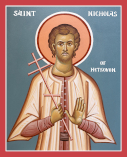 He was born in Metsovon of Epirus,
of pious parents. He left home while quite young and traveled to Trikala, where he found
employment with a Turkish baker. There he denied the Faith and embraced Islam. He then returned
home and repented. A neighbor of his former employer came upon Nicholas one day and discovered
his return to Christianity. He blackmailed Nicholas for several years. Finally, Nicholas decided
that his succumbing to this blackmail was tantamount to further denying Christ, and he became
determined to become a martyr to correct his denial of Christ. He confessed his intentions to his
parish priest, who advised him not to proceed with his plan, lest he be unable to endure their
tortures and fall a second time. Nicholas was determined, however, and his priest blessed and
strengthened him for his ordeal. Nicholas then traveled back to Trikala, where he refused to pay
his blackmailer any further. He was brought before the Turkish judge for having embraced and then
renounced Islam. He was beaten with rods, and finally burned alive in Trikala on May 16, 1617. He
was twenty-six years old. A pious Christian secretly recovered his skull from the ashes, and hid
it in the wall of a house he was building at the time. Later, a man named Melandros bought the
house. Every year, for several years, on the day of Nicholas’ martyrdom, Melandros beheld a
strange light emanating from the wall of the house. He received a divine revelation in his sleep,
disclosing that at the place the light appeared was hidden the holy skull of Nicholas the Martyr.
Melandros dug into the wall where he had beheld the light, and found the martyr’s relics. Feeling
himself unworthy to possess such a treasure, he turned it over to his brother, a monk at a
monastery of Meteora. The martyr’s head is preserved to this day in one of the monasteries
of the Meteora in Thessaly, and performs many miracles, heals the gravest sicknesses and is
particularly renowned for driving locusts from crops.
5. Our Holy Fathers, the Martyrs of St. Sava’s.
In the time of the Emperor Herakleios, in about 610, forty-four monks of the community of St. Sava the Sanctified suffered for the Christian Faith. Their heroism and sufferings were recorded by St. Antiochus (Dec. 24th).
FOR CONSIDERATION
When Theodore the Sanctified was in Panopolis with his spiritual father, St. Pachomios, a philosopher came to him and sought to dispute with him about faith. The philosopher posed these three questions to Theodore: ‘Who was not born, but died? Who was born, but did not die? And who died, but did not decay?’ To those questions, St. Theodore made answer: ‘Adam was not born, but died. Enoch was born, but did not die. Lot’s wife died, but did not decay.’ The saint added this advice to the philosopher: ‘Take note of this sound advice of ours: shun vain questionings and scholastic syllogisms; draw near to Christ, Whom we serve, and you will receive the forgiveness of your sins.’ The philosopher was rendered speechless by such a shrewd answer, and went away ashamed. From this, one sees clearly the difference between a pagan philosopher and a Christian saint. The one loses himself in abstractions, in skilful juggling with words, in contests of logic and mental gymnastics, while the other centers his whole mind on the living God and on the salvation of his soul. The one is abstract and dead; the other is practical and alive.
Daily Scripture Readings taken from The Orthodox New Testament, translated and published by Holy Apostles Convent, Buena Vista, Colorado, copyright © 2000, used with permission, all rights reserved.
Daily Prologue Readings taken from The Prologue of Ochrid, by Bishop Nikolai Velimirovic, translated by Mother Maria, published by Lazarica Press, Birmingham, England, copyright © 1985, all rights reserved. Edited by Dormition Skete.